
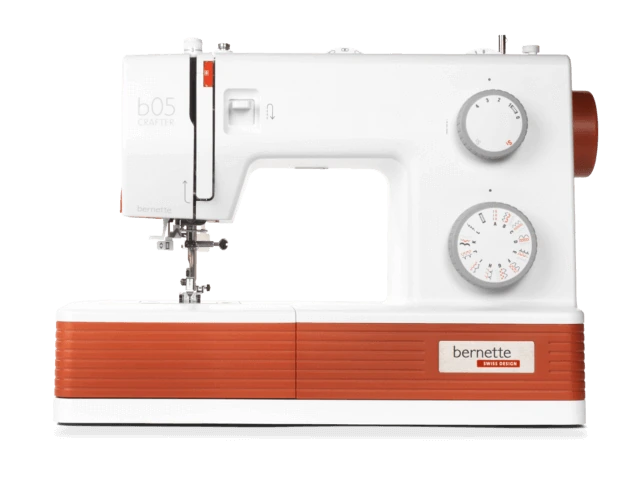
Your needs, this model
Does it fit your priorities?
Can I combine mechanical dials, adjustable foot pressure, a drop-in bobbin and at least 6 mm single-needle stitch width with a published maximum of at least 1,000 stitches per minute?
Yes. The CRAFTER documents that combination in its single-needle foot-control setup; the published maximum does not predict project speed.
Explore this need in the finder →Does the CRAFTER have a separate control that limits maximum sewing speed independently of pedal pressure?
No. Its speed changes with the foot control. The ACADEMY adds the separate switched ceiling.
Explore this need in the finder →Can I sew with a documented start/stop-button setup without operating the foot pedal?
No. The CRAFTER’s documented sewing setup uses its foot control; the power switch does not provide pedal-free seam control.
Explore this need in the finder →The bernette 05 CRAFTER is a mechanical sewing machine with a useful combination of adjustable presser-foot pressure, a drop-in bobbin and 30 stitch patterns. It suits someone who is comfortable controlling sewing from the foot pedal and wants a focused standard accessory package. The important comparison is the 05 ACADEMY: both share headline stitch and speed capabilities, but the CRAFTER does not have its independently switched speed ceiling or supplied large extension table.
Mechanical controls with room to adjust the fabric handling
You choose patterns and settings through physical dials. The machine's published maxima are 6 mm stitch width, 4 mm stitch length and 1,100 stitches per minute. The pattern groups do not all permit the same length adjustment, so treat the 4 mm figure as a capability limit rather than a promise for every decorative stitch.
The presser-foot pressure dial gives you a separate adjustment from upper-thread tension. That is useful when a thin fabric gathers unexpectedly or a layered section needs a different feeding setup. It does not remove the need for a suitable needle, thread and sample. The supplied height-compensation tool also gives you a way to support the foot across changes in seam thickness, rather than pulling the fabric through to force it over a ridge.
Against the simpler bernette 35, the CRAFTER is worth examining for its documented pressure control and top-loading bobbin arrangement. Against the ACADEMY, those features do not decide the choice because both 05 machines have them. The decision turns more on speed control and the accessories you will actually use.
Your foot controls the pace
The CRAFTER uses the pedal to vary sewing speed, up to the published maximum. Pressing farther increases speed and releasing the pedal stops the machine. Its ordinary on/off switch does not provide the ACADEMY's separate lower-speed ceiling. Gentle pedal control and an independent limiter are different features, especially if you want to prevent a deeper press from reaching full speed.
If a separate cap is important, select the ACADEMY rather than planning around an assumed CRAFTER setting. If you need to operate without a pedal, consider a documented start/stop-button model such as the bernette 37. Neither a mechanical pattern dial nor an easy-to-reach power switch establishes pedal-free sewing.
One-step does not mean stop-and-walk-away buttonholes
The CRAFTER includes a sliding buttonhole foot and a one-step sequence, with the button used to set the required length. The operator still starts with the pedal and stops at the completion point described in the manual. It is a different routine from a computerized buttonhole that explicitly stops itself.
That distinction can matter more than the number of decorative patterns if you often sew shirts or closures. Practice with the actual layers and stabilizer, then inspect the sample before opening the garment's buttonhole. The bernette 38 is a relevant comparison when automatic buttonhole completion is essential. Do not choose the CRAFTER on the strength of the word “automatic” without understanding its operator-controlled ending.
Six supplied soles and a table you add separately
The standard six-foot selection covers zigzag, regular and concealed zippers, buttonholes, blind hems and overlock-style finishing. It is a practical garment-sewing set. A button-sewing foot, extra decorative soles and the large extension table are additional choices rather than part of this assessed standard package. Confirm a dealer's actual bundle when it advertises extras.
The small removable sewing table contains the accessory box; it is not the separate large slide-on table. Removing it exposes the free arm for cuffs and similar tubular work. A large table, when added, supports fabric outside the arm but does not enlarge the 165 mm opening to the right of the needle. For a setup built around larger flat pieces, compare the ACADEMY's supplied table before assembling an accessory list.
The current manual gives a 416 × 174 × 299 mm machine envelope and 7.0 kg machine weight. Plan additional working space for cloth, cable and pedal placement. A narrow machine-body figure alone cannot tell you whether a desk will support the project comfortably.
A bobbin machine, with specific multi-needle and care instructions
Overlock-style stitches do not trim the edge like a serger, and free-motion decorative work does not create a motorized embroidery system. The CRAFTER remains an ordinary bobbin sewing machine even when you use a specialized foot. Buy it for those actual sewing capabilities rather than an accessory name that sounds like another machine category.
Its April 2026 guide documents both twin- and triple-needle threading. Those setups require a zigzag foot, straight stitch and centered needle; triple threading also needs an external spool stand. They do not establish a 6 mm multi-needle zigzag. Follow the specified setup before turning the handwheel or applying power.
Ownership also includes cleaning lint around the feed dog and bobbin area. The exact guide calls for needle-bar lubrication at its illustrated points, with a six-month interval when frequently used. Switch off and unplug for that work. Choose the CRAFTER when these hands-on controls and maintenance tasks suit you, and the smaller standard package is sufficient; choose the ACADEMY when its separate limiter and broader supplied tools answer real needs.
Sources: exact US product page, its linked April 2026 CRAFTER manual and the 2026 series comparison. Read October 23, 2026.
Key details at a glance
| Motor and stitch controls | Mechanical stitch-selection dials and ordinary on/off switch. Foot pressure varies sewing speed up to a published 1,100 stitches per minute; there is no independent maximum-speed limiter. |
|---|---|
| Stitch choices and limits | Thirty total patterns including a one-step buttonhole. Single-needle maxima are 6 mm width and 4 mm length; red and gray stitch groups have predefined lengths. Twin and triple needles require a centered straight stitch. |
| Buttonhole routine | The button-sized one-step sequence uses a sliding foot. The operator must stop at its ending point; automatic completion stopping is not established. |
| Working space and size limits | 165 mm to the right of the needle. The exact manual lists the machine as 416 mm wide × 174 mm deep × 299 mm high and 7.0 kg. Add working space for fabric, pedal, cables and any separate table. |
| Supplied tools and fabric support | Six standard presser-foot soles. The large extension table, button-sewing foot and additional specialty soles are optional; a small accessory-box sewing section is not the large table. |
| Needle setups, cutting and memory | Manual thread cutter. Twin and triple needles require the zigzag foot, centered needle and straight stitch; triple threading additionally needs a separate external spool stand. Needle spacing is not sideways stitch width. |
| Presser-foot pressure | A dedicated dial adjusts presser-foot pressure independently of upper-thread tension. Do not reduce the pressure below zero; test the actual needle, thread, fabric and layers. |
| Cleaning and lubrication | Clean lint in the specified feed-dog and bobbin areas. The April 2026 guide includes needle-bar oiling at its illustrated points, every six months when frequently used. Switch off and unplug before maintenance. |
Use the exact model’s instructions for operating limits, supplied equipment and version differences.
Sources for this assessment
Choose the operating routine that suits your work.
Start with whether you sew, embroider, serge or coverstitch, then compare controls, working area, supplied tools and setup limits.