
Your needs, this model
Does it fit your priorities?
Can I combine single-needle automatic cutting, pattern memory, pressure adjustment and a supplied extension table?
Yes. These functions coexist in the standard single-needle setup, within the guide’s thread restrictions. The automatic cutter is not used for number 30 or thicker thread.
Explore this need in the finder →Can twin-needle sewing use automatic thread cutting at the same time?
No. The twin-needle guide directs you to the manual cutter. Single-needle automatic cutting cannot be borrowed for the twin-needle plan.
Explore this need in the finder →Does the standard b38 package supply a walking foot?
No. The standard eight-foot list does not supply that accessory; the separately assessed Yaya Han package explicitly adds it.
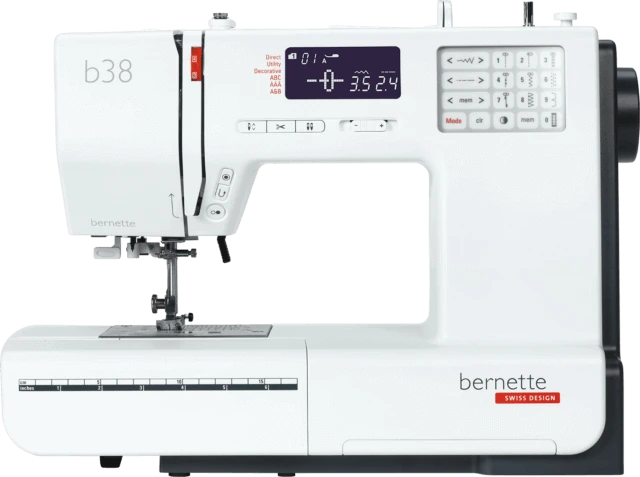
Explore this need in the finder →The bernette 38 adds several useful working conveniences to a compact computerized sewing machine: adjustable presser-foot pressure, automatic thread cutting, pattern memory and a supplied extension table. Its 394 patterns and three alphabet groups give it more decorative scope than the b37, but the more persuasive reasons to choose it are often the controls you will use at every seam. It is a sewing machine with built-in lettering, not a substitute for a hoop-driven embroidery system.
Pressure adjustment is different from thread tension
A dedicated dial changes presser-foot pressure. The guide starts regular sewing at setting six, then gives lower ranges for particular work such as appliqué and finer fabrics. This adjusts how the foot presses on the material, while the separate thread-tension control changes the balance of the threads. The distinction matters when comparing a machine that merely advertises adjustable tension with one that supplies both controls.
The b38 also has a speed slider that limits the maximum pace when using the pedal. Its stated maximum is 820 stitches per minute. If you prefer sewing from the start/stop button, disconnect the foot control first; the manual says the button does not operate with the pedal connected. A slow start and the ability to keep the machine running slowly while holding the button give you another way to approach detailed sections.
The needle up/down button helps with positioning, and a setting determines the needle's stopping position. These are useful when turning corners or repositioning a project. They do not substitute for supporting a heavy piece of fabric so it cannot pull against the stitch area. As with any new control layout, practice the stopping and locking functions on a sample before putting them to work on a finished garment.
Automatic cutting saves steps, with limits
A button trims the upper and bobbin threads after sewing. You can also program automatic cutting after the documented locking sequence. For someone sewing repeated seams or decorative combinations, this can remove a frequent reach for scissors. The b37 has a manual cutter, so this is a genuine functional difference rather than a distinction in stitch count.
Use the cutter within its instructions. For thread numbered 30 or thicker, the guide directs you to the manual cutter on the head cover. Twin-needle work also uses the manual cutter, and memorized pattern combinations are unavailable in twin-needle mode. Do not expect automatic cutting, twin-needle sewing and stored sequences to operate as one unrestricted combined setup.
The twin-needle setting restricts compatible stitches and width. Select it for the correct needle setup rather than relying on an ordinary decorative pattern's full 7 mm width. The machine's maximum stitch length is 5 mm, but individual patterns and modes have their own available settings. Maximum specifications describe the machine's range, not every stitch in every mode.
Lettering follows the fabric feed
The three alphabet groups cover ordinary letters and numbers, European accented characters and Cyrillic characters. You select their codes and add them to a sequence with the memory button. Up to 50 patterns can be memorized in a combination, and the LCD shows one character at a time. The guide explains reviewing, inserting, deleting and duplicating entries, so allow some learning time for longer text.
This is useful for stitched labels and decorative lines that move through the sewing machine. It is not an imported multi-directional embroidery design placed by a motorized hoop. Likewise, the supplied feet called embroidery feet support sewing techniques; their names do not establish an embroidery module. If you want large custom motifs from design files, choose a machine that expressly documents that different system.
The manufacturer lists eight buttonhole/eyelet choices, including one-step buttonholes with automatic completion. The sliding foot uses the actual button to set length, subject to the guide's one-inch button-holder limit and sample testing. The broader selection is useful for different garment finishes, but stabilizer, placement and a trial opening still matter.
The table helps support work, without enlarging the arm
A large extension table and hard cover are included, along with eight standard presser feet. The table supports fabric outside the machine; the specified space to the right of the needle remains 170 mm. It is helpful for piecing and larger panels, but it does not turn the b38 into a longarm quilting machine. Check your available work surface with the table installed and leave access for bobbin changes and cleaning.
The top-loading hook uses the J-marked plastic bobbins specified by the manual. Routine care includes removing lint around the bobbin holder, feed dog and thread-cutter mechanism, then applying two drops of oil to the indicated felt in the hook race. Unplug before the illustrated disassembly. Electronic controls leave this physical maintenance work in place.
Choose the b38 if pressure adjustment, automatic cutting, stored lettering and the supplied table will earn regular use. Choose the b37 if you mainly need its speed cap, needle positioning and pedal-free controls. Compare the Yaya Han edition if its supplied walking foot, specialty feet and cutting tools suit your actual projects; the standard b38 should not be credited with that extra package. The right version is the one whose routine and supplied tools solve concrete needs.
Key details at a glance
| Motor and stitch controls | Computerized stitch selection, a separate speed limiter and a needle up/down button. Disconnect the foot pedal before using the start/stop button. |
|---|---|
| Stitch choices and limits | 394 total patterns. Single-needle maximum width 7 mm and length 5 mm; specific stitches and twin-needle setup have smaller or separately restricted ranges. |
| Buttonhole routine | 8 manufacturer-listed buttonhole/eyelet choices, with documented automatic buttonhole completion stopping. The published group includes eyelet work. |
| Working space and size limits | 170 mm of stated space to the right of the needle. An extension table supports fabric around the machine and does not enlarge this opening. Body width and machine weight remain unconfirmed here. |
| Supplied tools and fabric support | 8 standard feet. Large extension table and hard cover supplied; walking foot is optional. |
| Needle setups, cutting and memory | Automatic cutting and stored combinations are single-needle functions. Twin-needle work uses the manual cutter and does not support memorized patterns; thread number 30 or thicker also uses the manual cutter. |
| Presser-foot pressure | Dedicated presser-foot pressure dial documented, separate from thread tension. |
| Cleaning and lubrication | Clean the bobbin holder, feed dog and hook race as illustrated; the current guide specifies two drops of oil on the indicated felt. Include the cutter mechanism in lint cleaning. Unplug first. |
Use the exact model’s instructions for operating limits, supplied equipment and version differences.
Sources for this assessment
Choose the operating routine that suits your work.
Start with whether you sew, embroider, serge or coverstitch, then compare controls, working area, supplied tools and setup limits.