
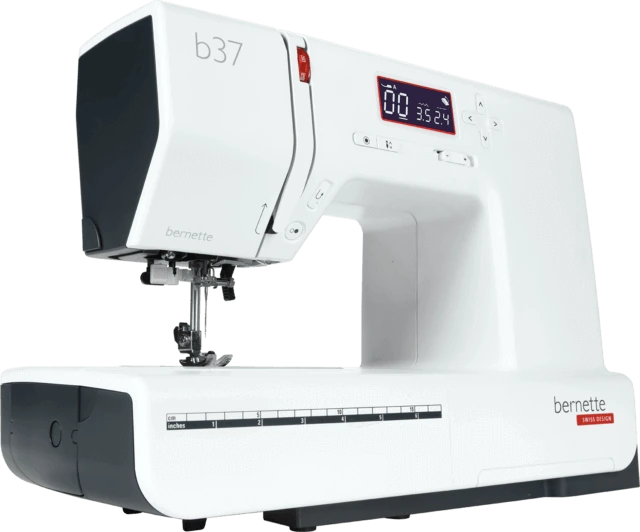
Your needs, this model
Does it fit your priorities?
Can I sew without the foot pedal, limit maximum speed and use a top-loading bobbin?
Yes. Disconnect the pedal for the start/stop-button setup. The separate speed slider and drop-in bobbin remain available.
Explore this need in the finder →Can the b37 cut threads automatically after a seam?
No. The exact model has a manual thread cutter, while the comparison table marks automatic cutting unavailable.
Explore this need in the finder →Is a large extension table supplied with the standard b37?
No. The manual labels that table a special accessory and the comparison brochure calls it optional.
Explore this need in the finder →The bernette 37 is the first electronic model in the b30 range, and its useful advantages are about control rather than a large decorative-stitch collection. It provides a speed-limiting slider, a start/stop button for sewing without the pedal, selectable needle positioning and a top-loading bobbin. It suits a learner who wants help regulating the machine or an occasional maker who values those controls more than lettering and automatic thread cutting.
Control the pace with your hand or your foot
The speed slider changes the maximum sewing speed, including when you use the foot pedal. You can set a lower ceiling and still vary the pace with pedal pressure. This is a different experience from the b33 and b35, whose sewing speed is controlled by the pedal without a separate limiter. The b37's published maximum is 700 stitches per minute; its value is the ability to choose an appropriate pace, not a promise to finish every project faster.
For pedal-free sewing, disconnect the foot control and use the start/stop button. The manual expressly says that the button does not work while the pedal is connected. The machine begins slowly, then runs at the slider setting; holding the button keeps it slow. Try that sequence on a scrap before guiding a long seam. A start button changes how you command the motor, but it does not remove the need to support and guide the material.
The needle up/down button is another practical upgrade. It lets you position the needle for a corner rather than repeatedly finding that position with the handwheel. The auto-lock and reverse buttons have different behavior depending on the chosen pattern, so learn their roles on your ordinary seam stitch before expecting identical behavior across decorative programs.
A useful stitch set without stored lettering
The b37 has 50 patterns, a maximum width of 7 mm and a maximum length of 5 mm. An LCD shows the selected pattern and settings; cursor and value buttons let you change them. That is a step away from visible mechanical dials, but it keeps the relevant numbers in one place. The stitch overview stored in the machine helps connect a pattern number with its appearance.
Its buttonhole and eyelet selection deserves a close look. The manufacturer groups five options under buttonholes/eyelets; the guide separately describes standard, round-end, keyhole and stretch buttonholes, plus the eyelet program. The standard buttonhole uses the sliding foot to set the size from a button up to one inch in diameter, and the machine stops automatically at completion. Lower the buttonhole lever first and test the fabric and interfacing combination before cutting the opening.
These functions cover many clothing and repair tasks without requiring the b38's lettering and pattern memory. The b37 is less attractive if your main goal is programming names or automatically cutting the threads after each seam. It has a manual cutter. Its decorative combinations also involve selecting patterns and using the lock function, rather than storing a long sequence as on the b38.
Separate the supplied package from optional support
The bobbin drops into the top of the hook area. The current guide specifies the correct J-marked plastic bobbins for the horizontal hook, so match the actual bobbin type when buying replacements. Removing the small sewing table exposes the free arm, while the 170 mm space to the right of the needle provides the same stated arm clearance as the mechanical b30 models.
A large extension table is shown in the guide, but it is labelled a special accessory, and the comparison brochure calls it optional for the b37. It is not part of the standard package assessed here. That distinction is important for quilting or long curtain panels: the table supports material around the machine; it does not increase the opening between the needle and the body.
Five standard feet are listed: zigzag, satin stitch, sliding buttonhole, zipper and button-sewing. A compatible walking foot is a separate accessory. The comparison table does not give the b37 adjustable presser-foot pressure. If you frequently change between delicate fabrics and stretch materials and specifically want that control, compare the b38's pressure dial rather than treating thread tension as the same adjustment.
Electronic controls still leave mechanical care
The current guide calls for cleaning lint from the feed dog, bobbin holder and hook race with the machine unplugged. It also specifies two drops of oil on the indicated felt in the hook area. Follow that model's diagram; “computerized” does not mean that all routine cleaning or oiling disappears. The regional auto-off timer described in the manual applies to specified 200–240 V markets, so it is not a feature to assume on the US machine.
Choose the b37 for controllable speed, pedal-free sewing, top bobbin access and automatic completion of the documented buttonhole cycle. Choose the b35 if dials and a simpler mechanical layout appeal more. Choose the b38 for pressure adjustment, automatic cutting, stored lettering and a supplied extension table. The b37 is the practical middle option when its everyday controls solve your main difficulties and the extra decorative workflow would go mostly unused.
Key details at a glance
| Motor and stitch controls | Computerized stitch selection, a separate speed limiter and a needle up/down button. Disconnect the foot pedal before using the start/stop button. |
|---|---|
| Stitch choices and limits | 50 total patterns. Single-needle maximum width 7 mm and length 5 mm; specific stitches and twin-needle setup have smaller or separately restricted ranges. |
| Buttonhole routine | 5 manufacturer-listed buttonhole/eyelet choices, with documented automatic buttonhole completion stopping. The published group includes eyelet work. |
| Working space and size limits | 170 mm of stated space to the right of the needle. An extension table supports fabric around the machine and does not enlarge this opening. Body width and machine weight remain unconfirmed here. |
| Supplied tools and fabric support | 5 standard feet. Large extension table and walking foot are not supplied in this assessed standard package. |
| Needle setups, cutting and memory | A manual cutter and no stored lettering or combinations. Twin-needle support does not establish a full-width twin stitch. |
| Presser-foot pressure | The current comparison table marks adjustable presser-foot pressure unavailable; thread tension remains a different adjustment. |
| Cleaning and lubrication | Clean the bobbin holder, feed dog and hook race as illustrated; the current guide specifies two drops of oil on the indicated felt. Unplug first. |
Use the exact model’s instructions for operating limits, supplied equipment and version differences.
Sources for this assessment
Choose the operating routine that suits your work.
Start with whether you sew, embroider, serge or coverstitch, then compare controls, working area, supplied tools and setup limits.