
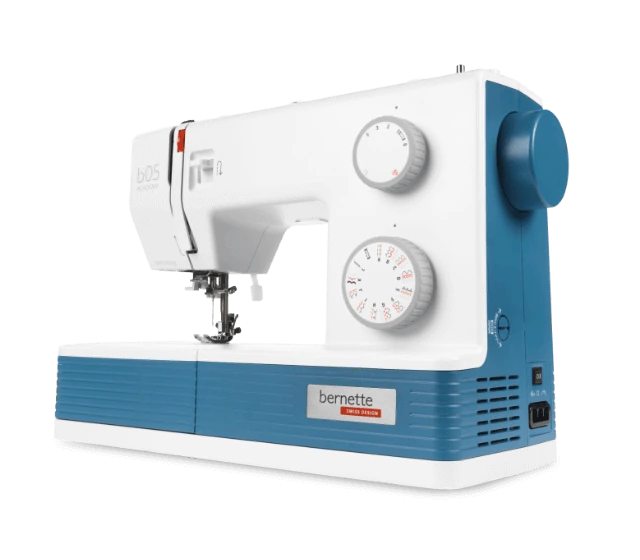
Your needs, this model
Does it fit your priorities?
Can I combine mechanical stitch dials, an independent maximum-speed control, adjustable foot pressure and a supplied large extension table?
Yes. The ACADEMY has a 650/1,100 speed switch, separate pressure adjustment and the large table in its standard US package. Sewing still uses the foot pedal.
Explore this need in the finder →Will its one-step buttonhole automatically stop the machine at completion?
No. The exact guide tells the operator to stop at the ending point; one-step sequencing does not establish automatic stopping.
Explore this need in the finder →Can I use a twin needle and retain at least 6 mm of sideways stitch width?
No. The exact twin-needle setup requires a centered straight stitch and zigzag foot; the single-needle 6 mm width cannot be transferred to that setup.
Explore this need in the finder →The bernette 05 ACADEMY is a mechanical household sewing machine for someone who wants physical stitch dials, adjustable presser-foot pressure and a way to cap speed independently of pedal pressure. Its supplied table and twelve presser-foot soles also make it a substantially different package from the 05 CRAFTER. The ACADEMY is most appealing when those working features matter more than computerized stitch selection or sewing from a start/stop button.
A slower ceiling while you still use the pedal
The main switch offers two running settings: a published maximum of 1,100 stitches per minute, or a lower maximum of 650. Within the selected range, the foot control varies speed and releasing it stops the machine. The lower setting can be useful when you want more room to work with the pedal before reaching the machine's fastest pace.
This remains foot-operated sewing. The switch does not start and stop a seam in place of the pedal, and it is not the continuously adjustable slider found on some computerized machines. If pedal-free operation is essential, compare the bernette 37 and its documented button-operated setup. Choose the ACADEMY's switched limit because it suits how you want to control the machine, rather than assuming every speed-control feature solves the same problem.
Useful stitch choices without a computerized workflow
The 30-pattern selection includes practical, stretch and decorative stitches plus a one-step buttonhole. The stated single-needle limits are 6 mm in width and 4 mm in length. Those are maximum capabilities, rather than settings available for every pattern: the manual gives fixed lengths for the red and gray pattern groups. Thread tension, foot pressure and stitch balance remain adjustments you make for the material and result.
The pressure dial is worth considering if your sewing moves between light garments, knits and layered seams. Changing the force of the foot on the fabric is different from changing thread tension. Neither adjustment guarantees a good result on an unfamiliar material, so work on a sample using the intended needle, thread and layers. The included height-compensation tool can help support the foot at changes in thickness; it does not turn the machine into an industrial production system.
A one-step buttonhole still needs your attention
The sliding buttonhole foot uses a button to establish the sequence's length. You select the buttonhole setting, lower its lever and sew using the foot control. The exact manual then tells the operator to stop when the final bead reaches the bar. That makes one-step sequencing a convenience without establishing automatic stopping at completion.
This distinction matters if you plan a row of garment buttonholes and expect the machine to stop each one for you. Compare a documented automatic-stop model such as the bernette 38 if that is a hard requirement. For either workflow, a sample in the actual fabric and stabilizer is more useful than assuming the first finished buttonhole will be ready for the garment.
The larger package supports more kinds of ordinary sewing
The ACADEMY supplies twelve foot soles, including concealed-zipper, button-sewing, hemming, darning and edgestitching options alongside the basic feet. Its sliding-sole zigzag foot is a different tool from a walking foot, and a walking foot is not listed as supplied. Similarly, an overlock-style stitch and foot do not provide a serger's trimming mechanism; an embroidery foot does not create motorized-hoop embroidery.
The separate extension table supports fabric around the free arm and has adjustable legs. Set it level on a stable surface. Removing the small accessory-box section gives access to the free arm for tubular pieces. Neither the table nor that removable section enlarges the stated 165 mm opening to the right of the needle, so consider how you will handle a bulky project through that opening.
The exact technical table lists a 416 × 174 × 299 mm machine envelope and a weight of 7.0 kg. Add space for the extension table, pedal, cables and fabric movement when planning a workstation. These machine dimensions do not describe the complete area occupied while sewing.
Needle changes and maintenance are part of ownership
The current guide documents twin- and triple-needle threading, with a separate external spool stand needed for the third thread. It requires the zigzag foot, a straight stitch and centered needle position for those setups. Do not carry the single-needle 6 mm capability into a multi-needle zigzag assumption. Threading those needles is a manual task with its own instructions.
The drop-in bobbin is accessible from above, but lint removal still involves the specified bobbin-area and stitch-plate procedure. The April 2026 guide also includes needle-bar lubrication, with a six-month interval for frequent use and oil applied only at its illustrated points. Unplug before maintenance and follow that model's guide rather than a generic claim that a drop-in-bobbin machine never needs oil.
Choose it for the mechanical controls and supplied working tools
The ACADEMY makes sense when an independent speed ceiling, adjustable pressure and a supplied table will be used regularly. Choose the CRAFTER if you prefer the simpler six-foot package and do not need the separate limiter. Choose a documented computerized alternative when pedal-free sewing, a needle-position button or automatic buttonhole stopping matters more. The ACADEMY's strongest case is practical control over ordinary sewing with a fuller set of working accessories.
Sources: exact US product and package page, its linked April 2026 ACADEMY manual and the 2026 05-series comparison. Read October 23, 2026.
Key details at a glance
| Motor and stitch controls | Mechanical stitch-selection dials. The main switch selects a 650 or 1,100 stitches-per-minute ceiling; the foot pedal varies speed within that range and stops sewing when released. |
|---|---|
| Stitch choices and limits | Thirty total patterns including a one-step buttonhole. Single-needle maxima are 6 mm width and 4 mm length; red and gray stitch groups have predefined lengths. Twin and triple needles require a centered straight stitch. |
| Buttonhole routine | The button-sized one-step sequence uses a sliding foot. The operator must stop at its ending point; automatic completion stopping is not established. |
| Working space and size limits | 165 mm to the right of the needle. The exact manual lists the machine as 416 mm wide × 174 mm deep × 299 mm high and 7.0 kg. Add working space for fabric, pedal, cables and any separate table. |
| Supplied tools and fabric support | The standard US package supplies twelve presser-foot soles, the separate large extension table and a finger guard. A walking foot is not listed in the supplied set. |
| Needle setups, cutting and memory | Manual thread cutter. Twin and triple needles require the zigzag foot, centered needle and straight stitch; triple threading additionally needs a separate external spool stand. Needle spacing is not sideways stitch width. |
| Presser-foot pressure | A dedicated dial adjusts presser-foot pressure independently of upper-thread tension. Do not reduce the pressure below zero; test the actual needle, thread, fabric and layers. |
| Cleaning and lubrication | Clean lint in the specified feed-dog and bobbin areas. The April 2026 guide includes needle-bar oiling at its illustrated points, every six months when frequently used. Switch off and unplug before maintenance. |
Use the exact model’s instructions for operating limits, supplied equipment and version differences.
Sources for this assessment
Choose the operating routine that suits your work.
Start with whether you sew, embroider, serge or coverstitch, then compare controls, working area, supplied tools and setup limits.