
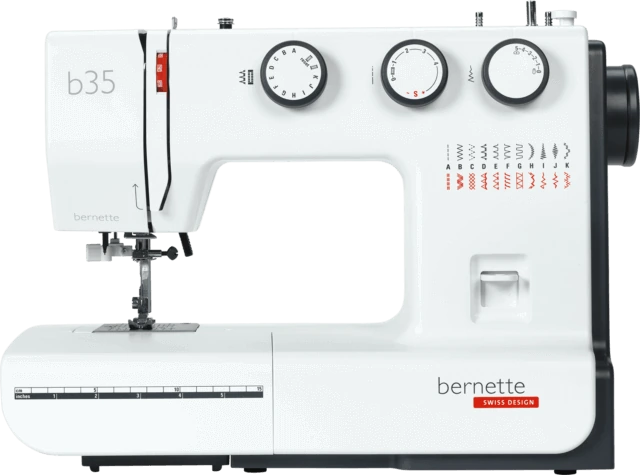
Your needs, this model
Does it fit your priorities?
Can I have mechanical controls, a one-step buttonhole and at least five millimeters of maximum stitch width with a single needle?
Yes. The b35 combines those features in its documented single-needle foot-control setup, with a separate width dial.
Explore this need in the finder →Will the buttonhole stop automatically at completion?
No documented automatic completion stop meets that condition. The b35 guide says to stop the machine at the ending point after its automatic sequence.
Explore this need in the finder →Does this setup provide at least seven millimeters of maximum stitch width?
No. The stated maximum is five millimeters.
Explore this need in the finder →The bernette 35 is a mechanical sewing machine whose most useful upgrades over the b33 are an automatic one-step buttonhole and a separate stitch-width knob. It supplies 23 stitch patterns and seven presser feet while keeping sewing speed under the foot pedal. It fits a maker who prefers dials but wants fewer manual stages when finishing clothing. It is less suitable if an independent speed limit, a start/stop button or automatic thread cutting is essential.
The extra dial changes what you can adjust
The b35 has front controls for pattern, stitch length and stitch width, with upper-thread tension adjusted separately. The stated limits are 5 mm wide and 4 mm long. The width dial gives you a direct way to change a zigzag rather than choosing a machine solely by its maximum-width number. Raise the needle clear of the fabric before changing the pattern or width as the guide instructs.
The 23 patterns combine utility, stretch and decorative stitches. Straight stitching, zigzag, overcasting-style stitches and blind hems cover many garment and repair tasks. The manual also explains a rolled hem using the supplied hemmer foot. An overcasting pattern on this bobbin machine is not the same mechanism as a dedicated serger that trims an edge while stitching with loopers. Choose it for normal sewing versatility rather than as a substitute for every specialist finishing machine.
The published maximum speed is 860 stitches per minute. That figure is a ceiling, not a recommendation to sew a difficult seam at full speed. Pressure on the foot control determines the actual pace; there is no separate speed regulator to cap it. The bernette 37 offers that regulator even though its published maximum is lower. For controlled starts and short detailed seams, the way you control speed can matter more than the largest speed number.
One-step buttonholes still require careful preparation
The sliding buttonhole foot takes the button in its rear holder, which sets the opening's size. The guide allows a button up to one inch, or 2.5 cm, in diameter. Attach the foot, lower the separate buttonhole lever, align the fabric and check that the slider and spring holder meet correctly. A gap can make the two sides different lengths.
Once you press the pedal, the machine sews the bartacks and both sides in its automatic sequence. The b35's instructions still tell you to stop at the ending point; do not assume it has the same automatic completion stop as an electronic b37. For a repeat buttonhole, reset the pattern selector as shown in the guide before sewing the next one. Those details are particularly useful when comparing an attractive “one-step” label with the actual work at the machine.
Make a test opening with the same fabric, interfacing and seam layers. A thick button may need extra room even after it fits the foot's holder. The manual also describes a corded buttonhole, but stabilizing the fabric and checking the sample remain your tasks. The b33 requires manually changing among four buttonhole stages, so the b35 is the more convenient mechanical choice for repeated clothing closures.
Budget for bobbin access and ordinary care
The b35 uses a front-loading bobbin case. Remove the sewing table, open the cover, release the case by its latch and follow the thread path through its slot and tension spring. This arrangement is accessible for cleaning, but it differs from lifting a bobbin out through a top cover. A mechanical needle threader helps form the thread loop through the needle; the separate thread cutter is manual.
The small sewing table doubles as accessory storage and pulls off to expose a free arm for tubular pieces. The series specification gives 170 mm to the right of the needle. A full extension table is not part of the stated b35 package. Support larger material on your work surface, particularly when its weight would otherwise drag against a seam.
The supplied feet include zigzag, sliding buttonhole, zipper, satin stitch, blindstitch, button-sewing and hemmer feet. A compatible walking foot shown elsewhere on the site is an additional purchase, not an integrated feed system or a standard included item. The current comparison table also distinguishes presser-foot pressure adjustment from thread tension: the b35 does not provide the pressure dial found on the b38.
Maintenance includes brushing the shuttle race and feed dog, removing and reseating the bobbin case correctly, and oiling the indicated shuttle location with one or two drops of appropriate sewing-machine oil. Unplug before the illustrated disassembly and wipe away excess oil. Do not apply another machine's oiling routine to every opening in the body.
Who should choose the mechanical middle ground?
Choose the b35 if you want visible dials, ordinary garment stitches and a more convenient buttonhole procedure than the b33. It is a useful fit for a maker who already feels comfortable controlling starts and stops with a pedal. Choose the b37 if a selectable speed cap, drop-in bobbin and pedal-free sewing are more important than retaining mechanical controls.
The b38 adds automatic thread cutting, adjustable presser-foot pressure, lettering and a supplied extension table. Those are concrete upgrades for repeated seams and decorative work. The b35 remains the sensible choice when you will use its independent width control and one-step buttonhole, while being content to position the needle and cut threads yourself.
Key details at a glance
| Motor and stitch controls | Mechanical stitch-selection dials; speed varies through the foot pedal without an independent speed limiter. |
|---|---|
| Stitch choices and limits | 23 total patterns. Single-needle maximum width 5 mm and length 4 mm; specific stitches and twin-needle setup have smaller or separately restricted ranges. |
| Buttonhole routine | One-step button-sized sequence, with the operator instructed to stop at the ending point. |
| Working space and size limits | 170 mm of stated space to the right of the needle. An extension table supports fabric around the machine and does not enlarge this opening. Body width and machine weight remain unconfirmed here. |
| Supplied tools and fabric support | 7 standard feet. Large extension table and walking foot are not supplied in this assessed standard package. |
| Needle setups, cutting and memory | A manual cutter and no stored lettering or combinations. Twin-needle support does not establish a full-width twin stitch. |
| Presser-foot pressure | The current comparison table marks adjustable presser-foot pressure unavailable; thread tension remains a different adjustment. |
| Cleaning and lubrication | Follow the exact guide for lint cleaning and the indicated shuttle-race oiling: one or two drops of appropriate machine oil, with excess removed. Unplug before illustrated disassembly. |
Use the exact model’s instructions for operating limits, supplied equipment and version differences.
Sources for this assessment
Choose the operating routine that suits your work.
Start with whether you sew, embroider, serge or coverstitch, then compare controls, working area, supplied tools and setup limits.