
Your needs, this model
Does it fit your priorities?
Does the 340S provide mechanical everyday sewing with a one-step buttonhole?
Yes. The exact page lists 23 patterns and one-step buttonhole; the manual identifies Model 340 and its automatic buttonhole foot.
Explore this need in the finder →Does one-step mean the 340S will stop the machine automatically at the end?
No. The exact manual instructs the operator to stop when the hole is complete; its reset procedure is also manual.
Explore this need in the finder →Does the 340S offer a confirmed maximum stitch width of at least 6 mm?
No. Elna specifies a 5 mm maximum width; that is not enough to meet a 6 mm essential minimum.
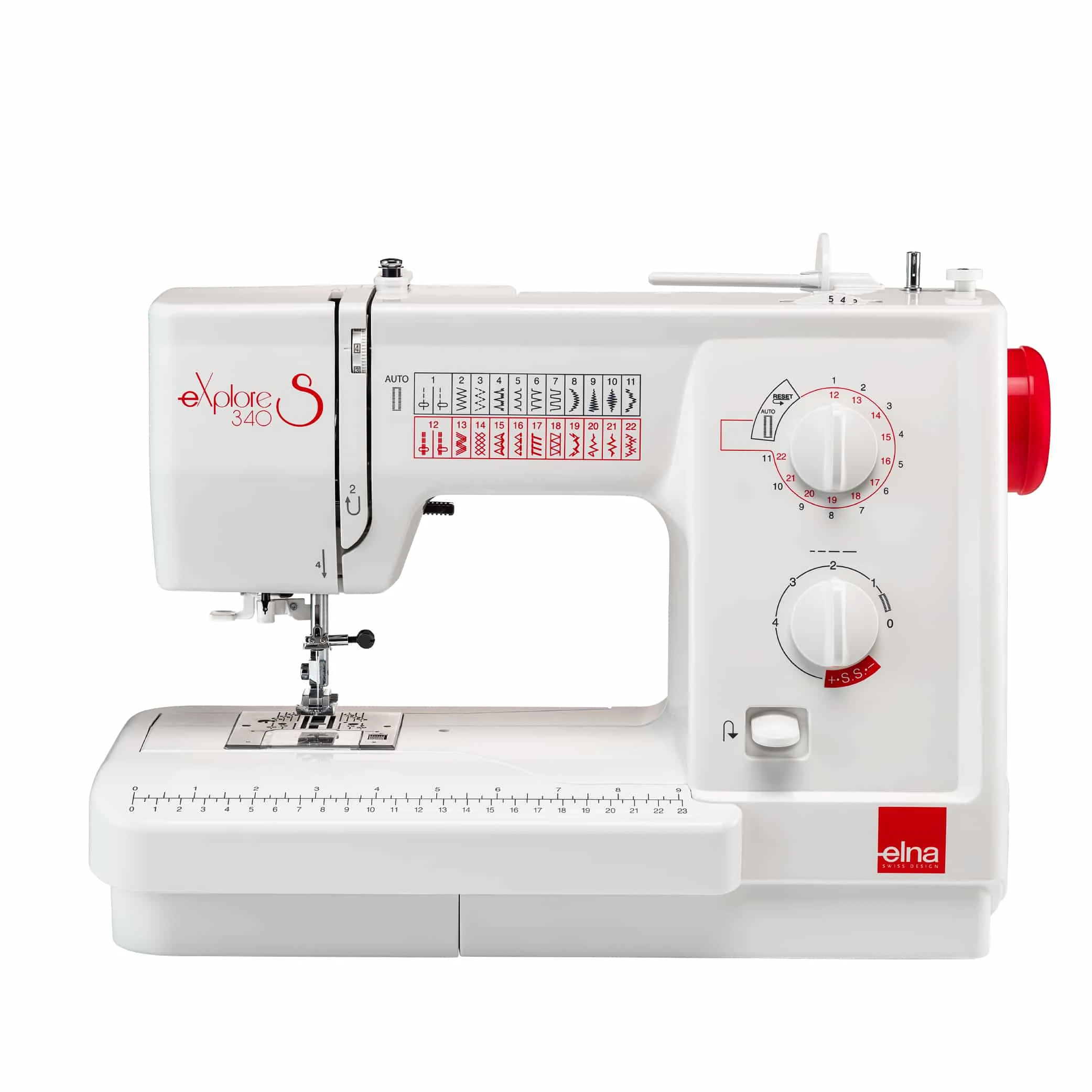
Explore this need in the finder →The Elna eXplore 340S is the more convenient of the two current 320S/340S mechanical models for repeated buttonholes: its included automatic buttonhole foot sizes a one-step sequence around a button. But the distinction deserves precision—the manual still tells the sewer to stop the machine when the buttonhole is complete. It does not document automatic completion stopping. With 23 stitches, adjustable presser-foot pressure and the same 6.5 kg body as the 320S, the 340S is a practical general-sewing machine whose advantage is an easier buttonhole routine and a somewhat broader pattern set.
What the extra patterns change—and what they do not
The maker lists 23 patterns for the 340S versus 19 on the 320S. Both offer a mechanical stitch selector, adjustable width to 5 mm and length to 4 mm, with stretch-stitch fine tuning. The extra choices are useful if you actually use decorative and utility stitches, but a larger count is not a measure of seam quality. Check the stitch chart and make a sample with the intended needle, thread and cloth before judging a pattern for a particular project.
Both machines use a horizontal rotary hook with a clear drop-in bobbin cover, a 3-piece retractable feed dog, foot-pressure and thread-tension controls, a built-in needle threader, free arm, manual thread cutter and extra-high presser-foot position. The documented work space is 160 mm to the right of the needle; the body measures 420 × 280 × 170 mm and weighs 6.5 kg. The stated maximum is 830 stitches per minute. The manual describes pedal-pressure speed control; there is no separate speed slider or documented pedal-free start/stop mode.
One-step, but not unattended
The included automatic buttonhole foot accepts a button to set the length, then the machine sews the sides and bartacks in one selector sequence. The manual cautions that the slider should meet its stopper without a gap and that a sample with matching fabric and interfacing is important, especially on stretch material. It explicitly instructs the operator to stop the machine when the hole is finished and reset the selector before sewing another. That is still much less dial-changing than the 320S's four-step method, but it is not a buttonhole setting that senses completion and stops on its own.
That difference matters in the questionnaire as well as in daily use. If your essential request is a one-step routine, the 340S meets it. If you also require an automatic end-of-hole stop, that extra need is not confirmed. The 320S is the four-step alternative; neither machine turns the buttonhole into an unattended operation.
The exact standard package is a useful part of its appeal
The current U.S. list includes the standard foot, zipper foot, satin-stitch foot, blind-hem foot, overedge foot C, automatic buttonhole foot R and quilting guide bar, plus three bobbins, needle set, lint brush, screwdriver, seam ripper, spool holders, additional spool pin, felt, foot controller and hard cover. The 320S instead lists the sliding four-step foot and does not list the 340S's overedge foot or quilting guide bar. These are meaningful package differences; optional accessories and dealer bundles should not be merged into the standard carton.
There is a small removable extension piece with storage beneath, but it is not a separately supplied large table for supporting quilts. A supplied overedge foot and an overcasting pattern can neaten fabric edges; they do not make the 340S a serger because it has no documented loopers or cutting knives. Similarly, the machine is a single-needle sewing setup, not a motorized-hoop embroidery, coverstitch or chainstitch machine.
Care, fit and alternatives
Elna publishes a maximum 5 mm stitch width and 4 mm stitch length, not a promise that every pattern reaches both limits. The 160 mm sewing space is workable for ordinary garment pieces but may feel restrictive when pushing bulky quilt layers under the arm. A removable accessory-storage piece does not increase the needle-to-arm opening. For bed-size projects, consider the fabric support and table around the machine rather than inferring room from its body dimensions.
The linked manual instructs owners to unplug before cleaning and shows how to brush lint from the hook race and feed dogs; follow that model-family procedure instead of dismantling other parts or applying oil without guidance. Compare the eXplore 340S with the less complicated 130 or 120 if you prefer a front-loading case, or with the 3210 Designed for Jeans if the higher listed stitch width and extra-high foot position are more relevant. The 3210 is heavier and shares the limitation that one-step buttonholes still do not stop automatically. Elna's product language is not an independent test of how any model handles a particular stack of denim; test the actual materials before buying for that task.
Sources: Elna USA's eXplore 340S product page, its linked 320S/340S instruction manual (especially pp. 8, 10, 12, 54–58 and 88), and the 2024 model-family specification sheet (pp. 1–2). The reviewed sources are not hands-on tests; dealer bundles may differ from the listed standard accessories. Reviewed October 26, 2026.
Key details at a glance
| Motor and stitch controls | Mechanical pattern, stitch-width and stitch-length dials with foot-controller speed variation. The maker-published maximum is a ceiling, not a separate maximum-speed limiter or Start/Stop function. |
|---|---|
| Stitch choices and limits | The exact product page and 2024 sheet report 23 patterns, maximum width 5 mm, maximum length 4 mm and a maximum 830 stitches per minute. Stretch-stitch length has fine tuning; the count is not a stitch-quality measure. |
| Buttonhole routine | The exact English manual pp. 54–58 identifies the one-step Model 340 foot R and button-based sizing. It expressly tells the operator to stop when a buttonhole is completed; one-step does not mean automatic completion stopping. |
| Working space and size limits | Elna’s 2024 sheet states a 160 mm sewing space to the right of the needle, with a 420 × 280 × 170 mm body and 6.5 kg weight. |
| Supplied tools and fabric support | The 340S standard list includes overedge foot C, automatic buttonhole foot R and quilting guide bar, plus standard/zipper/satin/blind-hem feet, three bobbins, needles, lint brush, seam ripper, screwdriver, spool holders, additional spool pin, felt, foot controller and hard cover. The exact page does not list a walking foot or large separate extension table. |
| Needle setups, cutting and memory | The confirmed setup is ordinary single-needle household sewing. The mechanical machine is not a serger, coverstitch machine or motorized-hoop embroidery unit; no automatic thread cutter or pattern memory is documented. |
| Presser-foot pressure | The exact Elna technical sheet and manual label a separate manual presser-foot-pressure dial. Do not confuse it with upper-thread tension. |
| Cleaning and lubrication | Use the exact instruction manual maintenance section; switch off and unplug before cleaning and do not dismantle beyond the described procedure. |
Use the exact model’s instructions for operating limits, supplied equipment and version differences.
Sources for this assessment
Choose the operating routine that suits your work.
Start with whether you sew, embroider, serge or coverstitch, then compare controls, working area, supplied tools and setup limits.