
Your needs, this model
Does it fit your priorities?
Can the 3210 combine mechanical single-needle sewing, a one-step buttonhole and a 6 mm width minimum?
Yes. The maker lists 6.5 mm maximum single-needle width and one-step buttonhole; the manual distinguishes the 3210 mechanical controls from the 3230 electronic controls.
Explore this need in the finder →Is twin-needle sewing documented, and does it meet a 3 mm width minimum?
Yes, as a separate optional twin-needle plan. The manual requires the additional spool pin, says the needle threader cannot be used, and limits non-straight stitches to 3 mm width or less.
Explore this need in the finder →Can the 3210 satisfy a twin-needle stitch-width minimum above 3 mm?
No. Its exact manual limits non-straight stitches to 3 mm or less in twin-needle use; the 6.5 mm single-needle maximum cannot be borrowed.
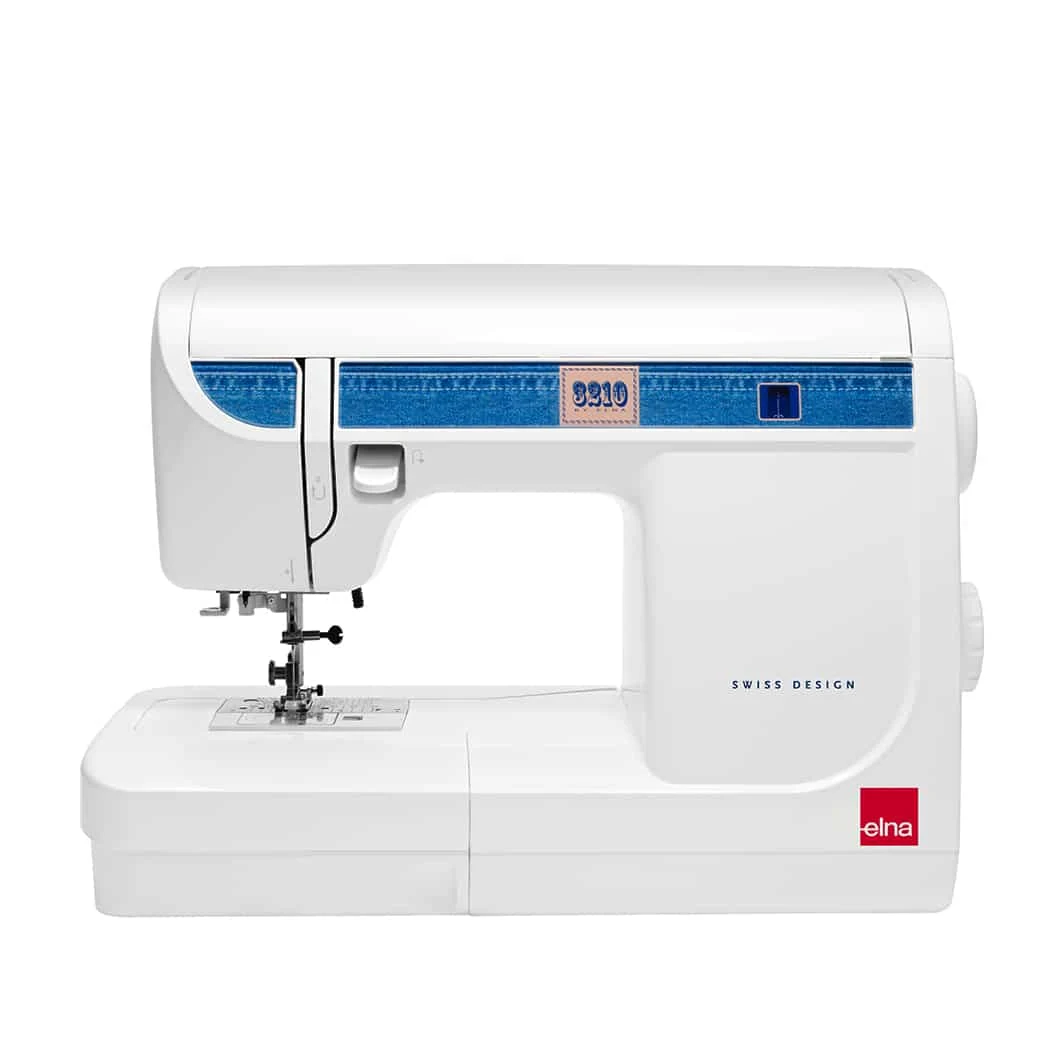
Explore this need in the finder →The Elna 3210 Designed for Jeans is a mechanical domestic sewing machine built around a useful combination for garment work: a 6.5 mm maximum stitch width, extra-high presser-foot position, adjustable foot pressure and a one-step buttonhole. Elna describes it as suitable for heavy fabrics, but that is a manufacturer claim, not a test of every denim seam stack. The 3210 is notably heavier than the eXplore 320S and 340S at 9.3 kg, and its 19 patterns and familiar mechanical dials make it a straightforward household machine rather than an industrial denim specialist.
Denim-oriented details, with realistic boundaries
The exact U.S. page calls out strong needle penetration and an extra-high presser-foot lifter. The linked manual also documents an adjustable foot-pressure dial and a drop feed dog. Those are useful controls when a garment has thick or uneven sections, but they do not establish a maximum fabric-stack thickness or prove the machine will sew every heavy material without adjustment. For a bulky hem, select the appropriate needle, raise the foot to the required position, stabilize the approach if useful, and test on scraps from the same layers before committing a finished garment.
Elna lists 19 stitches, a maximum width of 6.5 mm, a maximum length of 4 mm and a maximum speed of 860 stitches per minute. The speed figure is a ceiling, not a separate speed-limiter setting. The manual says the machine runs faster as you press harder on the foot control; its speed lever and electronic needle-up/down key are explicitly for the different 3230 model. The 3210 uses a stitch-selection display and mechanical controls, with no documented pedal-free Start/Stop.
One-step buttonholes still need the operator
The automatic foot sizes a buttonhole around a button, then sews the sides and bartacks in a one-step sequence. The manual asks for a sample and appropriate interfacing; it also calls for correct foot placement and a properly aligned slider. Critically, page 72 says automatic completion stopping is a 3230-only feature. For the 3210, the buttonhole mode is one-step but the operator must stop the machine at the end. If you require a one-step buttonhole and an independent automatic stop, do not treat those as the same feature.
The supplied package is unusually specific: Elna lists several presser feet, including automatic buttonhole foot R, an overedge foot, quilting guide, five bobbins, needle set, foot controller and a jeans carrying bag. The exact manual also refers to a 3210-only vinyl dust cover. Because accessory descriptions can vary between page revisions and seller bundles, check the exact carton rather than assuming every photograph shows all included items.
A documented twin-needle option—with limits
The 3210 manual's twin-needle section describes the optional needle and the additional spool pin. It warns that the built-in needle threader cannot be used with a twin needle and that, for stitches other than straight stitch, width must be 3 mm or less. That makes the twin setup a real option for suitable hems, but it should not inherit the 6.5 mm single-needle maximum. Confirm needle clearance by hand-turning the flywheel and follow the manual's stitch restrictions. The exact source does not publish a twin-needle-specific maximum speed, so the 860-stitch figure remains associated with the ordinary single-needle plan rather than transferred to this setup.
Space, care and what it is not
The machine body is 423 × 302 × 187 mm and weighs 9.3 kg. Elna's exact page does not give the needle-to-arm opening, so body width is not a substitute if a large sewing throat is essential. The machine has a horizontal rotary hook with a clear bobbin cover and a free arm for cuffs or tubular garment areas. The removable accessory-storage/extension piece exposes that arm; it is not a separately listed oversize quilting table. The overedge foot can help finish edges with compatible stitches, but the 3210 lacks the looper-and-knife mechanism of a serger.
The exact manual says to unplug before cleaning and provides steps for the hook area and feed dogs. It describes the machine as self-lubricating, with regular cleaning after extensive use, and cautions against dismantling beyond the illustrated steps. Use that model's guide rather than assuming a service routine.
Who should consider it?
Choose the 3210 if you value its wider 6.5 mm stitch range, one-step buttonhole sequence, adjustable foot pressure, extra-high lift and explicitly documented twin-needle hem method. Compare it with the eXplore 320S for a lighter, four-step machine, or the 340S for a similar 5 mm mechanical machine with 23 patterns and different standard accessories. The eXplore models list an actual 160 mm space right of the needle, while the 3210 page leaves that dimension unreported; don't treat its larger body as a confirmed larger sewing opening. The 3210 name and denim theme do not guarantee an outcome on every heavy fabric. This review is based on Elna's page, data sheet and manual, not a hands-on sewing trial.
Sources: Elna USA's 3210 product page, its linked 3210/3230 instruction manual (especially pp. 8, 10, 14, 20, 62, 70–72 and 100–102), and the 3210 specification sheet. The 3210 and 3230 controls are distinguished wherever the combined manual describes both; sources are not hands-on tests. Reviewed October 26, 2026.
Key details at a glance
| Motor and stitch controls | Mechanical pattern, stitch-width and stitch-length dials with foot-controller speed variation. The maker-published maximum is a ceiling, not a separate maximum-speed limiter or Start/Stop function. |
|---|---|
| Stitch choices and limits | The exact page and data sheet list 19 patterns, maximum single-needle width 6.5 mm, maximum length 4 mm and a maximum speed of 860 stitches per minute. |
| Buttonhole routine | The 3210 uses a one-step buttonhole sized with the buttonhole foot. The combined manual p. 72 says automatic stopping applies to Model 3230 only; it is not assigned to the 3210. |
| Working space and size limits | Elna reports body dimensions 423 × 302 × 187 mm and machine weight 9.3 kg. The reviewed exact 3210 page and specification sheet do not state the needle-to-arm opening; retain null rather than substitute body width. |
| Supplied tools and fabric support | The exact U.S. page lists the standard feet, buttonhole foot R, overedge foot, quilting guide, five bobbins, needle set, seam ripper, spool stand, foot controller and jeans carrying bag. The manual lists a 3210 vinyl dust cover. No walking foot or separate oversize extension table is listed. |
| Needle setups, cutting and memory | The confirmed setup is ordinary single-needle household sewing. The mechanical machine is not a serger, coverstitch machine or motorized-hoop embroidery unit; no automatic thread cutter or pattern memory is documented. |
| Presser-foot pressure | The exact Elna technical sheet and manual label a separate manual presser-foot-pressure dial. Do not confuse it with upper-thread tension. |
| Cleaning and lubrication | Use the exact instruction manual maintenance section; switch off and unplug before cleaning and do not dismantle beyond the described procedure. |
Use the exact model’s instructions for operating limits, supplied equipment and version differences.
Sources for this assessment
Choose the operating routine that suits your work.
Start with whether you sew, embroider, serge or coverstitch, then compare controls, working area, supplied tools and setup limits.