
Your needs, this model
Does it fit your priorities?
Can I do ordinary sewing with mechanical controls and a four-stage buttonhole on the eXplore 120?
Yes. Elna identifies the eXplore 120 as a mechanical sewing machine and lists one four-step buttonhole; the manual shows the selector changes and pedal-controlled sewing.
Explore this need in the finder →Does the eXplore 120 have a confirmed maximum stitch width of at least 5 mm?
No confirmed maximum width is published on the current page. The page calls the width preset, so do not use an undocumented number to meet an essential width requirement.
Explore this need in the finder →Does the eXplore 120 provide a top-loading drop-in bobbin?
No. Its exact page and manual describe a vertical oscillating hook and removable bobbin case, so a top-loading bobbin requirement points elsewhere.
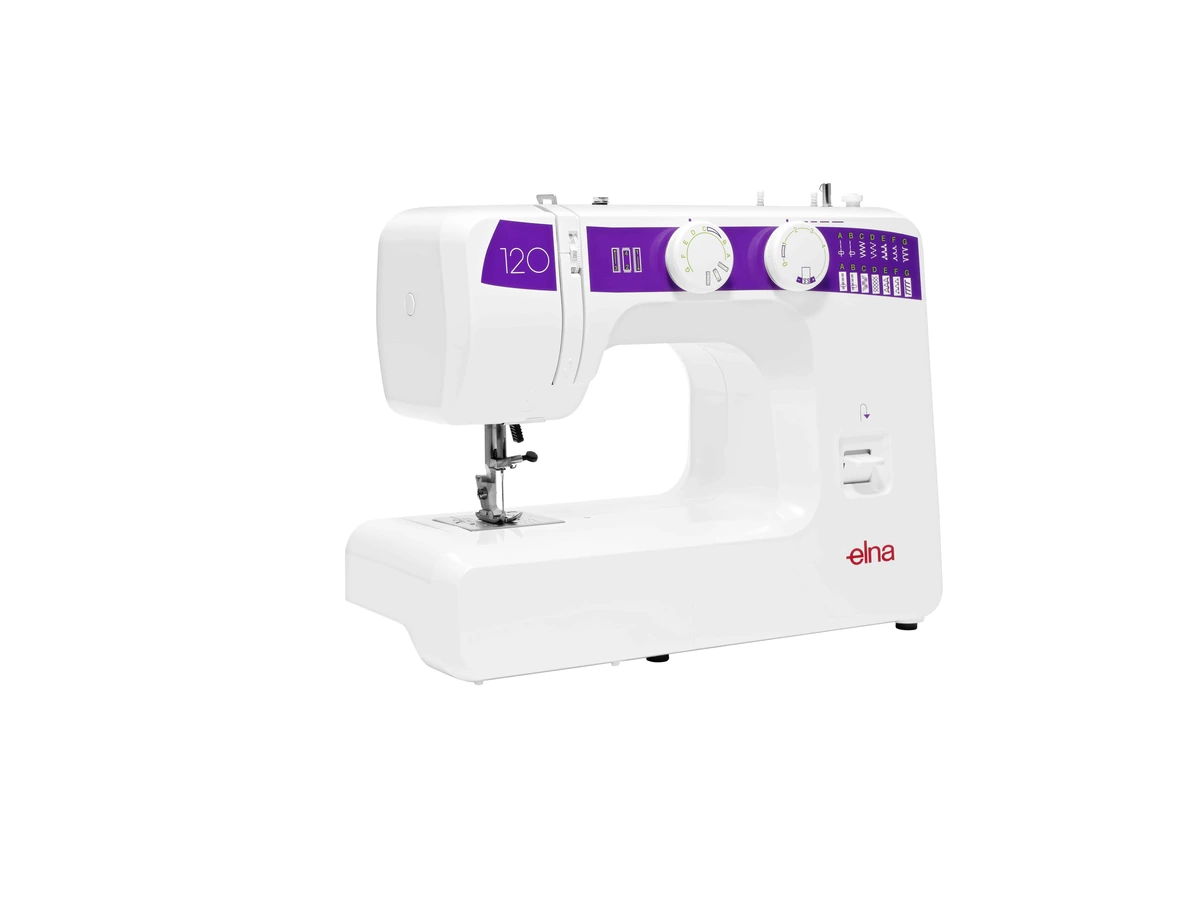
Explore this need in the finder →The Elna eXplore 120 is a mechanical household sewing machine for ordinary seams, hems and repair work. Its current U.S. product page lists 13 stitch patterns, a front-loading bobbin case and one four-step buttonhole. The appeal is not a large feature set; it is a conventional dial-and-pedal routine. The useful caution is that the page gives some settings as “preset,” while its linked manual explains a stitch-length dial. I would not turn an unspecified maximum stitch width into a number.
What the 120 actually offers
The model page identifies a vertical oscillating hook, three-piece feed dog, manual thread tension, clip-on feet, a free arm and 13 stitches. That is enough to describe a practical baseline for garment repairs and simple projects, but it is not evidence of industrial strength or a measured ability to sew a particular thickness. The manufacturer’s stated maximum speed is 800 stitches per minute. The manual says the foot control varies speed; there is no separate limiter listed. A published ceiling does not tell you how easily you can hold a slow pace, so if low-speed control is essential, compare a machine with a distinct speed-limiting control rather than assuming the pedal has one.
The page’s technical table calls maximum stitch width and maximum stitch length preset. The exact linked instruction book nevertheless shows a stitch-length dial and gives a 0.5–4 mm range for applicable settings. That is a real difference between a page summary and the machine’s operating guide. The book resolves that a length setting is adjustable; it does not supply a numerical maximum stitch width in the technical material I reviewed. If your project depends on a specific zigzag width, treat the eXplore 120’s maximum as unconfirmed and ask Elna or a dealer to demonstrate the exact model before making that requirement essential.
A four-step buttonhole takes active attention
The buttonhole is not a button-sized one-step cycle. The manual has you mark the opening, align the sliding buttonhole foot, sew one side, switch the selector for the bartack, reverse direction for the other side, and change again for the final bartack. You need to stop between stages and make a test sample in the same fabric and interfacing as the garment. That is a familiar mechanical routine, but it rewards careful marking and practice. If you sew many buttonholes and want a one-step sequence, the eXplore 120 is the wrong routine to buy around.
Front access has a hands-on bobbin tradeoff
The vertical oscillating hook uses a removable bobbin case accessed from the front, not a clear top-loading drop-in bobbin. Some sewists prefer seeing the bobbin through a clear cover; others are comfortable installing a case and checking its thread path. A case is one more part to handle when changing thread or clearing lint. This configuration also makes the maintenance section worth reading before purchase: Elna shows how to remove the case, clean the shuttle race with a brush and cloth, and clear the feed-dog area. Turn the power off or disconnect it as the manual directs before cleaning. Do not borrow an oiling schedule from a different Elna model.
The standard U.S. accessories are useful for basic clothing work: a standard foot, zipper foot, blind-hem foot, sliding buttonhole foot, darning plate, three bobbins, seam ripper, needle set and foot controller. The product page does not list a walking foot or a separate large extension table. A free arm helps with tubular sections such as cuffs, but it is not a larger quilting opening. For a wide fabric panel, you still need table support around the machine.
Size and practical fit
Elna lists the body at 388 × 295 × 152 mm and 6 kg. The page does not give the needle-to-arm opening, so these body dimensions should not be used to infer how much fabric fits beside the needle. Leave room for the work, pedal and cord. The current product page is the U.S. eXplore 120 listing; a similarly named model or a used machine’s accessory bundle may not match the standard set described here.
Choose the 120 if you mainly need conventional mechanical stitches, are comfortable with front bobbin-case access, and want a straightforward four-step buttonhole. Choose the eXplore 130 if an explicit 5 mm width and a broader 23-pattern selection matter. The eXplore 160 instead offers a top-loading rotary hook, retractable feed dog and clear bobbin cover, with a 700-stitches-per-minute published maximum. These are different tradeoffs, not a simple ranking. Review the exact package and operating guide for whichever model you consider.
Sources: Elna USA’s eXplore 120 product page and its linked instruction book, including the buttonhole and maintenance sections. Checked October 23, 2026.
Key details at a glance
| Motor and stitch controls | Mechanical stitch selector and stitch-length dial; sewing speed varies through the foot control. Elna publishes a maximum of 800 stitches per minute, not a separate speed limiter. |
|---|---|
| Stitch choices and limits | Thirteen patterns. The current page calls maximum width and length preset, while the linked manual shows a stitch-length dial with 0.5–4 mm settings for applicable stitches. A numeric maximum stitch width is not published on this page. |
| Buttonhole routine | One four-step buttonhole; the manual has the operator change settings at each side and bartack rather than finish in an autonomous cycle. |
| Working space and size limits | Body is 388 × 295 × 152 mm and 6 kg. The US page does not give the needle-to-arm opening; allow extra table area for the cloth, cable and pedal. |
| Supplied tools and fabric support | The US page lists standard, zipper, blind-hem and sliding buttonhole feet, darning plate, three bobbins, seam ripper, needle set and foot controller. It does not list a separate large extension table or walking foot. |
| Needle setups, cutting and memory | This is a mechanical bobbin sewing machine with no documented motorized hoop, serger knife, automatic thread cutting, stored patterns or sewn lettering. The single-needle foot-control arrangement is the only affirmative plan used. |
| Presser-foot pressure | A separate presser-pressure control is not established by the exact model page or parts/setting information reviewed; do not treat upper-thread tension as proof of foot-pressure adjustment. |
| Cleaning and lubrication | The linked guide describes removing and cleaning the bobbin case/shuttle race and cleaning lint from the feed dog. Switch off or unplug as directed; do not infer an oiling interval from another model. |
Use the exact model’s instructions for operating limits, supplied equipment and version differences.
Sources for this assessment
Choose the operating routine that suits your work.
Start with whether you sew, embroider, serge or coverstitch, then compare controls, working area, supplied tools and setup limits.