
Your needs, this model
Does it fit your priorities?
Can this one machine sew seams and also stitch a design with a motorized hoop?
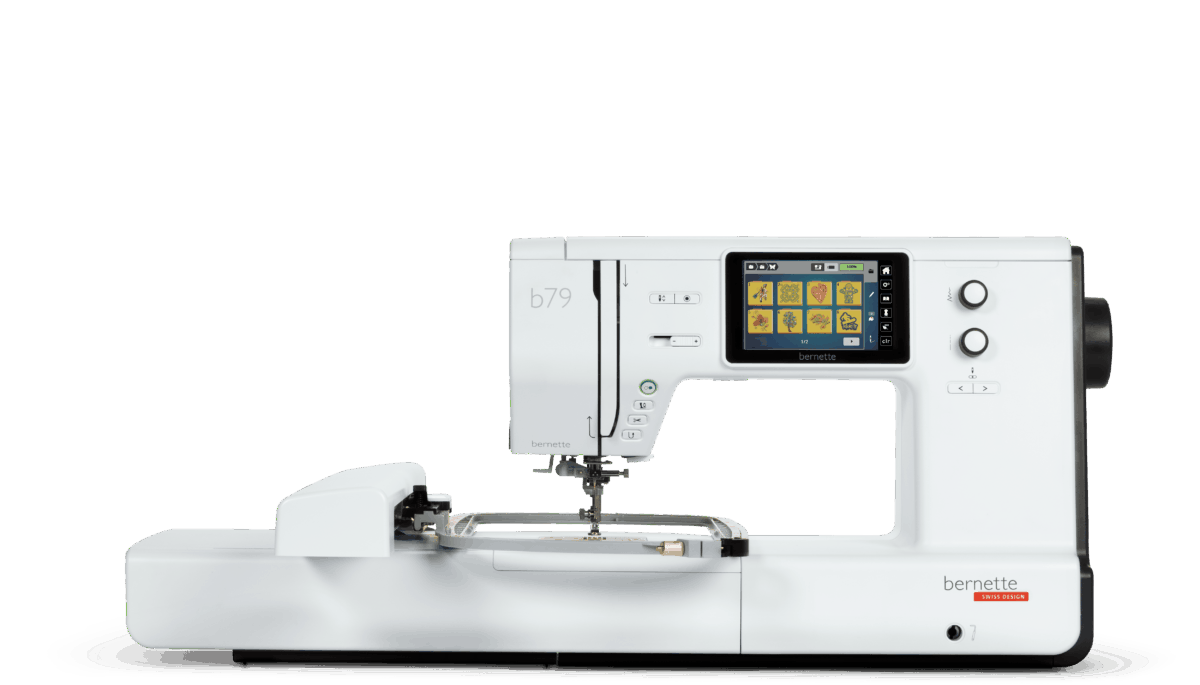
Yes, if you are willing to change modes. Sew with the embroidery unit removed; attach the unit and one of the included hoops for embroidery. The 9.34 kg machine body and 3.65 kg module are separate pieces.
Explore this need in the finder →Must the built-in embroidery library include Harry Potter designs?
No. The standard b79 has 208 general embroidery designs and seven embroidery alphabets, but it is not the Harry Potter library. If those licensed motifs are essential, choose the exact Harry Potter edition instead; the Yaya Han software and extra-foot bundle is a separate edition-specific choice.
Explore this need in the finder →Can the standard b79 embroider an uninterrupted design that needs 250 mm of length?
The included Large hoop is 160 × 260 mm and the stated maximum area is 260 × 160 mm; 250 mm falls within that listed dimension. This does not establish that every design shape or fabric can be hooped at that size.
Explore this need in the finder →Would this be the right choice if I require wireless transfer of designs?
That is not established here. The current page documents USB import, while the reviewed standard manual warns that third-party designs are not guaranteed. Test a real file and do not treat USB as wireless.
Explore this need in the finder →Can the module stay attached for free-arm sewing?
No. The model uses a separate embroidery arrangement; use the b79 body with the module removed for the free arm and tubular work.
Explore this need in the finder →Do I get a detachable walking foot in the standard package?
No detachable walking foot is listed. The model has bernette Dual Feed integrated in the machine; it moves fabric from above and below together, but it is not the same accessory.
Explore this need in the finder →Will your design require more than 260 mm of embroidery length?
The standard b79 maximum is 260 × 160 mm, so a 270 mm embroidery-length essential need does not fit this exact setup. A separate model with a documented multi-position hoop may handle a longer arrangement, but that is not the standard b79 Large hoop.
Explore this need in the finder →The standard bernette 79 is a computerized home sewing machine that also runs a motorized embroidery module. It has two different setups, not a sewing mode that works normally while the hoop arm is attached. The standard U.S. package lists 208 embroidery designs, seven embroidery alphabets and three hoops. It is distinct from the Harry Potter and Yaya Han editions, which have different libraries and bundled extras. This assessment uses the exact U.S. model page, linked standard manual and current U.S. brochure; it is not a hands-on test.
Plan for the mode change
For ordinary sewing, remove the embroidery unit. The b79 then has its 230 mm (9-inch) opening to the right of the needle, a free arm and the slide-on table for larger flat work. Hoop embroidery requires attaching the separate module, choosing one of the S, M or L hoops and stabilizing the material. With the module attached, the free arm is not the setup for a sleeve or trouser leg. The manual lists the machine body at 9.34 kg and the separate module at 3.65 kg, so plan both for storage and handling.
The standard b79 is for mixed work
The 2026 U.S. brochure confirms 500 total stitch patterns including the alphabet, with three sewing alphabets; the product page also lists 500 stitches. A five-inch color screen, multifunction knobs, needle-up/down, a speed slider and Start/Stop let you sew without relying only on the foot pedal. Maximum sewing speed is 1,000 stitches per minute; embroidery tops out at 850. The sewing speed ceiling can be reduced for controlled work. The product page and brochure group 17 buttonholes/eyelets, but that is not 17 distinct buttonhole styles: the page also refers to eyelets and a button-sewing program. The manual supports a one-step buttonhole that secures and stops.
Integrated bernette Dual Feed moves fabric from above and below together. That can help with slippery, stretchy or layered material and pattern repeats; it is not a detachable walking foot. The standard package lists ten presser-foot soles, not a separate walking foot. You still need the right needle, stitch and foot, and a test on the actual fabric. Adjustable presser-foot pressure is separate from upper-thread tension. Drop-feed and the free arm add sewing options, but do not turn the b79 into a serger or dedicated longarm.
Embroidery: a useful field, with a USB qualification
The included hoops measure 50 × 70, 120 × 180 and 160 × 260 mm. The maximum embroidery area is 260 × 160 mm; a 250 mm design length is within that listed dimension, while 270 mm is not. A maximum rectangle does not guarantee every design shape or fabric will fit, so check the on-screen boundary and test on the same stabilizer and material. The screen can rotate, mirror, resize and combine designs. The current product page lists common embroidery formats and USB import, but the manual warns that files not created or converted with BERNINA software are not guaranteed to read and embroider correctly. Bring an existing PES, DST or other third-party file to a dealer to test it. The exact reviewed sources do not establish wireless transfer.
Compare the bundles, not just the chassis
The standard b79 is the base 208-design package. The Harry Potter model is a separate product with a themed library; the Yaya Han edition lists 276 designs, BERNINA Embroidery Software 9 Creator and eight additional presser feet. Do not assign either edition's library or extras to the standard machine. If a named collection or software bundle is essential, choose that exact edition and confirm the seller's box contents. The current U.S. brochure lists ten standard foot soles, an embroidery module, three hoops, foot control, knee lever and large extension table for the standard b79. The manual's dimensions are 509 × 200 × 315 mm without the module and 710 × 475 × 315 mm with it. Keep table clearance for the moving arm.
Who should shortlist it?
Consider the standard b79 if both regular sewing and hoop embroidery will see use, you want a field up to 260 × 160 mm, and you accept a setup change, stabilizer and USB-based workflow. The questionnaire choices affect the result: hoop embroidery rules out sewing-only models; a 270 mm embroidery minimum excludes this b79; a required Harry Potter or Yaya bundle excludes the standard package. If embroidery is only a rare possibility, compare a sewing-only model such as the b38 or b08 before storing a module you will seldom use. If wireless transfer is essential, compare the b59 review rather than assuming the standard b79 offers an app route. Our combination-machine guide explains why format, hoop, workspace and mode change belong in one decision.
The manual says cleaning intervals vary with fabric and thread, gives a cleaning reminder at 500,000 stitches and a service reminder at four million stitches since service, and calls for needle-bar oiling every six months with frequent use. These are reminders rather than substitutes for routine care. Switch off and unplug before cleaning or oiling, then follow the manual's detailed steps.
Sources: exact U.S. bernette 79 page, standard b79 support/manual links, its linked English manual, and the official 2026 U.S. b70-series brochure. The page FAQ and brochure disagree on some stitch-category counts, so only their shared total of 500 is used. The manufacturer does not identify the product image as a photograph or render.
Key details at a glance
| Motor and stitch controls | Computerized b79 with 5-inch color touchscreen, multifunction knobs, separate speed control, needle up/down, foot-control sewing and a Start/Stop option. The manual lists separate sewing and embroidery arrangements. |
|---|---|
| Stitch choices and limits | The 2026 U.S. brochure confirms 500 total sewing stitch patterns including alphabet, plus three sewing alphabets; the current U.S. product page likewise lists 500 stitches. Its FAQ and the brochure disagree on some stitch-category breakdowns (including quilting and utility subsets), so this assessment uses the supported 500 total and does not assign a conflicting quilting subset. Maximum width is 7 mm and maximum length 5 mm in the supported single-needle setup. |
| Buttonhole routine | The current page and 2026 U.S. brochure group 17 buttonholes/eyelets; the page FAQ further notes a button-sewing program, and the manual handles buttonholes, eyelets and button sewing separately. Keep the number of distinct buttonhole styles unresolved. The manual supports a one-step routine that secures and stops. |
| Working space and size limits | The manual states 230 mm (9 inches) to the right of the needle for sewing; it separately gives a maximum embroidery area of 260 × 160 mm. The included Large hoop is 160 × 260 mm. These are different limits, and the standard package does not include a multi-position hoop. |
| Supplied tools and fabric support | The exact current U.S. page lists 10 presser-foot soles; the standard-model manual names the foot control, slide-on table, knee lifter and Large 160 × 260, Medium 120 × 180 and Small 50 × 70 mm hoops with templates. The 2026 U.S. brochure also lists the embroidery module and three hoops. Confirm the exact seller package and machine condition; a combined-feed mechanism is not a detachable walking foot. |
| Needle setups, cutting and memory | Use the sewing machine with embroidery module removed for tubular seams and ordinary sewing. Embroidery requires the attached module, selected hoop, appropriate stabilizer and a suitable test sample. The current page lists USB import and multiple common embroidery formats; the manual says it cannot guarantee designs not made or converted with BERNINA software. No wireless/app transfer is established by the exact reviewed sources. Sewing thread cutter is a user control, not a promise to cut every seam automatically. |
| Presser-foot pressure | The current U.S. model feature table and 2026 brochure list adjustable presser-foot pressure. Use the exact manual and test fabric to set pressure; it is not thread tension. |
| Cleaning and lubrication | The exact b79 manual says cleaning intervals depend on fabric and thread; it gives a cleaning reminder after 500,000 stitches and service reminder after four million stitches since service. If used frequently, it calls for needle-bar oiling every six months. Switch off and unplug for cleaning/oiling and follow its detailed steps; the reminders do not replace care. |
Use the exact model’s instructions for operating limits, supplied equipment and version differences.
Sources for this assessment
- Exact current U.S. standard bernette 79 model page
- Exact b79 support page linking the standard-model English manual and current 2026 U.S. b70-series brochure
- 2023-06 standard bernette 79 English user manual linked by the standard support page; its identical original bytes were reused from the existing b79 family archive, not downloaded again
- Official b79 English HTML manual index and individually selected standard b79 chapters for accessories, maximum speed, foot control, sewing, twin needle, embroidery, file types, hooping and care
- Current official 2026 U.S. bernette b70-series brochure, including the b79 comparison table
- Current U.S. bernette model directory listing standard b79 separately from the two b79 editions
- Exact manufacturer product-gallery PNG for the standard b79, shown with the embroidery module attached

Choose the operating routine that suits your work.
Start with whether you sew, embroider, serge or coverstitch, then compare controls, working area, supplied tools and setup limits.