
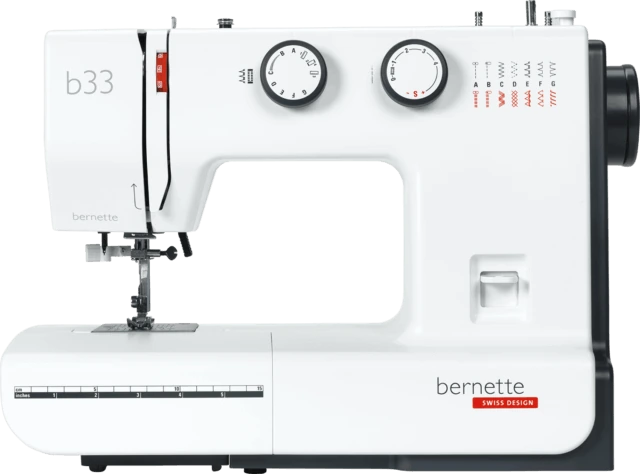
Your needs, this model
Does it fit your priorities?
Can I have a mechanical machine with a front-loading bobbin and a four-step buttonhole?
Yes. The b33 has mechanical pattern and length dials, a front-loading bobbin case and the documented four-step routine in its single-needle setup.
Explore this need in the finder →Does the b33 provide an automatic one-step buttonhole routine?
No. Its documented buttonhole requires switching the selector among the four stages.
Explore this need in the finder →Can I sew without using a foot pedal?
No documented button-operated setup meets this requirement. The guide varies motor speed through the foot control, and the current comparison table marks start/stop operation unavailable.
Explore this need in the finder →The bernette 33 is a mechanical sewing machine for someone who wants to learn with a small, visible set of controls. It supplies 15 stitch patterns, a front-loading bobbin and a four-step buttonhole. Its strongest argument is an uncomplicated working layout for seams, repairs and small projects. Its main compromise is that you do more of the stopping, positioning and buttonhole sequencing yourself than on the electronic models farther up the same series.
Two knobs keep the choices visible
The front dials select a stitch pattern and its length, with a separate upper-thread tension dial near the sewing head. The maximum stitch width is 5 mm and maximum stitch length is 4 mm. A maximum-width specification does not give the b33 the independent stitch-width knob found on the bernette 35. Check the actual control layout if you expect to tune a zigzag's width independently rather than select one of the machine's patterns.
The stitch set includes straight stitching, zigzag, stretch patterns and blindstitch options. That is a useful foundation for learning how fabric, needle and tension interact. It is not necessary to begin with hundreds of decorative patterns. Equally, a small stitch list will feel restrictive if lettering or stored decorative sequences are central to your projects. Those are stronger reasons to compare another machine than an ambition to own the highest stitch count.
Speed comes from the foot control: pressing farther makes the machine run faster. The manufacturer's comparison table lists a maximum of 860 stitches per minute, but there is no separate speed-limiting slider. A beginner who wants to limit the top speed while pressing the pedal fully should compare the bernette 37. Fewer electronic controls do not automatically make foot coordination easier for every learner.
Expect to participate in each buttonhole
The four-step buttonhole is the clearest practical distinction from the b35. You mark the opening on the fabric, sew a side, switch the selector for a bartack, change it for the other side and finish the remaining bartack. You are responsible for following the marked length and changing the setting at the right points. This can be a reasonable learning exercise on occasional repairs; it becomes more repetitive across a row of shirt buttons.
Use a sample matching the garment's fabric, interfacing and layers before cutting a real buttonhole. The supplied sliding buttonhole foot assists alignment, but it does not turn the procedure into the b35's automatic one-step cycle. If you expect to sew button-front clothing regularly, that difference can matter more than the eight additional patterns on the b35.
The b33 also has a mechanical needle-threading aid and a manual thread cutter. The aid still involves positioning the needle and guiding the thread through its hook; it is not powered automatic threading. At corners, use the handwheel to lower the needle before lifting the presser foot and turning the fabric. There is no programmable needle-stop button to do that positioning for you.
The bobbin and maintenance routine are part of the choice
This is a front-loading bobbin machine. Remove the small sewing table, open the cover and take out the bobbin case by its latch. Learning to seat and thread that case correctly is part of setup. If you strongly prefer viewing and changing a bobbin through a top cover, the b37's drop-in arrangement is a materially different option.
The removable sewing table exposes a free arm for sleeves and trouser legs. The series comparison gives 170 mm of space to the right of the needle. That is useful working room for ordinary garments, but it is not a promise that a bulky finished quilt will pass comfortably through every stage of quilting. Plan support for the fabric around the machine rather than letting a large project pull against the needle.
Five snap-on presser feet are supplied: the basic zigzag foot, sliding buttonhole foot, blindstitch foot, zipper foot and button-sewing foot. Do not count every compatible accessory on the website as included. The guide also describes lowering the feed dog, cleaning the bobbin case and shuttle race, and applying one or two drops of suitable sewing-machine oil at the indicated shuttle location. Unplug first, follow the illustrated disassembly and remove excess oil before it reaches fabric.
A useful basic machine when its manual steps suit you
Choose the b33 for occasional mending, straightforward garments and learning with knobs when a four-step buttonhole and foot-controlled speed feel comfortable. Its fabric chart includes denim and heavier materials with appropriate needles and thread, but that is not a guarantee for an arbitrary stack of thick seams. Test the real material and avoid pulling it through the machine.
Choose the b35 for an automatic one-step buttonhole and separate width control. Choose the b37 for a speed slider, pedal-free start/stop operation and a selectable needle-stop position. If adjustable presser-foot pressure or automatic thread cutting is essential, the bernette 38 documents those controls clearly. The b33 is most appealing when its simpler setup is the routine you actually want, rather than a collection of functions you expect to add later.
Key details at a glance
| Motor and stitch controls | Mechanical stitch-selection dials; speed varies through the foot pedal without an independent speed limiter. |
|---|---|
| Stitch choices and limits | 15 total patterns. Single-needle maximum width 5 mm and length 4 mm; specific stitches and twin-needle setup have smaller or separately restricted ranges. |
| Buttonhole routine | Four-step buttonhole with manual stage changes. |
| Working space and size limits | 170 mm of stated space to the right of the needle. An extension table supports fabric around the machine and does not enlarge this opening. Body width and machine weight remain unconfirmed here. |
| Supplied tools and fabric support | 5 standard feet. Large extension table and walking foot are not supplied in this assessed standard package. |
| Needle setups, cutting and memory | A manual cutter and no stored lettering or combinations. Twin-needle support does not establish a full-width twin stitch. |
| Presser-foot pressure | Pressure adjustment is unresolved: the current US b33 narrative says adjustable, while the current 2026 comparison table explicitly marks it unavailable and the exact guide does not identify a pressure dial. Confirm the actual control before buying for this requirement. |
| Cleaning and lubrication | Follow the exact guide for lint cleaning and the indicated shuttle-race oiling: one or two drops of appropriate machine oil, with excess removed. Unplug before illustrated disassembly. |
Use the exact model’s instructions for operating limits, supplied equipment and version differences.
Sources for this assessment
Choose the operating routine that suits your work.
Start with whether you sew, embroider, serge or coverstitch, then compare controls, working area, supplied tools and setup limits.