
Your needs, this model
Does it fit your priorities?
Can I use computerized controls, integrated upper feed and adjustable presser pressure for ordinary single-needle sewing?
Yes. The exact model page and manual identify the quilt ambition 635 as a computerized sewing machine with Original IDT top-and-bottom feed, adjustable presser pressure and a single-needle sewing plan. It is not a hoop-embroidery or serger setup.
Explore this need in the finder →Can I sew without the foot pedal and keep the maximum speed limited?
Yes. The model-specific guide documents Start/Stop operation without the foot control and a separate speed-control lever that sets the maximum sewing speed. The machine remains connected to household mains power.
Explore this need in the finder →Does the quilt ambition 635 place designs with a motorized embroidery hoop?
No. The current exact product page and 44-page manual describe a sewing machine, sewing alphabets and no embroidery module or motorized-hoop mode. Its sewn lettering is not embroidery.
Explore this need in the finder →Can I require an 8 mm maximum stitch width in the confirmed single-needle arrangement?
No. The exact product page specification says 7 mm maximum width. Its FAQ contains a conflicting Stitch Creator/9 mm statement, which is not relied on; confirm with PFAFF if that feature is essential.
Explore this need in the finder →Is an extension table confirmed in the exact standard package?
It is not confirmed. The product page's included-accessory list does not name an extension table, while gallery media separately labels an extension-table bundle; check the exact seller SKU and box contents before relying on one.
Explore this need in the finder →Can I require automatic thread cutting proven for thread finer than size 30?
No such fine-thread limit is established. The guide documents an operator-activated cutter button and end-of-stitch/sequence cutting, but does not specify a supported fine-thread threshold.
Explore this need in the finder →Does the one-step buttonhole routine stop when a buttonhole is complete?
Yes. The manual describes a button-sized one-step buttonhole routine and proceeds to lift the foot after the machine has sewn the buttonhole; practice on a stabilized scrap first.
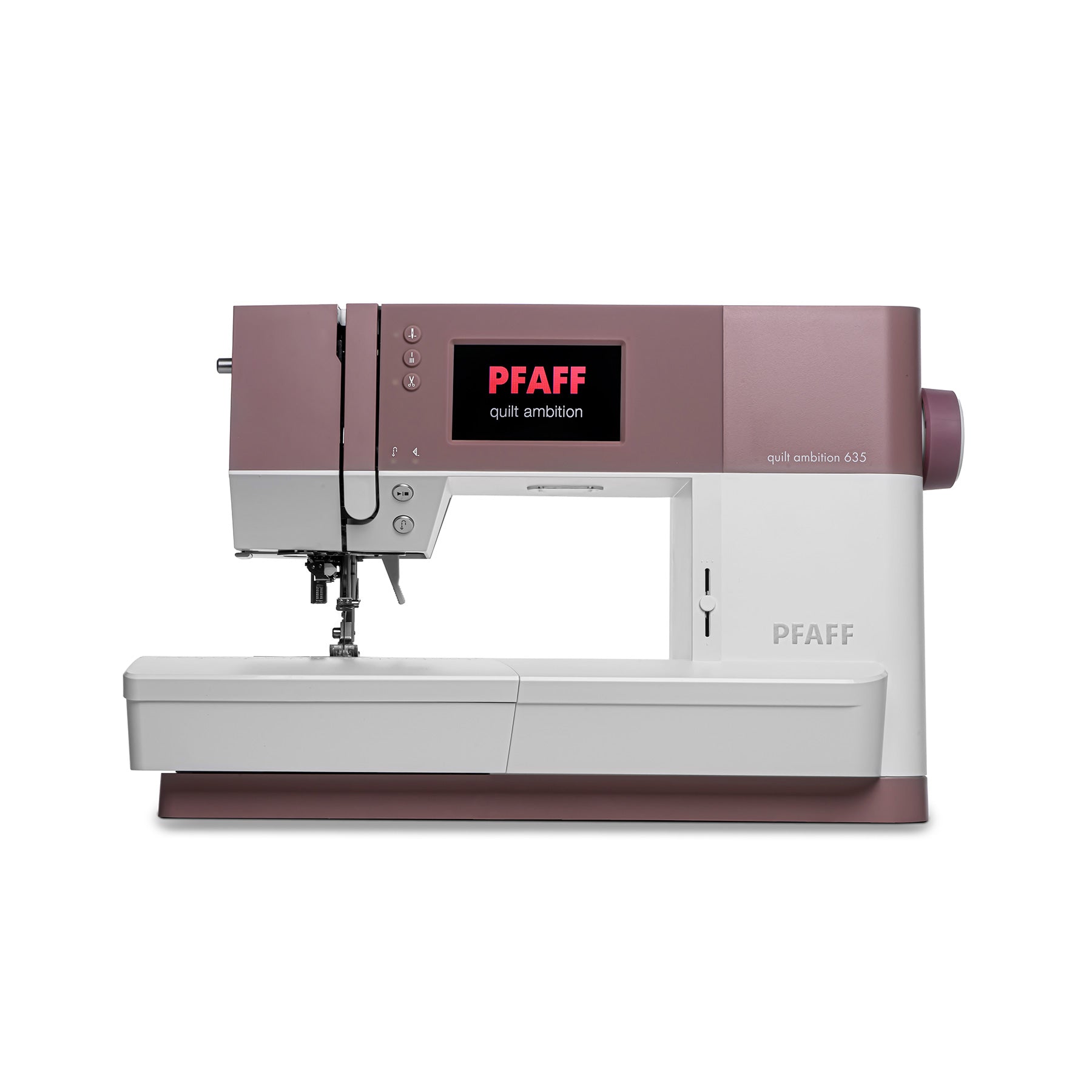
Explore this need in the finder →The PFAFF quilt ambition 635 is a computerized sewing-only machine for someone who wants a quilting and garment-sewing routine, integrated upper feed, stitch choices on a color touch screen, and more room than a compact starter machine. It has PFAFF’s Original IDT feed, 200 mm of space to the right of the needle, adjustable presser pressure, and a supplied quarter-inch quilting foot. It does not embroider with a motorized hoop, and it is not a longarm or a serger.
Choose it for steady household sewing and piecing
The IDT system feeds fabric from above and below at the same time. The manual describes it as a way to reduce layers shifting when sewing quilts and plaids, and it can help with matching seams or feeding lighter materials. It is a built-in feed system, not a detachable walking foot, and it cannot guarantee an ideal result on every thickness or fabric. Select a compatible IDT foot, needle and stitch, and sew a sample with the same layers before committing a long seam.
The 200 mm opening gives room for a quilt sandwich or home-decor panel, but you still guide rolled fabric through a conventional flatbed machine. It has a free arm and drop-feed for free-motion work. The manual says to move the fabric by hand and names an open-toe free-motion foot as optional; the standard package lists an “Embroidery/Free-Motion” foot, so confirm the toe style if that setup is essential.
Computerized controls without the embroidery workflow
The product page lists 201 stitches, 7 mm maximum width, 5 mm maximum length, a 4.3-inch diagonal color screen, two sewing fonts, a semi-automatic needle threader, needle up/down, a speed slider and Start/Stop. The manual confirms button operation without a foot control and an 800-stitches-per-minute maximum. A foot control is also included.
The stitch count needs context: six patterns numbered 196–201 require optional presser feet. Two alphabets, Block and Cyrillic, produce sewn letters rather than embroidery. A product-page FAQ claims Stitch Creator and custom 9 mm stitches, but its specification table says 7 mm and the model guide does not establish Stitch Creator. Treat 7 mm as the supported maximum; confirm with PFAFF if custom 9 mm design is essential.
Buttonholes, needle choices and package limits
A button holder on the one-step buttonhole foot sets the buttonhole length; the guide says it can sew buttonholes up to 25 mm. It identifies seven buttonhole patterns in the stitch overview, including eyelet buttonholes, and instructs you to stabilize the fabric and test on a scrap. The automatic sequence is convenient, but buttonholes still call for careful positioning and a test before cutting. A twin-needle program is also documented; it narrows allowed stitch width to the selected needle spacing, so the single-needle 7 mm maximum must not be carried into every twin-needle setup.
The standard included list names IDT feet, zipper and blindhem feet, a one-step buttonhole foot, quarter-inch quilting foot, bobbins, needles, tools, foot control and cover. It does not name a detachable walking foot. Extension-table bundle imagery appears on the page, but the included list does not settle whether the base seller box contains the table. Ask for the exact SKU and package contents rather than relying on a gallery image.
Space, weight and care
The 2023 user guide gives body dimensions of 480 × 193 × 300 mm and a machine weight of 8.8 kg. That is portable enough to move between sessions if needed, but it is not a featherweight travel machine. Keep a stable table and room for fabric beside the needle; an extension table would add support outside the 200 mm opening but would not widen that opening. The machine is intended for 100–240 V household power, and its supplied foot control is model C-9000.
Care is relatively uncomplicated but not maintenance-free. PFAFF says no oiling is needed. The guide calls for regular lint removal from the feed teeth and bobbin area, with the machine switched off and unplugged before cleaning; it cautions against blowing air into the bobbin area. If you routinely sew linty fabrics, clean more often and follow the model-specific steps rather than relying on a generic sewing-machine routine.
Who should shortlist it?
Shortlist the quilt ambition 635 if you want a computerized single-needle machine with integrated dual feed for ordinary seams and quilting, and you can work within a 200 mm opening and the 7 mm published width. The speed slider, button operation, drop-in bobbin, adjustable pressure and named quilting foot make a more considered routine than a bare mechanical model, without adding a separate embroidery unit. It is a poor fit if motorized hoop embroidery, a confirmed included extension table, a supplied detachable walking foot, pedal-free sewing without mains power, or a much larger quilting opening is essential.
If you need more confirmed arm clearance and an included extension table, compare the bernette 77, whose reviewed package and 230 mm opening differ in those specific ways. If you want actual embroidery rather than the PFAFF’s sewn alphabets, see the PFAFF creative icon 3; it is a separate sewing-and-embroidery combination with a much larger machine and a different setup. Neither alternative replaces checking the seller’s current stock, warranty, or exact package.
Sources: the exact U.S. PFAFF quilt ambition 635 product page, SKU 850354112 and the model-specific English user guide 4711367-26B. Reviewed October 24, 2026; this is a source-based assessment, not a hands-on test.
Key details at a glance
| Motor and stitch controls | Computerized PFAFF household sewing machine. The exact U.S. product page lists a color touch screen, foot control, Start/Stop button, separate speed slider, needle up/down, built-in semi-automatic needle threader and automatic tension. The manual confirms Start/Stop can run without the foot control; this remains a mains-powered arrangement. |
|---|---|
| Stitch choices and limits | The product page specification table states 201 stitches, 7 mm maximum width and 5 mm maximum length; the model guide lists two alphabets (Block and Cyrillic). The manual's chart shows patterns 196–201 require optional presser feet. The same product page FAQ conflicts by referring to Stitch Creator and custom 9 mm stitches; the exact guide does not establish that feature, so 7 mm is the supported published width. |
| Buttonhole routine | The 44-page model-specific guide lists seven buttonhole patterns (including eyelet buttonholes) and describes a one-step buttonhole foot whose button holder sets buttonhole length, up to 25 mm. It instructs the user to stabilize the fabric and sew a test. Do not interpret the count as seven equally suitable styles for every garment. |
| Working space and size limits | The exact U.S. product page gives nearly 200 mm (7.9 in) from needle to tower. The manual technical table gives machine body length 480 mm, width 193 mm, height 300 mm and net mass 8.8 kg. This is a conventional flatbed opening, not a longarm frame. |
| Supplied tools and fabric support | The product-page included list names several IDT feet, zipper/blindhem/buttonhole feet, a 1/4-inch quilting foot, needles, bobbins, tools, foot control and cover. It does not name a detachable walking foot. It does not settle whether the base package includes an extension table; separate gallery images label an extension-table bundle, so that package fact remains null and seller box contents need confirmation. |
| Needle setups, cutting and memory | The model is a conventional computerized lockstitch sewing machine with a single-needle plan; twin-needle selection is documented with an on-screen width program, which limits stitch width for the chosen twin needle. No motorized embroidery, serger-overlock, coverstitch or dedicated longarm setup is established. Sewn alphabets are not hoop embroidery. |
| Presser-foot pressure | The manual documents a presser-foot pressure dial and advises lowering pressure for very light fabrics or increasing it for heavier fabrics; this is distinct from thread-tension adjustment. |
| Cleaning and lubrication | The model guide says oiling is not needed. It directs frequent lint cleaning, including the feed teeth and bobbin area, with the machine off/unplugged; it warns not to blow air into the bobbin area. |
Use the exact model’s instructions for operating limits, supplied equipment and version differences.
Sources for this assessment
- Exact U.S. PFAFF quilt ambition 635 product page, SKU 850354112
- Exact model English PFAFF quilt ambition 635 user guide 4711367-26B, 44 pages, ©2023
- Official U.S. manual directory with the exact quilt ambition 635 guide and product-page links
- Previously archived current U.S. PFAFF directory; the quilt ambition 635 card and exact product handle were personally inspected
- Exact official product image from the quilt ambition 635 U.S. product page

Choose the operating routine that suits your work.
Start with whether you sew, embroider, serge or coverstitch, then compare controls, working area, supplied tools and setup limits.