
Your needs, this model
Does it fit your priorities?
Does one machine for sewing and quilting with a pedal-free option matter?
The b77 is a sewing-and-quilting machine; its foot control can be disconnected for Start/Stop sewing. It is not a motorized embroidery setup.
Explore this need in the finder →Must this machine place a design with a motorized embroidery hoop?
No. The b77's documented role is sewing and quilting. Its decorative stitches and sewing alphabets are not embroidery; choose an exact sewing-and-embroidery model if hoop work is essential.
Explore this need in the finder →Do I need a one-step buttonhole that secures and stops at completion?
The exact manual describes the automatic one-step buttonhole sequence, which sews a securing stitch and stops after the buttonhole. The stitch count includes eyelets and is not a count of distinct everyday buttonhole shapes.
Explore this need in the finder →Is a removable walking-foot accessory essential, rather than integrated upper feed?
The b77 has integrated Dual Feed, but no detachable walking foot is listed in its eight-foot package. Requiring the separate accessory excludes this exact package.
Explore this need in the finder →Can the b77 meet a 230 mm workspace, at least 7 mm stitch width, upper-feed and 9.5 kg body ceiling in one single-needle sewing setup?
Yes according to the exact single-needle b77 sewing configuration: 230 mm workspace, 7 mm width, integrated Dual Feed and 9.21 kg body weight. The 9.5 kg ceiling applies to the machine body, not its separate table or storage accessories.
Explore this need in the finder →Will the automatic cutter be available if I require a twin-needle setup?
That combination is not established. The manual's twin-needle procedure restricts the setup to a centered straight stitch and does not document the single-needle cutter arrangement there; unknown does not meet an essential cutting requirement.
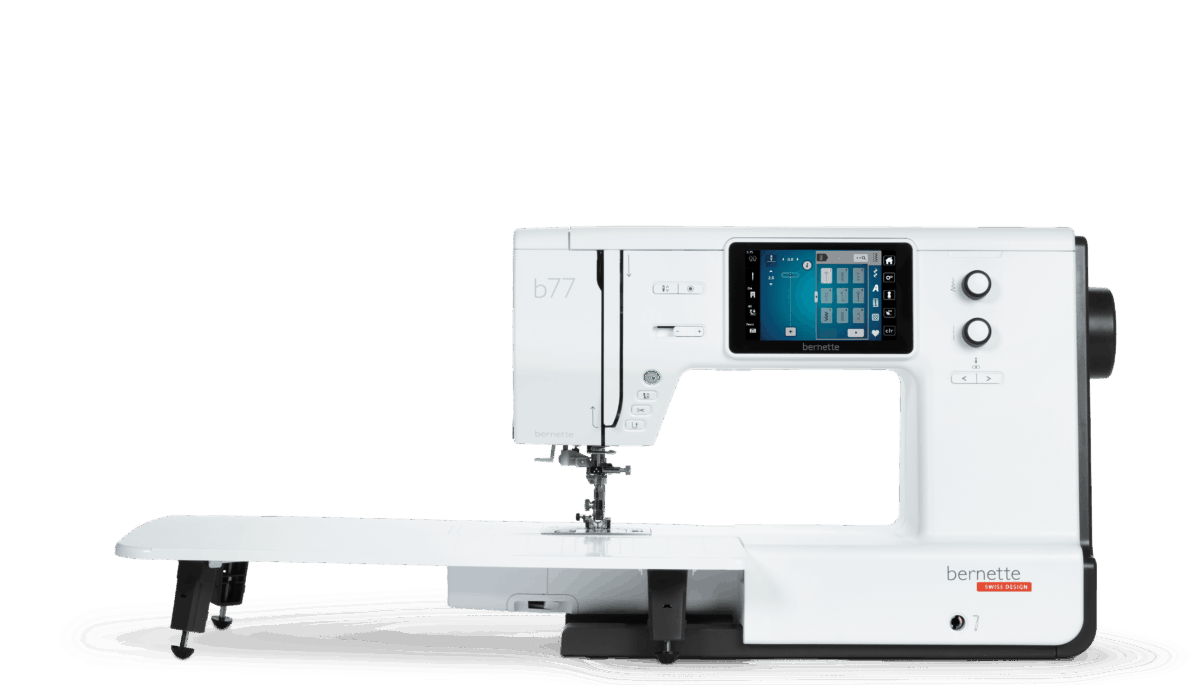
Explore this need in the finder →The bernette 77 is a computerized household sewing machine for ordinary sewing and quilting, not a combination sewing-and-embroidery unit. Its current U.S. page lists a five-inch color touchscreen, 500 sewing stitches, integrated bernette Dual Feed, a 230 mm opening to the right of the needle, and eight supplied presser-foot soles. This is a source-based assessment of the listed configuration, not a hands-on test; confirm the exact seller's package and condition before buying.
A roomy sewing machine, not a smaller b79
The b77 shares the b70-series screen-and-control style with the b79, but its job is narrower. The 2026 U.S. brochure describes the b77 as the sewing-only model; the b79 adds an embroidery module and motorized hoop work, while the b70 DECO is embroidery-only. The b77's screen can create decorative stitches and lettering, but those are sewn under the operator's control, not designs placed by an embroidery hoop. If hoop embroidery is essential, compare the exact b79 packages rather than assuming an accessory can turn this b77 into one.
For sewing, 230 mm (about 9 inches) of space to the right of the needle gives quilts and larger flat projects room beside the needle. It is not a longarm frame: you still support and maneuver the quilt. The free arm and slide-on table serve different jobs—the arm helps with tubular pieces, while the table supports broad work. A separate large extension table is listed as included, but a used or open-box package should be checked item by item. The smaller sewing-only bernette 38 has a listed 170 mm throat.
Dual Feed is useful, with a specific meaning
The integrated Dual Feed moves fabric from above and below together. The b77 manual names difficult fabrics such as knits, fleece, velvet, coated cloth and batting, as well as matched checks and stripes, as possible applications. That makes it relevant to quilting, garments and layered home projects, but it is not a promise every fabric stack will feed perfectly. Needle, stitch, foot, fabric thickness and presser-foot pressure still matter; test the actual layers before a visible seam.
Dual Feed is not a detachable walking foot. It is built into the machine and must be engaged as instructed. The standard page lists eight foot soles but does not list a separate walking-foot accessory in the package. If receiving a removable walking foot is essential, reject the b77 even if its integrated system may address some of the same feeding problems. The manual also distinguishes adjustable presser-foot pressure from upper-thread tension and gives guidance for changing pressure with fabric thickness.
Computerized conveniences are not automatic sewing
The touchscreen, multifunction knobs and sewing consultant offer on-machine guidance. A speed-control slider, needle up/down, Start/Stop button and programmable foot control with a heel/back-kick action give options beyond sewing only by pedal. Maximum published sewing speed is 1,000 stitches per minute; the manual explains how to lower the speed ceiling. This is a configurable limit, not a separate slow-speed motor.
The b77 lists an automatic thread cutter, but that does not mean it cuts every seam without an action. The manual shows a cutter button and allows a programmed heel action to secure stitches and cut thread together. Buttonholes use a separate routine: with the included buttonhole foot, the one-step sequence sews a securing finish and stops when complete. The brochure lists 17 buttonholes including eyelets; that figure should not be read as 17 ordinary buttonhole shapes. Test the selected stitch on the actual fabric before relying on it for a garment.
The 500 stitch patterns include practical, decorative and quilting selections plus three sewing alphabets in the series brochure. Maximum width is 7 mm and length is 5 mm in the standard single-needle setup. Those limits suit many garment and piecing tasks; verify a particular stitch, foot and plate combination rather than infer compatibility from the screen or total stitch count.
Storage and care are part of the decision
The English manual lists the machine body at 509 × 200 × 315 mm and 9.21 kg, before the project or separate table is added. It is a substantial unit to move often. The model page lists the extension table, slide-on table, knee lifter, foot control, dust cover and eight foot soles; check those items in any secondhand package. This powered, computerized machine is not the basic unpowered model for someone who wants mechanical dials.
Computerized controls do not eliminate routine care. The manual says cleaning intervals depend on fabric and thread, gives a cleaning reminder after 500,000 stitches and a service reminder after four million stitches since service. Treat those as reminders, not permission to ignore lint or oiling instructions. Switch off and unplug before cleaning, and follow the manual's bobbin-area and needle-bar procedures.
How questionnaire choices change the shortlist
Requirements for general sewing, computerized controls, a 230 mm workspace, adjustable presser-foot pressure or integrated upper feed can favor the b77's sewing plan. A pedal-free Start/Stop option can fit that same plan. Choosing motorized-hoop embroidery excludes it; requiring a detachable walking foot also excludes it because that package is not established. A stricter size or weight limit may remove it even when its stitch features fit. Match the needs to one operating setup rather than collecting capabilities from unrelated machines.
Shortlist the b77 when sewing and quilting are the actual work, the broad workspace and integrated feed matter, and you do not need hoop embroidery. Compare the b79 if embroidery is essential, and compare the smaller sewing-only bernette 38 if a narrower opening and simpler package suit your projects better. If fabric performance or a particular included foot decides the purchase, test the intended layers with a dealer and verify the exact box contents.
Sources: the exact U.S. bernette 77 page, its official support page and linked English HTML manual, and the already archived official 2026 U.S. b70-series brochure (b77 description and comparison table). The manufacturer does not say whether its product image is a camera photograph or a rendering.
Key details at a glance
| Motor and stitch controls | Computerized b77 with a 5-inch color touchscreen, multifunction knobs, a sewing consultant, Start/Stop option, foot control with programmable heel action, and reduced maximum-speed setting. Its listed product role is sewing and quilting only; a sewing screen and alphabet are not a motorized embroidery setup. |
|---|---|
| Stitch choices and limits | The 2026 U.S. b70-series brochure gives 500 total sewing patterns including 22 utility stitches, 133 decorative stitches, three sewing alphabets, 35 quilting stitches and 17 buttonholes including eyelets. Maximum single-needle width is 7 mm, maximum stitch length 5 mm, and maximum sewing speed 1,000 stitches/minute. The buttonhole category count is not interpreted as the number of ordinary buttonhole shapes. |
| Buttonhole routine | The exact English manual describes a one-step automatic buttonhole routine using the slide-type buttonhole foot, with a securing stitch and automatic stop when complete. Test the selected stitch and fabric before production use. |
| Working space and size limits | The exact model page and 2026 brochure state 230 mm (9 inches) of space to the right of the needle. Manual technical data give body dimensions 509 × 200 × 315 mm and body weight 9.21 kg. This sewing opening is not a quilting frame or longarm throat. |
| Supplied tools and fabric support | The product page lists eight presser-foot soles, large extension table, slide-on table, knee lifter, foot control and cover among included equipment. A used or open-box unit may lack accessories, so verify the exact seller package. Integrated Dual Feed is not a separate walking-foot accessory. |
| Needle setups, cutting and memory | The b77 is a sewing-and-quilting machine. It has free-arm and computerized sewing setups, including foot control and Start/Stop. The b70 DECO is embroidery-only; the b79 adds sewing and hoop embroidery. The b77's screen stitches and alphabets do not qualify as motorized-hoop embroidery. In twin-needle operation, the manual requires a centered straight stitch with the zigzag foot and two threaded needles; single-needle widths, buttonholes and cutter assumptions do not carry over. |
| Presser-foot pressure | The official manual provides adjustable presser-foot pressure and instructs users to change it according to fabric thickness. It is separate from upper-thread tension. |
| Cleaning and lubrication | The exact manual says maintenance intervals vary with fabric and thread. It prompts cleaning after 500,000 stitches and service after four million stitches since service; follow the detailed unplugged cleaning and maintenance steps rather than treating those reminders as complete maintenance. |
Use the exact model’s instructions for operating limits, supplied equipment and version differences.
Sources for this assessment
- Exact current U.S. bernette 77 product page
- Official b77 support page linking the exact English HTML manual and b70 brochure
- Complete official English HTML b77 manual; exact manual index and selected b77 chapters archived and individually inspected
- Official 2026 U.S. b70-series brochure, previously archived for the standard b79 and reused without another download; b77 prose and comparison table personally inspected
- Current U.S. bernette all-model directory; exact b77 card individually verified among the listed machine entries
- Exact manufacturer b77 PNG showing the machine with slide-on extension table

Choose the operating routine that suits your work.
Start with whether you sew, embroider, serge or coverstitch, then compare controls, working area, supplied tools and setup limits.