
Your needs, this model
Does it fit your priorities?
Can I sew ordinary seams with mechanical controls, top-loading bobbin access and at least 5 mm maximum width?
Yes. The eXplore 160 documents a horizontal rotary hook with clear top bobbin cover and 5 mm width; its ordinary sewing plan uses the foot pedal.
Explore this need in the finder →Does the eXplore 160 meet an 800-stitches-per-minute minimum?
No. Elna publishes 700 stitches per minute for the 160. The eXplore 120 and 130 are rated at 800, but they are different models and use front-loading cases.
Explore this need in the finder →Can I get the eXplore 160 with the front-loading bobbin case used on the 120 and 130?
No. The exact 160 page specifies a horizontal rotary hook with clear cover; the 120 and 130 use vertical oscillating hooks and front bobbin cases.
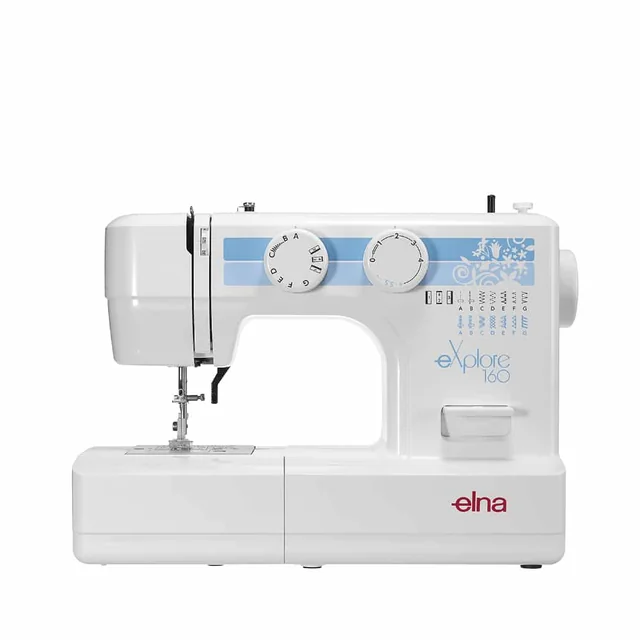
Explore this need in the finder →The Elna eXplore 160 takes a different route from its similarly named 120 and 130 siblings. It has 12 stitch patterns, a horizontal rotary hook with a clear top bobbin cover, and a retractable feed dog. Its listed maximum speed is 700 stitches per minute, lower than the 800 published for the 120 and 130. This is not automatically a “better” or “worse” model: the deciding features are bobbin access, feed-dog control, pattern selection and the pedal pace you want.
A top-loading bobbin and lowerable feed dogs
The current U.S. product page describes a horizontal full-rotary hook and transparent bobbin cover. You load the bobbin from above and can see the supply through the cover, rather than lifting a front cover to remove a vertical oscillating bobbin case as on the eXplore 120 and 130. If that change is central to your routine, the 160 is the clear model in this trio to examine. It still needs correct bobbin placement and threading; visible thread does not eliminate setup.
Elna also documents a retractable feed dog, and the manual identifies the drop-feed lever among the machine parts. Lowering the feed dogs changes how fabric is fed and can be useful for tasks that require manual fabric movement, but it is not the same as a serger or integrated embroidery system. Confirm the exact suitable foot, needle and procedure before trying a specialized technique. The standard package list does not name a walking foot or a separate large quilting table. The manual calls the accessory box an extension table; that should not be mistaken for a larger slide-on work surface.
Mechanical settings and the 700-stitches-per-minute ceiling
The 160 uses mechanical pattern and stitch-length dials, with speed varied by a foot controller. Elna publishes 12 stitches, up to 5 mm width, 4 mm length and 700 stitches per minute. The machine has one four-step buttonhole. The guide explains that the selector changes for the buttonhole sides and bartacks, and that the length dial can adjust stitch density. Expect an operator-controlled process: you mark the buttonhole, sew its sections and stop between changes. If you want a one-step buttonhole routine or a separate speed limiter, those are not established here.
The lower published maximum compared with the 120 and 130 is a useful specification, but not a speed test. Foot-pressure sensitivity, how slowly you can sew, and results on your fabric are not established by the number. If a minimum rate of 800 is essential, the 160 does not meet it on Elna’s stated figures. If 700 is enough and a transparent top bobbin is more valuable, it may fit better than the higher-rated siblings.
Included accessories and practical dimensions
The current U.S. page lists a standard foot, zipper foot, blind-hem foot, four-step buttonhole foot, three bobbins, seam ripper, needle set, screwdriver, small and large spool holders, spool pin, foot controller and soft cover. It does not list a walking foot or a separate large extension table. The exact manual identifies the accessory box as the extension surface, which is useful for support near the machine but is not a promise of a large quilting table. If you need a bigger work surface, verify its size and compatibility as a separate purchase or bundle.
Elna lists the 160 body at 385 × 282 × 150 mm and 6 kg. The technical comparison table does not identify a carry handle for this configuration. No needle-to-arm opening measurement is published on the page. Plan the full sewing station around the fabric you will support, not the body width alone. The three-machine comparison also shows that the 160 has fewer patterns than the 130, despite its bobbin and feed-dog differences.
Maintenance and fit
The 76-page instruction book has model-specific care steps: switch off and unplug, remove the needle plate and bobbin holder as directed, and brush lint from the hook race and feed dogs. The text reviewed here does not add a lubrication interval. Follow the machine’s own instructions rather than assuming all mechanical machines need identical service. The current product list identifies the eXplore 160, while Elna’s support directory links the manual used in this assessment; used-market bundles and regional units should be checked separately.
Choose the 160 when you want mechanical controls, a clear top-loading bobbin and documented drop-feed capability, and are comfortable with pedal-only speed control and a four-step buttonhole. Choose the eXplore 130 if 23 patterns and the published 800-stitches-per-minute maximum matter more than a drop-in bobbin. The eXplore 120 also has an 800 maximum, but its current product page does not quantify the maximum stitch width. Compare the exact routine and standard accessory list before treating any of them as interchangeable.
Sources: Elna USA’s eXplore 160 product page and its linked instruction book, including the speed, four-step buttonhole and maintenance sections. Checked October 23, 2026.
Key details at a glance
| Motor and stitch controls | Mechanical pattern and stitch-length dials with speed varied by the foot controller. The model page publishes 700 stitches per minute; it does not describe an independent speed cap. |
|---|---|
| Stitch choices and limits | Twelve patterns, 5 mm maximum width and 4 mm maximum length. Pattern count is lower than the 130; the 160 instead documents a horizontal rotary top-loading hook, a retractable feed dog and a transparent bobbin cover. |
| Buttonhole routine | The manual identifies a four-step buttonhole and explains stitch-density adjustment through the stitch-length dial. The operator still makes the stage changes and stops. |
| Working space and size limits | Body is 385 × 282 × 150 mm and 6 kg; the product comparison table does not identify a carry handle for the 160. Opening width is not published here. |
| Supplied tools and fabric support | The current page lists standard, zipper, blind-hem and four-step buttonhole feet, three bobbins, seam ripper, needle set, screwdriver, spool holders, spool pin, foot controller and soft cover. The manual calls the removable accessory box an extension table; a separate large quilting table is not in the listed standard package. |
| Needle setups, cutting and memory | A drop-feed lever is documented, but this remains a foot-controlled mechanical bobbin machine, not a serger or motorized hoop-embroidery system. No automatic thread cutter, stored pattern memory or lettering is established. |
| Presser-foot pressure | A dedicated presser-pressure adjustment is not established in the exact model page and manual sections reviewed; do not substitute thread tension. |
| Cleaning and lubrication | The linked guide calls for removing the needle plate and bobbin holder, then brushing lint from the hook race and feed dogs; it says to switch off and unplug before cleaning. No oiling interval is added. |
Use the exact model’s instructions for operating limits, supplied equipment and version differences.
Sources for this assessment
Choose the operating routine that suits your work.
Start with whether you sew, embroider, serge or coverstitch, then compare controls, working area, supplied tools and setup limits.