
Your needs, this model
Does it fit your priorities?
Can a computerized single-needle setup combine IDT integrated feed, adjustable presser pressure and a 7 mm maximum width?
Yes. In the documented single-needle plan, the manual confirms IDT upper-and-lower feeding and adjustable presser pressure, while the U.S. page lists a 7 mm maximum width and 200 mm opening. Those are published capabilities, not a promise that every fabric will feed perfectly.
Explore this need in the finder →Can I sew without the pedal and use a separate speed cap?
Yes. Disconnect the foot control and run the machine with Start/Stop; the separate speed lever sets the maximum. It still requires a household mains outlet.
Explore this need in the finder →Does this machine sew a motorized embroidery hoop?
No. The exact page identifies a household sewing machine and the exact manual documents sewing stitches, not a motorized embroidery hoop setup.
Explore this need in the finder →Can I require automatic thread cutting during a single-needle seam?
No. The specification calls the thread cutter manual and the guide shows a hand-operated cutter; no automatic thread-cutting arrangement is documented.
Explore this need in the finder →Can I require an extension table to be established as part of this machine's exact package?
No, not as an essential package requirement. The gallery names an extension-table bundle but the regular included-accessory list omits a table, so ask the seller about the exact SKU box before buying.
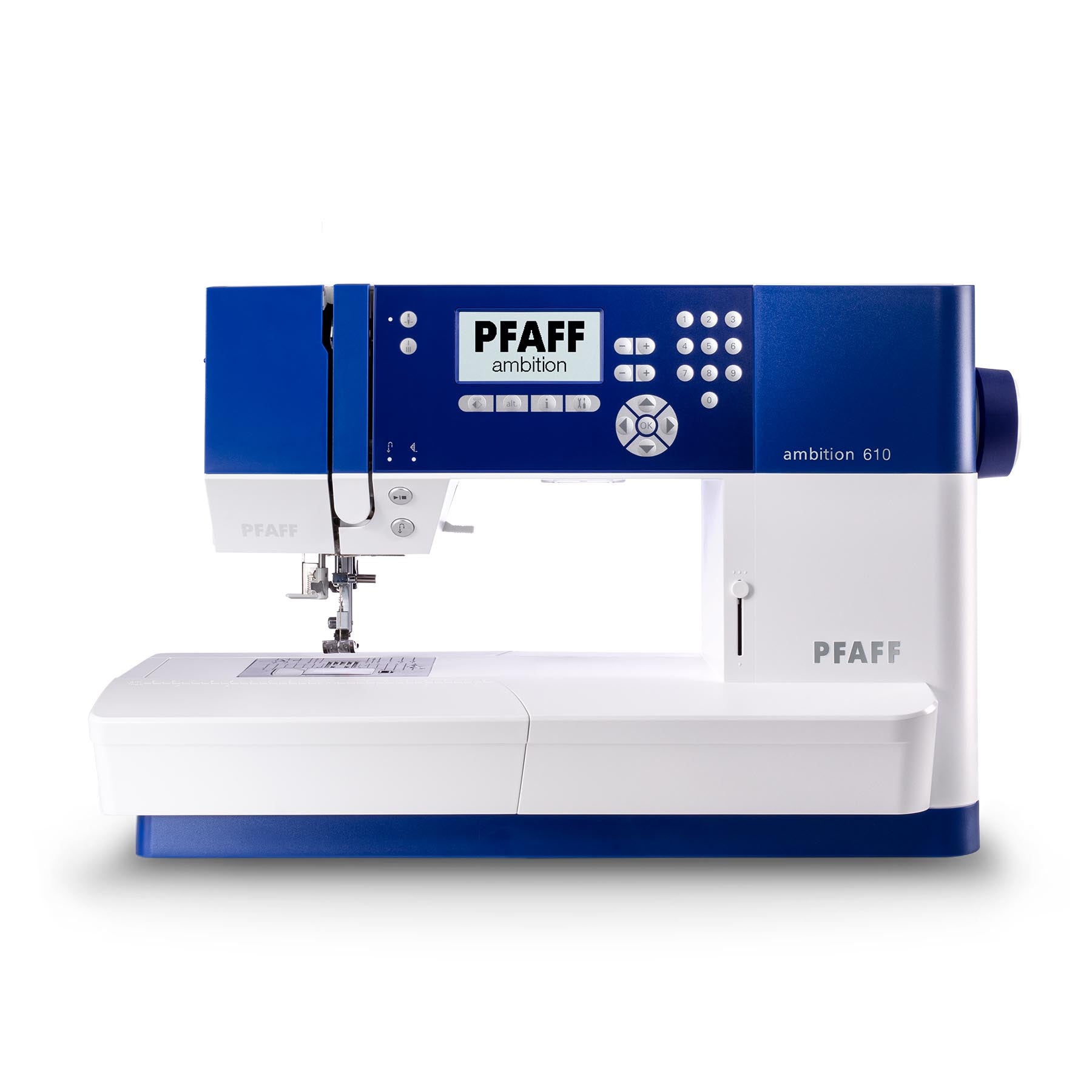
Explore this need in the finder →The PFAFF ambition 610 Blue is a computerized household sewing machine for someone who wants an integrated fabric-feed system, a practical quilting workspace and better speed control than a basic mechanical model, but does not need hoop embroidery. The current U.S. product page identifies the blue-finish model as SKU 850224112. Its useful combination is PFAFF IDT upper feed, a 200 mm opening to the right of the needle, adjustable presser-foot pressure, a speed slider and a Start/Stop button. Its limits matter just as much: it is not a serger, embroidery machine or longarm, and several attractive accessories shown in page media are not confirmed in the regular included list.
Why the IDT system matters for real sewing
The manual describes IDT as feeding fabric from both above and below. That can help reduce layer shift when you sew quilts, plaids and lighter fabrics, but it is not a guarantee that every stack will feed evenly; needle choice, presser foot, thread, stabilizer and the fabric itself still matter. The manual says to engage IDT with compatible feet that have the required center-back cutout. In the listed package, the standard, fancy-stitch and blindhem feet are IDT-compatible; the one-step buttonhole foot and the ordinary fancy-stitch foot are separate types. The system is integrated upper feeding, not a detachable walking foot.
A 200 mm (7.9 in) opening gives room for piecing, garment seams, mending and moderate home quilting. It is still a flatbed machine: bulky quilt fabric must be supported and managed by hand, and this is not the space or frame of a longarm. The page lists an extension-table bundle in its image gallery, but the regular “What’s Included” list does not name a table. If an included table is essential, confirm the seller’s exact SKU and box contents rather than treating the gallery image as proof.
Computerized controls without a complicated screen workflow
The ambition 610 provides 110 stitch patterns, up to 7 mm wide and 5 mm long. The manual’s overview identifies six patterns, numbered 105–110, that require optional specialty feet. The small graphic display and physical buttons let you select stitches and settings; the control layout is less screen-led than a color touchscreen model. A built-in needle threader, needle up/down button and stitch recommendations are useful daily aids. A speed slider caps the maximum sewing speed, and Start/Stop can run the machine with the foot control disconnected. That is still mains-powered sewing, not a battery or cordless setup.
Use the regular foot control if you prefer familiar pedal modulation. Choose Start/Stop when you want your hands on the fabric, then set a suitable speed ceiling before sewing. The published maximum is 800 stitches per minute; a published motor maximum is not a promise about how quickly a particular fabric or project should be sewn. The manual also documents an adjustable presser-pressure dial, drop feed for free-motion work and a free arm when the accessory tray is removed. Free-motion work requires an optional open-toe foot, so check that foot separately if it is part of your plan.
Buttonholes, stitch width and twin-needle setup
The one-step buttonhole foot uses a button holder to set the buttonhole length, up to 25 mm. The guide lists six buttonhole patterns, including an eyelet buttonhole; it asks you to stabilize the fabric and sew a test sample before cutting. That is more convenient than measuring a four-step buttonhole by hand, but good results still depend on fabric support and selecting the right pattern. The machine has 29 needle positions for straight stitching and a twin-needle program. That program narrows the allowed width according to the chosen twin needle, so the single-needle 7 mm maximum must not be assumed for twin-needle stitching.
What the source says is included—and what it does not
The exact page lists six presser feet: standard 0A, fancy-stitch 1A and 2A, IDT blindhem 3, IDT zipper 4 and one-step buttonhole 5. It also lists a foot control, hard cover, needles, five bobbins, tools and a power cord. The page does not name a detachable walking foot or a quarter-inch quilting foot in that included list. PFAFF’s current page calls this a store-exclusive product; check the current dealer offer, warranty and exact package before buying. Its price and availability may change.
Ownership and alternatives
This is a relatively substantial 8.5 kg household machine with listed dimensions of 18.9 × 7.6 × 11.8 inches. The model guide says no oiling is needed, but it does call for regular lint cleaning around the feed dogs and bobbin case with the included brush; do not blow lint into the bobbin area. A physical thread cutter is manual, so the machine does not replace the hand-snipping step with automatic cutting. The manual’s chart documents sewing stitches, not motorized hoop embroidery, a serger, coverstitch or a longarm arrangement. Built-in decorative stitches and sewing lettering, where offered by another machine, are not the same as moving a hoop under a needle.
Compare the PFAFF quilt ambition 635 if you want a larger color touchscreen, a higher stitch count, sewn alphabets, automatic thread snips and a listed quarter-inch quilting foot; it shares the 200 mm opening and integrated IDT but has its own unresolved package and specification questions. The 610 is a more straightforward choice if its 110-stitch display, manual thread cutting and 200 mm workspace suit your routine. Neither machine is a fit when motorized embroidery, a confirmed standard-box extension table, a detachable walking foot or automatic thread cutting is essential.
Sources: the exact U.S. PFAFF ambition 610 Blue product page, SKU 850224112 and the model-specific English PFAFF ambition 610 User’s Guide, code 4710495-26C, found through the official manual directory. Reviewed October 24, 2026. This is a source-based assessment, not a hands-on test.
Key details at a glance
| Motor and stitch controls | The exact current U.S. product page identifies the Blue finish and SKU 850224112 and lists a small LCD/graphic display, Start/Stop button, speed slider and foot control. The 44-page English user guide describes the display as graphic and confirms Start/Stop operation without the foot control; the machine remains mains powered. |
|---|---|
| Stitch choices and limits | The product-page specification states 110 stitches, 7 mm maximum width and 5 mm maximum length. The complete guide stitch overview lists six buttonhole patterns (including an eyelet buttonhole) and identifies patterns 105–110 as requiring optional feet. A built-in sewing alphabet or saved pattern-combination feature is not established by the model guide. |
| Buttonhole routine | The manual describes a one-step buttonhole foot with an adjustable button holder for buttonholes up to 25 mm. It instructs users to stabilize the fabric, select a suitable pattern and sew a test on scrap. The six charted buttonhole choices are not interchangeable for every fabric or garment. |
| Working space and size limits | The exact page gives a 200 mm (7.9 in) opening to the right of the needle. It lists overall dimensions as length × width × height, 18.9 × 7.6 × 11.8 in (480 × 193 × 300 mm), and the manual gives a net machine mass of 8.5 kg. This is a domestic flatbed opening, not a longarm frame. |
| Supplied tools and fabric support | The product page identifies six named presser feet: standard 0A, fancy stitch 1A and 2A, IDT blindhem 3, IDT zipper 4 and one-step buttonhole 5; foot control, power cord, hard cover, needles, five bobbins and tools are also listed. It does not list a detachable walking foot, quarter-inch quilting foot or extension table. Gallery media separately names an extension-table bundle, so table inclusion is left unknown pending confirmation of the seller's exact box. |
| Needle setups, cutting and memory | The model is a conventional computerized household lockstitch machine. The guide documents a twin-needle program that automatically limits allowed width for the chosen needle spacing; a fixed twin-needle maximum is therefore not claimed. It documents no motorized hoop embroidery, serger/overlock, coverstitch or longarm setup. The manual thread cutter is user-operated, not an automatic thread cutter. |
| Presser-foot pressure | The manual identifies an adjustable presser-foot pressure dial set to a standard value N and says a lower number can help with very light fabrics while a higher number can help with heavier fabrics. This is separate from the upper-thread tension dial. |
| Cleaning and lubrication | The model guide says no lubrication/oiling is needed. It instructs users to switch off and clean the feed-dog and bobbin areas with the included brush, and specifically warns not to blow air into the bobbin-case area. |
Use the exact model’s instructions for operating limits, supplied equipment and version differences.
Sources for this assessment
- Exact U.S. PFAFF ambition 610 Blue product page, SKU 850224112
- English 44-page PFAFF ambition 610 User's Guide, code 4710495-26C, ©2018
- Official U.S. PFAFF manual directory naming the ambition 610 manual and linking its exact product page
- Previously archived current U.S. PFAFF directory; the ambition 610 named whole-machine card was personally inspected
- Exact official 1800×1800 ambition 610 Blue product image from its U.S. product page

Choose the operating routine that suits your work.
Start with whether you sew, embroider, serge or coverstitch, then compare controls, working area, supplied tools and setup limits.