
On this page
Your needs, this model
Does it fit your priorities?
Can I sew ordinary seams without a foot pedal while keeping a direct stitch-selection display?
Yes. The exact 260c page and model-specific manual document direct computerized stitch selection and a Start/Stop button that runs without the foot pedal. The machine also supports a separate foot-control plan if you prefer pedal operation.
Explore this need in the finder →Can it run a one-step buttonhole while using its foot control and computerized stitch selection?
Yes. The exact product page and owner’s manual identify a one-step buttonhole foot and document an included foot control. The manual says the machine stops after the last buttonhole column, but this does not provide automatic thread snipping.
Explore this need in the finder →Can I require mechanical stitch-selection dials rather than computerized controls?
No. The 260c is the computerized SMARTER model with direct-selection buttons and an information display. Compare the mechanical SMARTER 160s if dials are essential.
Explore this need in the finder →Does its single-needle setup meet a 6 mm minimum maximum stitch width?
Yes. PFAFF states a 6 mm maximum width for the single-needle specification. The documented maximum is not a guarantee that every stitch is available at that width.
Explore this need in the finder →Does the single-needle setup meet a 7 mm minimum maximum stitch width?
No. The exact product listing gives a 6 mm maximum, below a 7 mm essential minimum.
Explore this need in the finder →Can I require a separate speed slider that limits maximum sewing speed?
Yes. The exact listing identifies a speed slider and the model-specific manual describes it as the maximum-speed control; 750 stitches per minute is the maker-stated top specification.
Explore this need in the finder →Will the one-step buttonhole setup automatically stop when its cycle is complete?
Yes. The exact 260c manual says the machine ties and stops after it finishes the last buttonhole column. This is distinct from the manual thread cutter, which is not automatic.
Explore this need in the finder →Can I depend on it for a motorized hoop-embroidery task?
No. The inspected exact product page and manual document a domestic sewing machine with 27 sewing stitches; they do not establish an embroidery-unit or motorized-hoop plan.
Explore this need in the finder →Can a 6 mm twin-needle maximum-width requirement pass?
No. The manual depicts twin-needle threading but instructs the user to reduce width for the specific twin needle. It gives no universal maximum, so the width remains unknown and cannot satisfy a numeric essential filter.
Explore this need in the finder →Can I require a documented integrated dual-feed system?
Do not count this model as a confirmed match. The inspected exact page and manual do not identify PFAFF IDT or another integrated upper-feed system, so that requirement remains unverified.
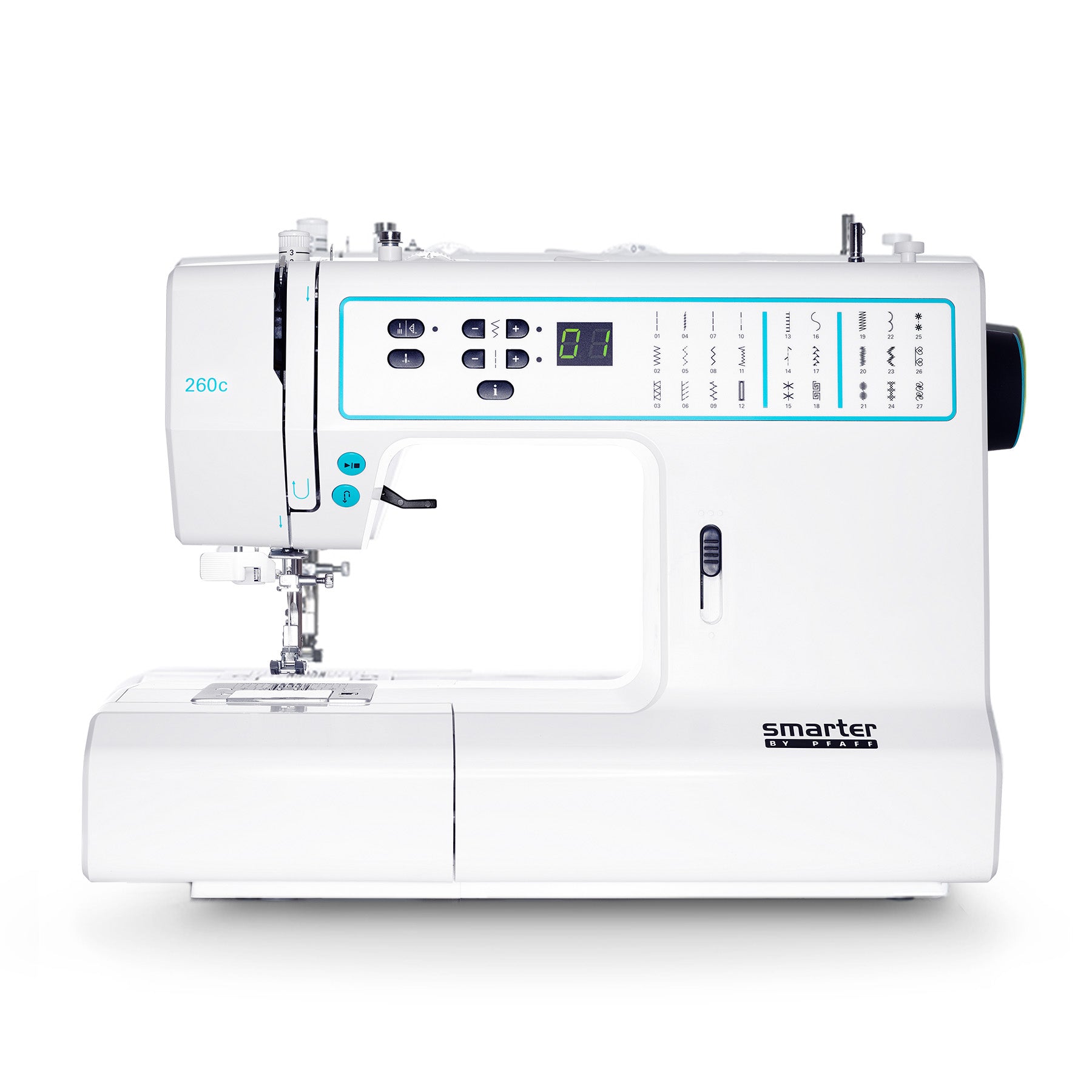
Explore this need in the finder →The SMARTER BY PFAFF 260c is a computerized household sewing machine built around direct stitch selection, a small information display and two ways to control sewing: the included foot pedal or a Start/Stop button. PFAFF’s current U.S. listing identifies SKU 850191112 and specifies 27 stitch patterns, a 6 mm maximum stitch width, a 4.5 mm maximum stitch length, a 160 mm (6.3-inch) needle-to-tower space and a maximum speed of 750 stitches per minute. That combination suits a home sewer who wants a clear, button-led interface for garments, repairs and decorative seams without moving to an embroidery machine. This is a source-based assessment, not a hands-on test.
Direct selection is the main everyday advantage
The machine’s front panel shows the stitch choices, and each stitch has a corresponding selection button. The display identifies the selected stitch and the recommended presser foot, so you can use the chart and machine prompts instead of remembering a long menu path. Its automatic starting stitch length and width are convenient defaults, not fixed limits: the French-language, model-specific owner’s manual documents using the plus and minus controls to adjust a selected stitch. Those changes apply only to that stitch and do not remain saved after the machine is turned off. If you routinely personalize a pattern setup and expect it to return next week, ask a dealer to demonstrate how the settings behave before treating that as a stored memory feature.For sewing, choose either the foot control or the Start/Stop button; the manual says the button can start and stop the machine without the pedal. The speed slider sets the maximum sewing speed, a useful distinction from simply pressing a foot pedal more gently. PFAFF lists 750 stitches per minute as the ceiling, not as an independently measured speed. Needle up/down, reverse and tie-off controls help with pivots and seam endings. Tie-off is not an automatic thread cutter: the current specification lists a manual thread cutter, so thread trimming remains a separate hand step.
Buttonholes are more than a stitch count
The 260c includes a one-step buttonhole foot. The manual instructs you to fit the button in the foot’s holder to set the buttonhole length, lower the buttonhole lever and begin the cycle. It says the machine ties the threads and stops sewing when the final buttonhole column is finished. That is a useful, repeatable routine for occasional shirt, jacket or craft buttonholes; it is still sensible to stabilize the fabric and test the chosen stitch and button on similar scrap first. Do not confuse this documented buttonhole stop with automatic thread snipping, which is not listed for this model.The 27 choices are sewing stitches—utility, stretch, patchwork and decorative patterns—not an inventory of motorized embroidery designs. The 260c is not a serger that trims an edge while enclosing it with loopers, and no embroidery unit or hoop workflow is listed on its exact product page. Its built-in needle threader and snap-on presser-foot system reduce some setup steps, but the manual still covers ordinary needle, thread, tension and bobbin preparation.
Plan around its work area and included box
At 160 mm from needle to tower, the 260c gives a compact opening for typical garment panels, hems, repairs and smaller craft pieces. It is not the roomy throat of a dedicated quilting machine. The machine has a free arm, a drop-feed control and an extra presser-foot lift; its owner’s manual also documents adjustable presser-foot pressure. Those are practical options when changing fabric handling or reaching a small tubular item, but they do not establish how the machine will perform on every thick or layered fabric. Use the correct needle and foot and sew a sample before committing a seam.Package details deserve a careful look because PFAFF labels the current U.S. listing “Store Exclusive” and “Dealer Exclusive.” The product page’s specifications say 16 accessories and list a foot control, hard cover, needles, tools, bobbins, an edge/quilting guide and five presser feet, including a one-step buttonhole foot. The exact 36-page owner’s manual names the 260c on its cover and lists the same general foot set, but its older accessory illustration says three bobbins rather than the five on the current U.S. page. The manual also warns that the equipment and accessory set may change. Confirm the current contents for SKU 850191112 with the actual dealer; do not assume a gallery image labeled “Essentials Bundle” describes the base offer or that an extension table is included.
Who should choose it—and who should compare
Choose the 260c if you want computerized direct stitch selection, an adjustable speed ceiling, needle positioning and a genuine pedal-free Start/Stop option, while keeping ordinary sewing and buttonholes in one machine. Its small display and compact sewing space make it less suited to anyone who needs a large work area, a wide stitch for a specialty technique, or a clear, documented embroidery or upper-feed system. If mechanical dials are the priority and pedal-free sewing is not, compare the SMARTER BY PFAFF 160s: it is a mechanical alternative with the same listed 160 mm opening, but not the same computerized controls. If a bundled table, an exact accessory package or a specialty feed system is essential, check the dealer’s written SKU-specific offer before buying rather than inferring it from the brand name or machine photograph.Key details at a glance
| Motor and stitch controls | The exact U.S. listing identifies the 260c as computerized, with direct stitch-selection buttons and an information display. The exact-model French owner’s manual p21 documents Start/Stop operation without the foot pedal, a speed-control lever that sets maximum speed, reverse, tie-off and needle-up/down buttons. Both the foot pedal and power cord are in the documented package; their precise current dealer-box contents should be checked against the SKU-specific listing. |
|---|---|
| Stitch choices and limits | PFAFF lists 27 sewing stitch patterns, maximum 6 mm width, maximum 4.5 mm length, automatic default stitch settings and a 1.2-inch diagonal information display. The model-specific manual p23 documents user adjustment of the selected stitch’s width/position and length; settings apply to the selected stitch, revert when selecting a different stitch, and do not automatically persist after power-off. These are sewing stitches, not embroidery designs. |
| Buttonhole routine | The exact U.S. product page lists a one-step buttonhole foot. The exact-model manual pp8, 29 explains setting length with the button in the foot’s holder and instructs that the machine ties and stops sewing at completion of the final buttonhole column. That is a buttonhole-cycle stop, not an automatic thread cutter; the product specifications identify a manual thread cutter. |
| Working space and size limits | The current U.S. listing specifies 160 mm (6.3 inches) from needle to tower; the free arm is documented in the exact model manual. An extension table is not in the current U.S. page’s included-items list, so the current dealer package should be confirmed before relying on one. |
| Supplied tools and fabric support | The current U.S. page lists 16 accessories, five bobbins, a hard cover, foot control, power cord, needles, tools, an edge/quilting guide and five presser feet. The exact 260c owner’s manual’s older French package diagram lists three bobbins and the same five types of presser foot, and its disclaimer allows equipment/accessory changes. The dealer-specific box contents therefore remain a verify-before-buy issue; gallery images labeled Essentials Bundle are not package evidence. |
| Presser-foot pressure | The exact-model manual p17 identifies a dedicated presser-foot pressure control, says the default value suits most cases, and explains easing or increasing pressure for very thin or thick fabric. |
More specifications and setup details
| Cleaning and lubrication | The exact 260c manual p32 describes routine exterior and bobbin-area cleaning and states the machine does not need lubrication/oiling; follow its safety steps and disconnect power before servicing. |
|---|
Use the exact model’s instructions for operating limits, supplied equipment and version differences.
Sources for this assessment
- Exact current U.S. SMARTER BY PFAFF 260c whole-machine listing, SKU 850191112; personally inspected the product identity, controls, specifications, included-items list, dealer-exclusive status and page-linked gallery image.
- Official 36-page French SMARTER BY PFAFF 260c owner’s manual; the exact model appears on the cover. Personally inspected the machine controls, accessory list, threading, pressure setting, feed dog control, Start/Stop and speed slider, stitch adjustments, automatic one-step buttonhole stopping and maintenance sections. The source is French, not an English manual.
- Official PFAFF/SINGER manual-library metadata record identifying SmarterbyPfaff_FR.pdf as French and naming SMARTER BY PFAFF 260c Sewing Machine; used to distinguish the exact 260c owner’s manual from the separate English 260c marketing brochure and mismatched English manual-directory link.
- Exact-model official English four-page SMARTER BY PFAFF 260c feature brochure; it confirms the model and 27-stitch feature set but is not an owner’s manual.
- Main machine-only image linked from the exact U.S. 260c listing; personally viewed and confirmed by the visible 260c casing mark.

Choose the operating routine that suits your work.
Start with whether you sew, embroider, serge or coverstitch, then compare controls, working area, supplied tools and setup limits.