
On this page
Your needs, this model
Does it fit your priorities?
Can I use a mechanical sewing machine with a foot control and a one-step buttonhole routine?
Yes. The exact U.S. 160s listing and its linked manual document mechanical dial controls, an included foot control and the one-step 5B buttonhole foot. The manual still tells the sewer to stop at the final buttonhole column; one-step is not the same as automatic completion stopping.
Explore this need in the finder →Can I sew without a foot pedal if I require an alternative Start/Stop control?
No documented pedal-free plan is available. The exact manual shows the foot-control connection and the 160s page does not document Start/Stop. Treat pedal-free operation as unmet rather than assuming a button control.
Explore this need in the finder →Will its single-needle setup meet a seven-millimeter minimum maximum stitch width?
No. PFAFF specifies up to 6 mm on the single-needle setup. The machine can still offer useful utility and decorative width, but it does not meet a 7 mm essential minimum.
Explore this need in the finder →Can I require a dedicated motorized-hoop embroidery setup?
No. The exact product is a mechanical domestic sewing machine; its 23 listed patterns are sewing stitches, not an embroidery-unit/hoop workflow.
Explore this need in the finder →Is a twin-needle routine documented, and is the single-needle width limit safe to assume for it?
A twin-needle threading routine is documented, but the manual warns that the width must be reduced to suit the particular needle and supplies no universal maximum. A separate essential twin-needle width requirement remains unverified and should not pass.
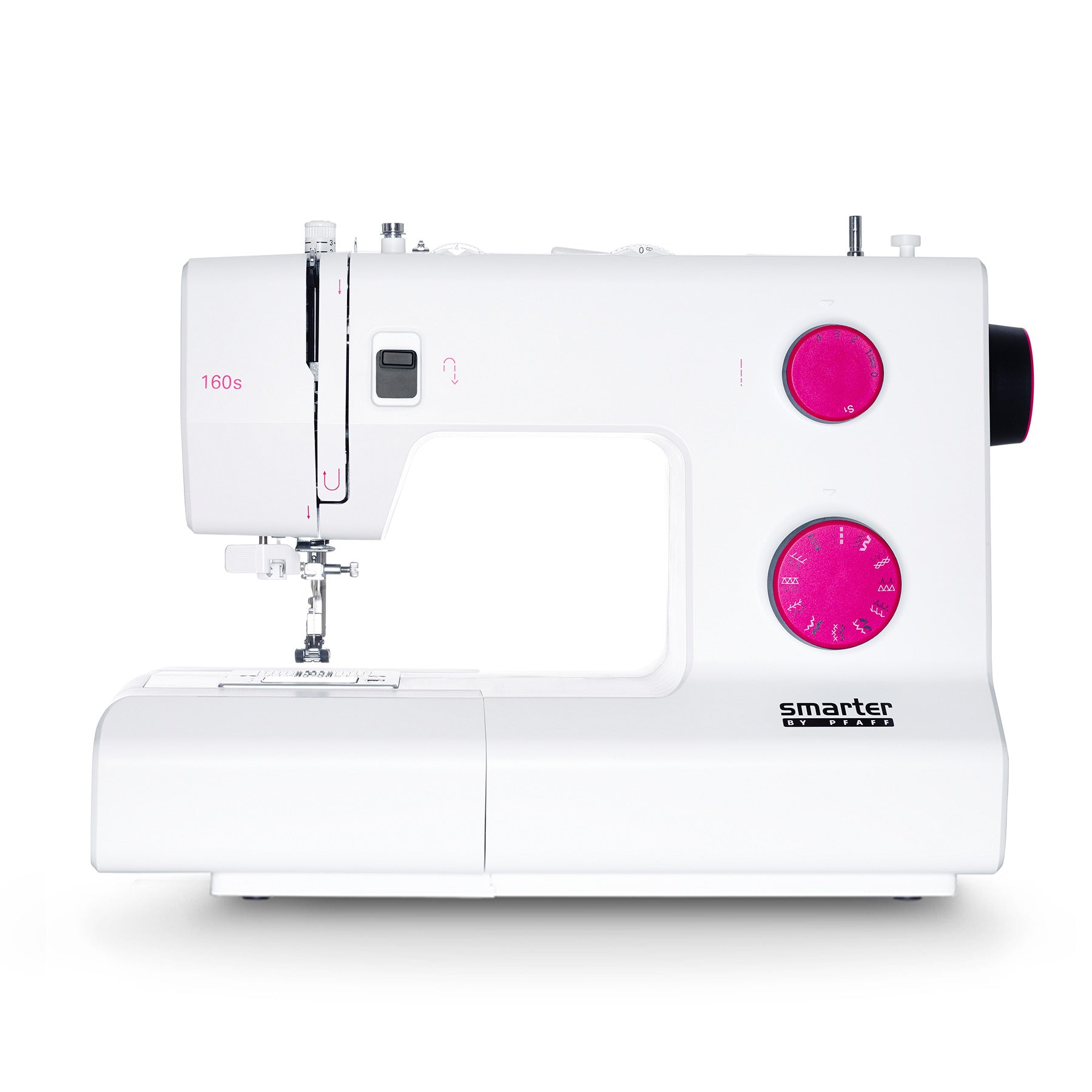
Explore this need in the finder →The SMARTER BY PFAFF 160s is a straightforward mechanical sewing machine for someone who would rather set physical dials than learn a display menu. The current U.S. PFAFF listing identifies SKU 850184112 and describes 23 stitch patterns, up to 6 mm stitch width, 4 mm stitch length, a 160 mm opening to the right of the needle, a built-in needle threader and a maximum speed of 750 stitches per minute. Its practical appeal is everyday clothing, repairs and smaller home projects with a little more stitch choice than a two-dial basic machine. This is a source-based assessment of the listed configuration, not a hands-on test.
Physical controls keep routine sewing visible
The machine uses a stitch-selection dial, stitch-length dial and stitch-width dial, with a separate manual thread-tension control. The manual’s stitch chart includes straight, zigzag, stretch, blindhem, overlock-style, button-sewing and decorative options. “Overlock stitch” here names a stitch made on a conventional domestic machine; it does not turn the 160s into an overlocker that trims and wraps an edge with loopers. You can drop the feed dogs for documented button sewing and other work where the fabric is moved by hand, and the accessory tray slides off to expose a free arm for sleeves or trouser legs. The adjustable presser-foot pressure gives another physical adjustment for very light or heavier fabrics, though the manual calls its normal setting suitable for most sewing and recommends trying settings on a sample.The 160s model-specific distinction in the shared 130s/140s/150s/160s manual is the one-step buttonhole foot, 5B. The button placed in the foot holder sets the buttonhole length, and the instructions tell you to stabilize the fabric. “One-step” describes the stitch routine, not a promise that the machine will sew every garment’s buttonhole unattended: the manual tells the sewer to begin with the foot control and stop when the final column is complete. That is easier to repeat than changing stitch settings between buttonhole sides, but it still calls for a test on comparable scrap and a steady hand on the pedal.
What it can—and cannot—do for a project
A 6 mm maximum width covers the width the manufacturer specifies for the 160s, while the 4 mm maximum stitch length and 23 patterns give useful utility and decorative options without a large computerized library. The manual also documents twin-needle threading, using its auxiliary spool pin, but warns that the width must be reduced as needed to keep the twin needle clear of the presser foot and stitch plate. Because the safe width depends on the particular twin needle, do not treat the single-needle 6 mm maximum as a twin-needle promise. Try the full needle swing by turning the handwheel before sewing.The manufacturer’s 750-stitches-per-minute figure is a maximum specification, not an independently measured speed. The page and manual describe the included foot control but do not document a separate speed slider or Start/Stop control. If an essential requirement is setting a fixed speed cap or sewing without a pedal, compare a machine whose exact manual documents those controls. The 160s also has no documented embroidery-unit workflow, built-in lettering, automatic thread snipping or PFAFF IDT integrated upper-feed system. Decorative stitches and a built-in needle threader are useful conveniences, but they are not substitutes for those distinct functions.
Measure the opening and verify the dealer package
The 160 mm (about 6.3-inch) needle-to-tower opening is suitable for many garments, hems and repairs; it is not a roomy quilting throat. A large extension table, if you need one, supports fabric outside the arm but does not increase the opening. PFAFF’s ambition 610 has a published 200 mm sewing space and integrated IDT, while the computerized passport 3.0 offers a speed slider and Start/Stop arrangement but a shorter 145 mm opening. Those are different tradeoffs, not automatic upgrades: choose the control method and work area that match your projects.At 6.2 kg (13.7 lb), with a carrying handle and a listed hard cover, the 160s can be moved around a home more readily than a large quilting machine, but it is not a featherweight travel unit. Its exact U.S. product page labels it dealer-exclusive and directs shoppers to find a store, so availability and dealer support are local questions rather than guaranteed online stock. The listing names five presser feet, bobbins, tools, an auxiliary spool pin, foot control and power cord, needles and a hard cover. Its introduction says 15 complimentary accessories while the specification block says 16; confirm the actual SKU 850184112 box contents with the dealer, especially if a table or a bundle matters. Bundle-titled gallery images are not a substitute for a written package list.
Who should choose it
Choose the 160s if you want mechanical stitch selection, a built-in needle threader, an actual one-step buttonhole routine and enough width for ordinary zigzag and decorative work, while accepting foot-control-only sewing and a compact throat. It makes less sense when you need a long quilting workspace, a separate speed cap, automatic thread cutting, computerized combinations or a documented accessory table. The manual calls for routine lint cleaning and says no oiling is needed; that simple care plan does not remove the need to use the right needle and foot, keep the bobbin area clean and check stitch settings on a fabric sample. Confirm the dealer’s package and service arrangements before deciding that the pictured machine is the whole offer.Key details at a glance
| Motor and stitch controls | The exact listing identifies the machine as a mechanical sewing machine. The manual shows a stitch-selection dial, stitch-length and width dials, handwheel, reverse lever and foot-control connection; no Start/Stop or separate speed-slider operation is documented. |
|---|---|
| Stitch choices and limits | The official U.S. listing specifies 23 stitch patterns, up to 6 mm stitch width and 4 mm stitch length. Manual pages 9 and 21–22 show the stitch chart and physical dials. The 6 mm maximum is for the single-needle setup; manual page 16 warns that twin-needle width must be narrowed for the needle actually installed. |
| Buttonhole routine | The official listing/manual identify the 150s/160s one-step 5B foot. Manual page 29 sets buttonhole length from the button in the foot holder and directs the user to stop after the final buttonhole column. This is one-step buttonhole sewing but not a documented automatic-stop cycle. |
| Working space and size limits | The product listing specifies 160 mm (6.3 in) from needle to tower. This throat measurement is distinct from any extension table. |
| Supplied tools and fabric support | The exact U.S. page says 15 complimentary accessories in its introduction and 16 included accessories in its specification block. The written list names five presser feet, bobbins, tools, a hard cover and foot control/power cord among the accessories; dealer-exclusive package details should be confirmed for SKU 850184112. No extension table is documented. |
| Presser-foot pressure | The manual page 18 documents a presser-foot pressure dial. It says the standard value suits most cases, with adjustments available for very light or heavier fabric. |
More specifications and setup details
| Cleaning and lubrication | The manual page 33 directs routine bobbin/feed-dog cleaning and says no lubrication (oiling) is needed. It cautions to raise the needle, lower the feed dogs and switch off before opening the bobbin area. |
|---|
Use the exact model’s instructions for operating limits, supplied equipment and version differences.
Sources for this assessment
- Exact U.S. SMARTER BY PFAFF 160s Sewing Machine listing, SKU 850184112 / GTIN 7393033086862; inspected exact title, current dealer-exclusive status, technical features, included accessories and product-specific image.
- Official manufacturer-linked 36-page English SMARTER BY PFAFF 130s/140s/150s/160s Owner’s Manual, footer 4710092-26A; the U.S. product page links the 160s directly to this manual. Inspected the 160s-specific parts, accessories, twin-needle threading, stitch controls, foot pressure, feed-dog control, buttonhole and maintenance sections.
- Exact machine image linked as the main SMARTER BY PFAFF 160s product image from the official U.S. listing; archived and visually checked for the 160s casing mark.

Choose the operating routine that suits your work.
Start with whether you sew, embroider, serge or coverstitch, then compare controls, working area, supplied tools and setup limits.