
On this page
Your needs, this model
Does it fit your priorities?
Can the SMARTER BY PFAFF 140s meet a mechanical foot-control brief with a four-step buttonhole?
Yes. The exact U.S. model is mechanical and its page lists the foot control; the shared 130s/140s manual assigns the four-step 5A foot to this model group.
Explore this need in the finder →Does the 140s offer one-step buttonholes like the nearby 160s?
No. The manual distinguishes the 130s/140s four-step 5A from the 150s/160s one-step 5B. If one-step operation is essential, compare the exact 160s setup or another model with a matching manual.
Explore this need in the finder →Can I sew with the pedal disconnected or set a separate speed ceiling?
No documented 140s Start/Stop button or separate speed limiter is present. The 750 spm figure is a maker-listed maximum and the normal setup is a foot control.
Explore this need in the finder →Will the 140s meet a required 7 mm single-needle width?
No. The exact listing states 6 mm maximum single-needle width. Its 160 mm opening is also not a long quilting throat.
Explore this need in the finder →Is twin-needle threading supported, and is a numeric width limit known?
The shared family manual describes twin-needle threading, but does not state a universal safe twin width. Narrow the width to suit the actual needle and check its full motion by hand; a required numeric twin width is not verified.
Explore this need in the finder →Can I use its 21 stitch patterns for motorized hoop embroidery?
No. The 140s is listed as a mechanical domestic sewing machine. Decorative stitch patterns are not a motorized embroidery-unit and hoop workflow.
Explore this need in the finder →Does the 140s buttonhole stop automatically at completion?
No such automatic completion stop is documented. The four-step routine has the sewer complete the sides and bartacks in sequence.
Explore this need in the finder →Is presser-foot pressure adjustable, and what does that help with?
Yes. The official family manual describes a pressure dial for very light or heavier fabrics; it does not replace testing the setup on a sample.
Explore this need in the finder →What does the official image show, and what is in the listed package?
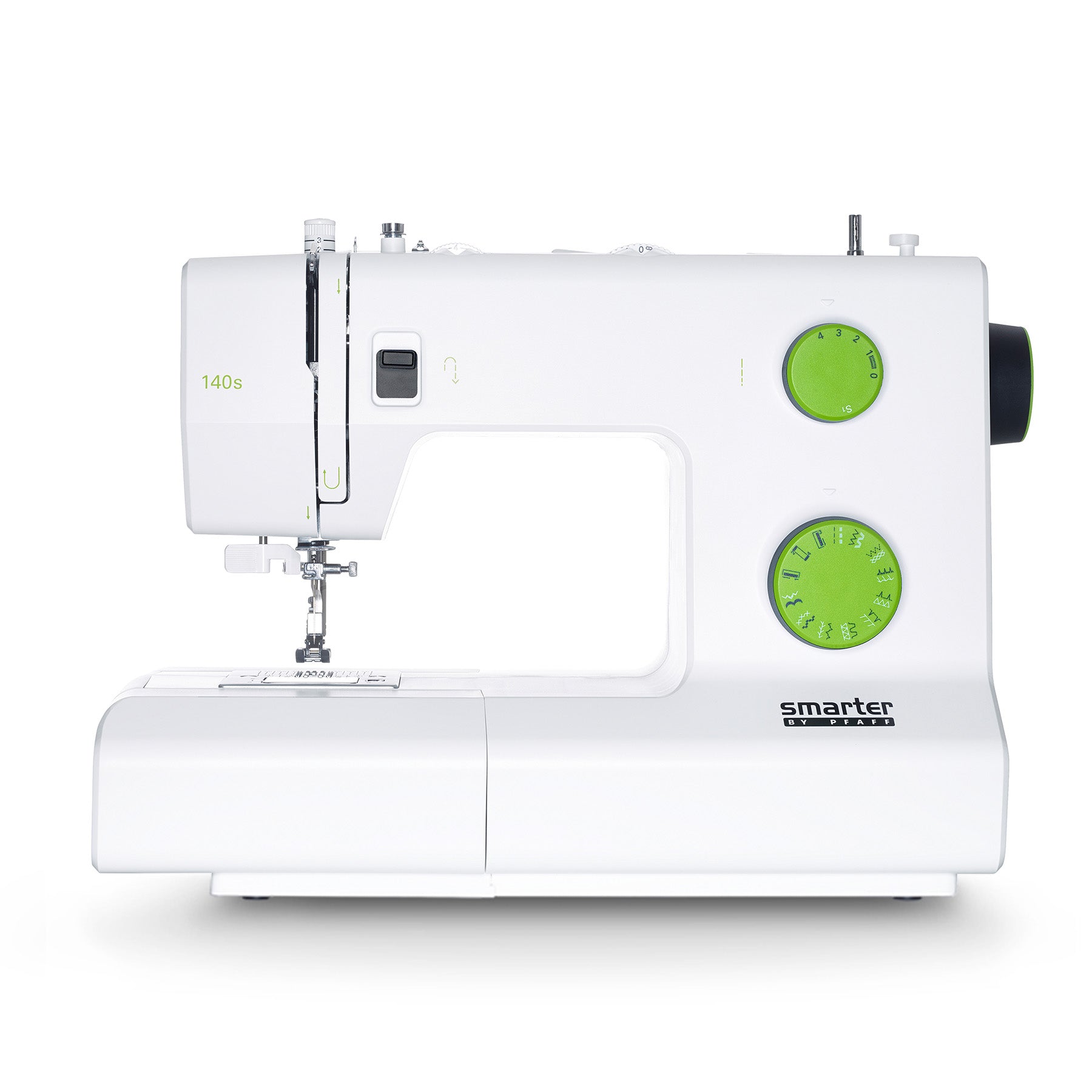
The image is the exact official 140s model view. The maker page lists 16 accessories including five feet, a foot control, needles, small tools and a hard cover; check the actual offer if a specific accessory is essential.
The SMARTER BY PFAFF 140s is a compact mechanical home sewing machine for people who want physical stitch dials and a conventional foot pedal, rather than a computerized screen. The current U.S. PFAFF listing identifies SKU 850183112 and GTIN 7393033086558. It specifies 21 stitch patterns, up to 6 mm width and 4 mm length, a 160 mm (6.3-inch) needle-to-tower opening and a maximum sewing speed of 750 stitches per minute. Those are useful boundaries for comparing it with a more elaborate machine; they are manufacturer specifications, not results from a hands-on test.
Simple dials, with more than a straight stitch
The 140s uses mechanical stitch-selection, length and width dials, manual upper-thread tension and a foot control. Its 21 patterns include ordinary straight and zigzag work as well as stretch, blindhem and decorative choices. That is a practical range for clothing repairs, hems, simple garments, crafts and smaller home projects. It is not an embroidery library: decorative stitch patterns formed with a regular needle and bobbin are different from a motorized embroidery unit that moves a hoop.
The maker lists a built-in needle threader, a manual thread cutter and seven-point feed dogs. The shared SMARTER 130s/140s/150s/160s manual explains the presser-foot pressure dial, top tension dial, and how to lower the feed dogs for work such as button sewing. Removing the accessory tray exposes a free arm for sleeves and trouser legs. The normal pressure setting is intended for most fabrics, with adjustment available for very light or heavier material. These features add manual control, not automatic tuning; expect to choose a needle, foot and settings for the fabric and test a seam on a scrap.
The four-step buttonhole is the defining 140s tradeoff
On the 140s, buttonholes use the four-step foot 5A. The manual has the sewer make the sides and bartacks in separate stages, guiding length and alignment by marks on the foot. Stabilizing the fabric and making a scrap test are recommended. This is a usable basic buttonhole routine, but it asks for more hands-on transitions than a one-step system and the instructions do not describe an automatic completion stop.
That distinction matters more than a small stitch-count difference if you sew many shirts or other button-front garments. The PFAFF SMARTER 160s is a close comparison: its shared family manual assigns the 150s/160s the one-step 5B foot, while the 130s/140s use 5A. The 140s listing also has 21 stitch patterns rather than the 160s page’s 23. If four-step sewing is fine and the listed 140s package is the one you want, the 140s remains a coherent mechanical choice. If repeatable one-step buttonholes are essential, choose a model whose exact manual documents that setup instead.
Check the needle setup and control requirements
The listed 6 mm width is the single-needle maximum; the maximum stitch length is 4 mm. The manual describes twin-needle threading with an auxiliary spool pin, but it does not give a universal safe zigzag-width number for every twin needle. Narrow the width for the actual needle and turn the handwheel through the full movement before sewing. The built-in needle threader is not for twin needles. Because the two-needle maximum remains unspecified, do not treat a required twin-needle width as confirmed.
The machine is pedal-operated. Its 750-stitches-per-minute figure is a stated maximum, not a separate speed limiter, and the listing/manual do not establish a Start/Stop sewing arrangement for pedal-free use. If you need to sew with the pedal disconnected or to set a hard speed ceiling, compare a model whose same operating plan documents those controls. The 160 mm opening is ample for many garments and repairs, but it is not a large quilting throat; a separate table, if purchased, supports fabric outside the arm without increasing that needle-to-tower space.
Package and care are part of the decision
The exact U.S. page lists 16 included accessories, including five presser feet, bobbins and small tools, a foot control and power cord, needles and a hard cover. Confirm the bundle for the exact SKU if an accessory or table is essential, especially when buying through a seller rather than the manufacturer. The listing gives a machine weight of 6.2 kg (13.7 lb), which is manageable to move around a home but not a featherweight travel format. It also publishes dimensions in length × width × height order; use the manufacturer’s stated axes rather than guessing which number is front-to-back clearance for your shelf.
The manual’s maintenance section calls for cleaning lint from the bobbin and feed-dog area and says the machine does not require oiling. This is straightforward care, not a reason to sew through lint buildup or ignore needle condition. Use the correct presser foot and needle, keep the feed path clean, and test settings after changing fabric or thread.
Who should choose it?
Choose the SMARTER 140s if you want mechanical dials, a built-in needle threader, a free arm, a 6 mm single-needle width and a basic four-step buttonhole, while accepting foot-control sewing and a compact 160 mm opening. It is less suitable when you need a one-step buttonhole, automatic thread cutting, a speed slider, pedal-free Start/Stop, integrated IDT, a documented extension table or hoop embroidery. For the first two controls, compare the PFAFF SMARTER 160s or a documented computerized alternative such as the passport 3.0; verify the exact control plan and offered package before ordering. This review addresses the manufacturer-listed configuration, not the condition or completeness of a used or dealer-selected bundle.
Key details at a glance
| Motor and stitch controls | The exact current U.S. listing identifies a mechanical sewing machine; the family manual shows the physical stitch-selection, stitch length and width dials, foot control, handwheel and reverse lever. No Start/Stop button or independent speed limiter is documented. |
|---|---|
| Stitch choices and limits | The exact page lists 21 stitch patterns, up to 6 mm width and 4 mm length. The shared family manual identifies the sewing stitches and the 130s/140s control dial behavior; the stitch designs do not imply hoop embroidery. |
| Buttonhole routine | The shared official manual assigns four-step presser foot 5A to the 130s/140s on page 8 and gives the staged buttonhole routine on page 30. It is not a one-step or documented automatic completion-stop setup. |
| Working space and size limits | The exact U.S. product listing specifies 160 mm (6.3 inches) from needle to tower. This is the machine opening, not a table dimension. |
| Supplied tools and fabric support | The exact U.S. product page lists 16 included accessories, including five presser feet, foot control and power cord, needles, bobbins, tools and hard cover. Exact seller/dealer bundle and stock are not independently assured. |
| Presser-foot pressure | Shared official manual page 18 identifies an adjustable pressure dial and explains loosening for very light fabric and tightening for heavier fabric. The normal value is described as suitable for most cases. |
More specifications and setup details
| Cleaning and lubrication | Shared official family manual page 33 recommends cleaning the bobbin/feed-dog area and says no oiling is needed. |
|---|
Use the exact model’s instructions for operating limits, supplied equipment and version differences.
Sources for this assessment
- Exact current U.S. SMARTER BY PFAFF 140s Sewing Machine page, SKU 850183112 / GTIN 7393033086558; inspected exact title, capability text, listed accessories, specifications and linked image.
- Previously archived current U.S. PFAFF all-machines directory page 2; exact SMARTER BY PFAFF 140s card links to the model URL.
- Exact 140s-page manual-link response; Widen returned a 200 HTML viewer page rather than a readable PDF.
- Official 36-page English SMARTER BY PFAFF 130s/140s/150s/160s Owner’s Manual, publication 4710092-26A. Reused existing identical archived bytes; manually reviewed pages 6–9, 15–16, 18, 22, 30, 33 and 36 for exact 140s controls, presser feet, twin-needle routine, pressure, width and buttonhole distinctions.
- Exact hero image linked by the current U.S. 140s page, original 1800×1800 JPEG; visually inspected for visible 140s mark and PFAFF SMARTER branding.

Choose the operating routine that suits your work.
Start with whether you sew, embroider, serge or coverstitch, then compare controls, working area, supplied tools and setup limits.