
Your needs, this model
Does it fit your priorities?
Can I use a mechanical foot-control machine with PFAFF IDT and side-loading bobbin access for ordinary sewing?
Yes. The exact select 4.2 page identifies a mechanical machine and Original IDT; its manual shows foot-control operation and a removable bobbin case accessed through the left-side door.
Explore this need in the finder →Will this setup meet a seven-millimeter single-needle stitch-width requirement?
No. PFAFF lists 5.5 mm as the select 4.2 maximum; that does not meet a seven-millimeter minimum. The passport 3.0 lists 7 mm and the expression 715 lists 9 mm, with different workspace and control tradeoffs.
Explore this need in the finder →Can I require a one-step buttonhole that stops automatically when complete?
No. The select-line manual gives the select 4.2 a four-step buttonhole that requires the operator to select stitches 1 through 4. It is not a one-step, self-stopping routine.
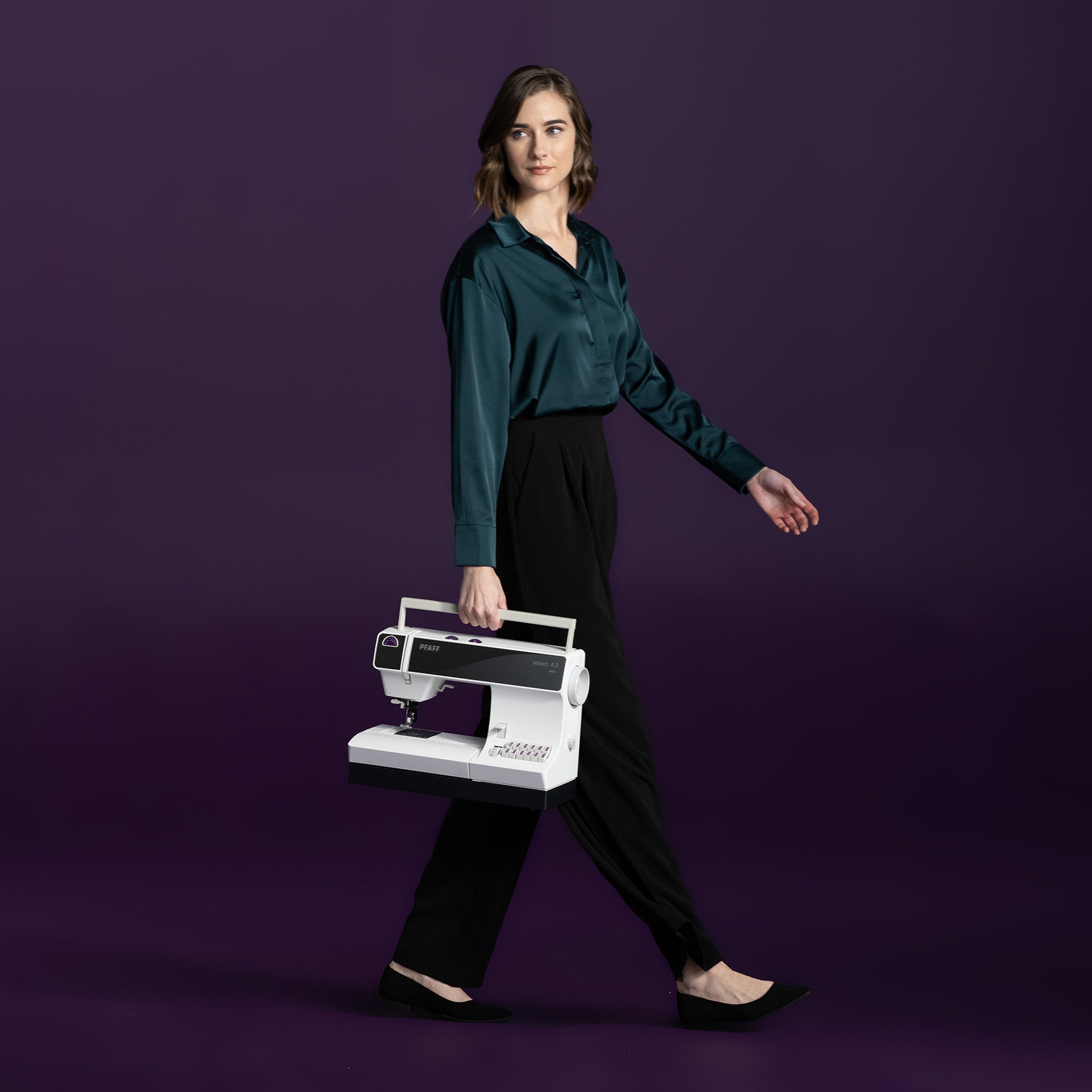
Explore this need in the finder →The PFAFF select 4.2 is a mechanical home sewing machine for someone who wants a foot pedal, physical stitch selection and integrated fabric feed rather than a screen-based workflow. The current U.S. PFAFF listing identifies SKU 850361112 (GTIN 7393033085940), describes the machine as mechanical and lists 40 stitches, a 5.5 mm maximum width, a 173 mm opening and a 900-stitches-per-minute maximum. This is a source-based assessment, not a hands-on test. The maker’s listing was marked out of stock and dealer-exclusive when checked; availability and a dealer’s package can change.
Mechanical controls, with a useful stitch range
“Easy Select” is a set of push-button stitch controls, not a display or an automatic stitch computer. The owner manual shows how to select individual patterns and combine certain utility buttons, so the machine is more versatile than a straight-stitch-only mechanical model while still asking the operator to choose stitches and settings directly. PFAFF lists 40 patterns. The manual’s examples span ordinary straight and zigzag work, stretch seams, blind hems, decorative finishes, patchwork and quilting stitches.
The listed maximum stitch width is 5.5 mm and maximum length is 6 mm. Those are machine limits, not a promise that every pattern uses the full range. Straight stitching uses zero width; the manual explains that some stitches have their own recommended settings. A sewist who regularly wants broader zigzags or decorative motifs should compare the exact width on a more feature-rich computerized machine instead of treating the number of stitch buttons as the main measure of versatility.
Why the IDT system matters—and where it stops helping
The select 4.2’s distinguishing mechanical advantage is PFAFF’s Original IDT, an integrated dual-feed mechanism that moves fabric from above and below. The manual says to engage it for compatible feet with a center-back cutout. This gives the machine a practical advantage on multiple layers, matching stripes or checks, and fabrics that tend to shift or pucker; it can also help a quilt sandwich advance evenly. It does not remove the need to test needle, thread, foot and tension on a scrap, and it is not an aftermarket walking foot supplied in the box.
The opening from needle to tower is 173 mm (6.8 inches). That is more room than the compact 145 mm opening listed for the PFAFF passport 3.0, but much less than the 250 mm listed for the computerized expression 715. The select 4.2 can handle clothing, mending, home-dec projects and manageable piecing, but bulky quilt rolls are still constrained by the arm. An extension table can support fabric outside the machine without enlarging that opening. The current written accessory list names an edge/quilting guide but not a separate extension table, while the product gallery also contains images labeled as an accessories bundle. Treat a table as unconfirmed until the exact dealer offer names it.
Garments, buttonholes and daily operation
The manual documents a built-in needle threader specifically on the 4.2 version, a removable accessory tray for free-arm access, a side-access removable bobbin case and a drop-feed control. It also documents twin-needle threading and a twin-needle hem routine. For twin-needle work, the manual says to use the center needle position; do not carry the single-needle 5.5 mm maximum into that setup. This is useful for paired topstitching on hems, not a reason to assume every stitch, presser foot or width works with two needles.
Buttonholes are a real but hands-on routine. In the model-family manual, the standard buttonhole takes four separately selected stitch steps: sew one side, select the bartack, sew the opposite side to length, then select the second bartack. The operator controls the sequence; it is not a one-step self-stopping buttonhole. The manual recommends making a sample and describes stabilizer or gimp thread for fabrics that need support. If an automatic buttonhole sequence is essential, the passport 3.0’s documented one-step routine is a different fit.
Speed is controlled at the foot pedal. The manual describes a half-speed or full-speed position on the pedal slide, while the product page publishes 900 stitches per minute as the maximum. That is a catalog specification, not a measured sewing speed through every material. The cutter is manual, thread tension is manual, and the product page lists a mechanical control style. I found no supported Start/Stop-without-pedal operation for this model, so do not choose it if pedal-free sewing is a requirement.
Choose it for the mechanical routine, not imagined package extras
The select 4.2 makes sense for a sewist who prefers direct button controls and a pedal, values IDT for consistent feeding, wants an integrated needle threader, and usually works on garments, repairs, home decor or modest-size quilting. It is a more specialized choice than an entry model when layered feeding and manual stitch control matter. The official page’s copy is internally inconsistent about whether the included-accessory total is 18 or 19; its written list names several useful feet, bobbins, needles, a foot control and power cord. Neither the count nor a gallery bundle image establishes a particular dealer’s box. Ask for the written SKU, included-foot list, table status, service terms and return conditions before buying, especially while the manufacturer store listing is out of stock.
Look at the PFAFF passport 3.0 if you want computerized selection, Start/Stop operation and automatic thread snips in a more compact 145 mm opening. Compare the expression 715 if a much wider 250 mm workspace and 9 mm stitch width outweigh the select’s mechanical controls; it is a different computerized tier, not simply the same machine with more stitches. The select 4.2 is not a serger: its manual describes overlock and overcasting stitches, but it does not trim an edge with a separate looper mechanism. Its decorative “embroidery” stitches likewise do not mean motorized hoop embroidery. If those are essential jobs, select the corresponding machine class rather than stretching this one beyond its documented role.
Key details at a glance
| Motor and stitch controls | The U.S. page calls this a mechanical machine. Easy Select is a push-button pattern selector; operation uses the included foot control. The owner manual documents half/full pedal positions, not Start/Stop sewing without a pedal. No display or computerized pattern memory is documented. |
|---|---|
| Stitch choices and limits | PFAFF lists 40 stitches and a maximum 5.5 mm width/6 mm length. The select-line manual separately shows select 4.2 utility, stretch, decorative, patchwork and quilting stitches. Decorative stitched “embroidery” is not a motorized hoop capability. |
| Buttonhole routine | Manual printed pp. 33-34 give the 4.2 a four-step standard buttonhole: the operator separately selects the right side, first bartack, left side and second bartack. It is not an automatic one-step/self-stopping sequence. |
| Supplied tools and fabric support | Product page accessory count conflicts: lead copy says 18 complimentary accessories while the specification says 19. Gallery alt labels some images as an accessories bundle; the written named list includes feet and an edge/quilting guide but not an extension table. Exact dealer package/table inclusion remains unknown. |
Use the exact model’s instructions for operating limits, supplied equipment and version differences.
Sources for this assessment
- Exact U.S. PFAFF select 4.2 listing: SKU 850361112, GTIN 7393033085940, mechanical control, listed specifications, stock/dealer status, image alt text and accessory claims.
- Official 40-page English select-line owner manual linked by the exact U.S. select 4.2 manual-directory card; pages 4-10, 11, 16, 18, 21-25, 32-34 and 37-39 individually inspected for 4.2-specific instructions.
- Reused archived official manuals index; its exact select 4.2 card links the same English select-line manual and the exact U.S. product page.
- Exact PFAFF select 4.2 image from the official U.S. product-page gallery; source page alt text names the exact model and the front-panel mark is visually legible.

Choose the operating routine that suits your work.
Start with whether you sew, embroider, serge or coverstitch, then compare controls, working area, supplied tools and setup limits.