
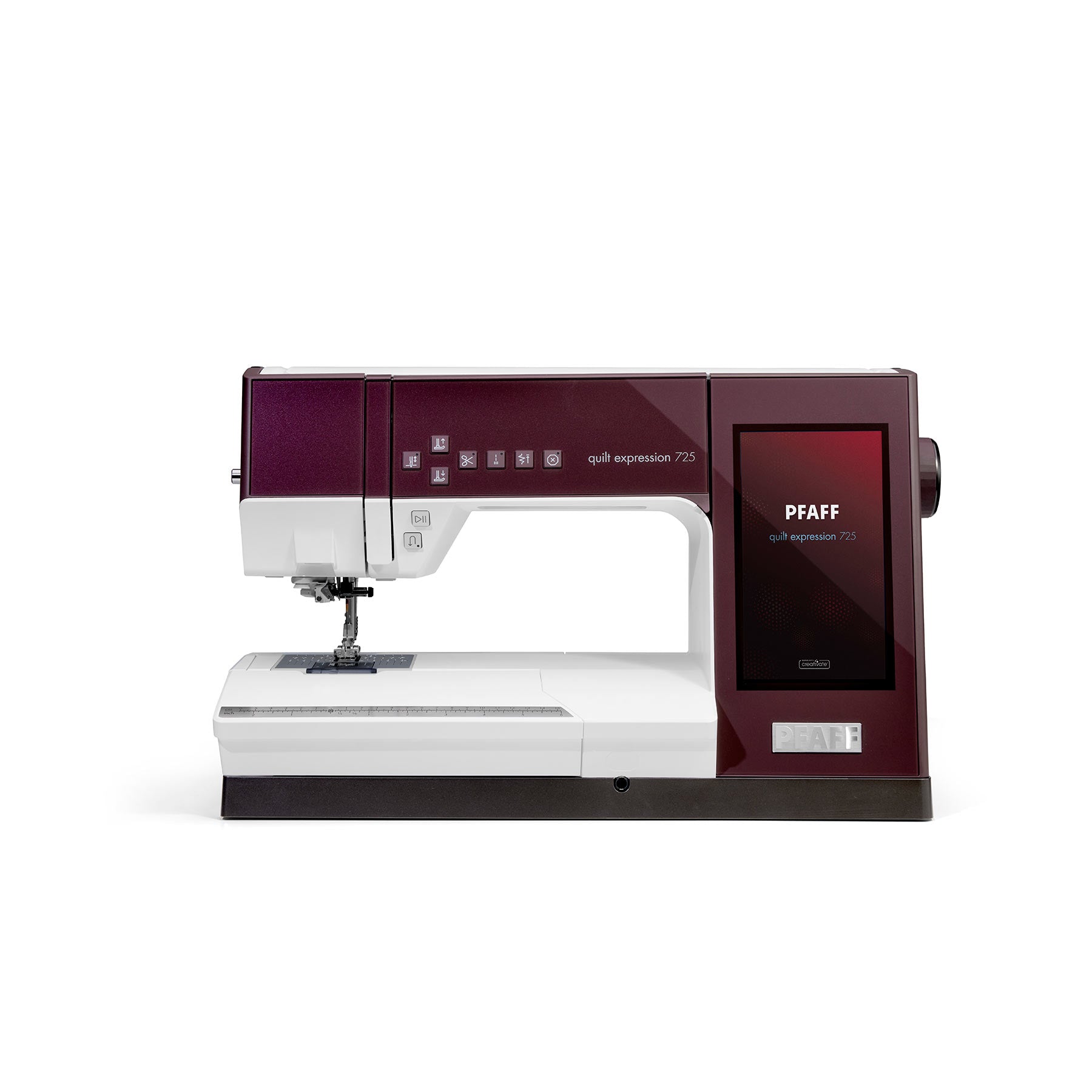
Your needs, this model
Does it fit your priorities?
Can I require roomy computerized quilting sewing with IDT, at least 9 mm single-needle width and a pedal-free speed ceiling?
Yes for this documented single-needle setup: the U.S. page and guide establish computerized controls, IDT, Start/Stop without the foot control, a speed slider, 9 mm maximum width and 250 mm needle-to-tower space. The guide’s technical table gives 1000 stitches/minute maximum.
Explore this need in the finder →Will this machine automatically sew a design inside a motorized embroidery hoop?
No. The exact product is listed as a sewing machine and its package does not include a motorized hoop unit. The 6A manual foot supports free-motion embroidery-like work, not the motorized-hoop workflow required here.
Explore this need in the finder →Can I insist on a published maximum of at least 1,050 stitches per minute?
No. The exact model guide states 1000 stitches/minute maximum, so a 1,050 minimum is not met.
Explore this need in the finder →Can an essential twin-needle setup also require automatic thread cutting?
Not established for this restricted setup. The manual explains twin-needle threading and stitch-width safety but does not specify automatic cutting in that mode; unknown does not pass.
Explore this need in the finder →Does the documented standard U.S. package guarantee a large extension table?
Not established. The product-page list and model manual do not identify an included extension table; check the seller’s written package.
Explore this need in the finder →The PFAFF quilt expression 725 is a quilting-oriented computerized flatbed, not a basic dial machine. Its exact U.S. listing identifies SKU 850337112 and was marked out of stock when checked. The machine is presented for quilters who want more room, fabric control and stitch editing at the needle. The official page and model guide are the evidence here; this is not a hands-on test.
Where the 725 earns its place
The space to the right of the needle measures 250 mm, just under ten inches. That gives a quilt sandwich more room to turn and settle than a compact general-purpose machine, but it is still a domestic flatbed, not a longarm. The Original IDT system feeds from above and below, which is useful when piecing layers that can creep. It is integrated into the machine rather than a separate walking-foot attachment; the standard package does not establish a detachable walking foot or an extension table. Confirm any dealer bundle in writing rather than reading either accessory into the model name.
The machine also gives quilting work a set of specific controls: adjustable laser guidance can help line up decorative stitch rows; the 1/4-inch quilting foot and straight-stitch plate support accurate piecing; and the knee lift lets a sewer raise the presser foot while keeping both hands on a bulky project. These are helpful aids, not substitutes for a test seam. Batting thickness, fabric, needle, thread and technique still affect feeding and stitch quality. If your table cannot accommodate a full-size machine, the advertised throat opening does not make the machine portable.
Computerized tools—and a number worth checking
The 8-inch color touchscreen, Stitch Creator, 9 mm maximum width and 6 mm maximum length make it easier to select or edit decorative stitches than on a mechanical dial-only machine. The maker’s page lists 730 stitches. Do not let that figure decide the purchase by itself: the page’s feature copy says six sewing fonts, while its specification table says four. The model-specific English guide lists four font families—Block, Comic, Cyrillic and Grand—so four is the defensible font figure and the page conflict remains visible.
The guide documents sewing with either the foot control or the Start/Stop button, and a separate slider sets a speed ceiling. It gives 1,000 stitches per minute as the maximum. A button-operated run is not cordless: the machine still needs its mains connection. Needle up/down, automatic needle threading, programmed thread cutting and automatic presser-foot lift are convenient on a long quilting session. The included 5A Sensormatic foot supports automatic buttonholes, while 5M gives a manual route. Test buttonholes on matching scrap and avoid assuming one setting suits every fabric.
Read the kit list before paying
There is a real discrepancy between two manufacturer documents. The U.S. product page repeats the 1A fancy-stitch foot in its “What’s Included” list and does not name 2A. The exact 725 guide lists 0A, IDT 1A and 2A, then feet 3, 4, 5A, manual 5M, 6A, 8 and the quarter-inch quilting foot. It also describes the straight-stitch plate, knee lift, five bobbins, foot control, cover, needles and basic tools. This is useful evidence about the model, but it does not settle which retail box a particular seller will ship. Ask for the exact included-foot list, table status and any bundle extras before checkout.
Know what the 725 is not
The 725’s built-in fonts create sewn lettering; they do not make it a motorized embroidery machine. The manual’s 6A foot is described for embroidery and Sensormatic free-motion work, which means the sewer moves the fabric by hand under the needle. The model page’s package does not list an embroidery unit or hoop. If you need the machine to move a hoop through digitized designs, shortlist a true sewing-and-embroidery configuration instead. Likewise, the 725 does not trim and overlock raw edges, make coverstitch hems or provide a longarm frame.
For ordinary seams and quilting with the same broad 250 mm workspace and integrated IDT feed, the reviewed PFAFF expression 715 is a useful comparison. The 725 makes more sense if its adjustable laser, presser-foot recognition and quilting controls will be used; it is not automatically a better choice just because the stitch total is larger. If a motorized embroidery hoop is central, compare an actual combination model such as the PFAFF creative icon 3 rather than treating CREATIVATE connectivity or stitched fonts as embroidery.
Care and buying checks
The manual calls for no oiling. Switch off before removing the needle plate, brush lint from the feed teeth and bobbin area, and take care near the thread-cutter blade. Because the manufacturer listing was out of stock at review time, verify current availability and exact SKU with an authorized seller. Keep the machine’s user guide and service support in mind: the screen and connectivity add capability, but also make this a more involved purchase than a straightforward mechanical machine.
Sources: the exact U.S. PFAFF quilt expression 725 listing, the official model manual directory, and the PFAFF quilt expression 725 User Guide 471098026E. Reviewed October 25, 2026; manufacturer documentation, not a hands-on test.
Key details at a glance
| Motor and stitch controls | The U.S. product page identifies the computerized touch-screen model, Start/Stop, speed slider and automatic thread cutting; the manual documents sewing with the Start/Stop button without the foot control. A foot control is also listed with accessories. The model guide gives 1000 stitches/minute maximum. |
|---|---|
| Stitch choices and limits | The current U.S. page states 730 stitches and 9 mm maximum width / 6 mm maximum length. Its feature copy says six sewing fonts but the specification table says four; the model-specific manual identifies four (Block, Comic, Cyrillic and Grand). Four is recorded; the conflict is preserved. The total-number field remains null because the page does not define what its stitch total includes. |
| Buttonhole routine | The page and manual list both Sensormatic 5A and manual 5M buttonhole feet. The manual describes automatic buttonholes using the 5A and manual buttonhole work with 5M. It does not establish one universal buttonhole length or a separate maximum; test on similar fabric and confirm the included-foot package. |
| Working space and size limits | The exact U.S. page states 250 mm (nearly 10 inches) from needle to tower. This broad flatbed space can make it easier to move a quilt sandwich, but does not make the machine a longarm. A separately supplied extension table is not established. |
| Supplied tools and fabric support | The official U.S. product page package list repeats the 1A fancy-stitch foot and does not name the 2A. The exact model manual lists 0A, IDT 1A, 2A, 3, 4, 5A, manual 5M, 6A, foot 8, and the 1/4-inch quilting foot, plus a straight-stitch plate and knee lift. The guide’s included accessories list also has the foot control, cover and basic tools. Ask the seller to confirm the written U.S. box; neither a detachable walking foot nor an extension table is established as included. Built-in IDT is a different feature from a detachable walking foot. |
| Needle setups, cutting and memory | The exact U.S. listing calls this a sewing machine and does not list a motorized embroidery unit or hoop in its package. The manual’s 6A foot is for embroidery/free-motion use, but free-motion sewing and sewn lettering do not establish an embroidery machine that moves a hoop through stored designs. No overlock, coverstitch or longarm plan is documented. |
| Presser-foot pressure | The model-specific guide documents adjustable presser-foot pressure as a sewing setting. This is distinct from thread tension; the setting does not guarantee successful feeding on every fabric stack. |
| Cleaning and lubrication | The manual says no oiling is needed. It directs users to switch off before removing the needle plate and cleaning the feed teeth/bobbin area with the supplied brush, take care around the cutter, and wipe the screen with a soft slightly damp microfiber cloth. Do not blow air into the bobbin case. |
Use the exact model’s instructions for operating limits, supplied equipment and version differences.
Sources for this assessment
- Exact PFAFF U.S. product page for quilt expression 725; lists SKU 850337112, the current product listing state, quilting-focused control/feed features, specifications and package list.
- Official Singer/PFAFF manual directory card names the 725 guide and links the exact U.S. product page.
- Official 104-page English PFAFF quilt expression 725 User Guide, document 471098026E; exact model guide inspected.
- Manufacturer-hosted product-page image; original JPEG 1800 × 1800, exact quilt expression 725 casing mark visually inspected.

Choose the operating routine that suits your work.
Start with whether you sew, embroider, serge or coverstitch, then compare controls, working area, supplied tools and setup limits.