
Your needs, this model
Does it fit your priorities?
Can I sew without the foot control while keeping computerized stitch choice and integrated IDT feed?
Yes in the Start/Stop sewing arrangement: the guide documents button operation and the speed slider, and the exact product page specifies Original IDT and a 7 mm width maximum.
Explore this need in the finder →Will a 145 mm sewing opening meet a 200 mm minimum for broad quilting projects?
No. The exact Passport 2.0 listing specifies 145 mm from needle to tower. The PFAFF ambition 610 is listed at 200 mm and the quilt expression 725 at 250 mm; check their other controls and package details too.
Explore this need in the finder →Does this model sew actual motorized-hoop embroidery, rather than decorative machine stitches?
No embroidery-unit or hoop operation is documented for the exact Passport 2.0. The 70-stitch chart is for sewing; compare a separately documented embroidery model if hoop designs are essential.
Explore this need in the finder →Can I require IDT and an adjustable presser-foot pressure dial for regular sewing?
Yes. The page identifies Original IDT, and the manual describes an adjustable pressure dial for very light or heavy fabric as needed. Test the intended fabric and foot on a scrap.
Explore this need in the finder →Does the exact listed package establish a detachable walking-foot attachment?
No separate walking foot is named in the 18-accessory list. IDT is integrated dual feed and should not be confused with a detachable foot in the box.
Explore this need in the finder →Can I require a programmable automatic thread cutter?
No. The maker specifies a manual thread cutter. Trim the thread by hand; do not select this configuration for automatic end-of-seam snipping.
Explore this need in the finder →Can I rely on an extension table and carrying bag being included with every offer?
No. The official accessory list does not name either item, although a gallery alt description refers to an extension-table/bag bundle. Confirm the exact seller SKU and written contents before buying.
Explore this need in the finder →Does the maker publish a maximum speed of 800 stitches per minute?
Yes. The current U.S. product specification states a maximum 800 stitches/minute, and the guide documents a speed slider. This is a maker-declared maximum, not a hands-on speed measurement.
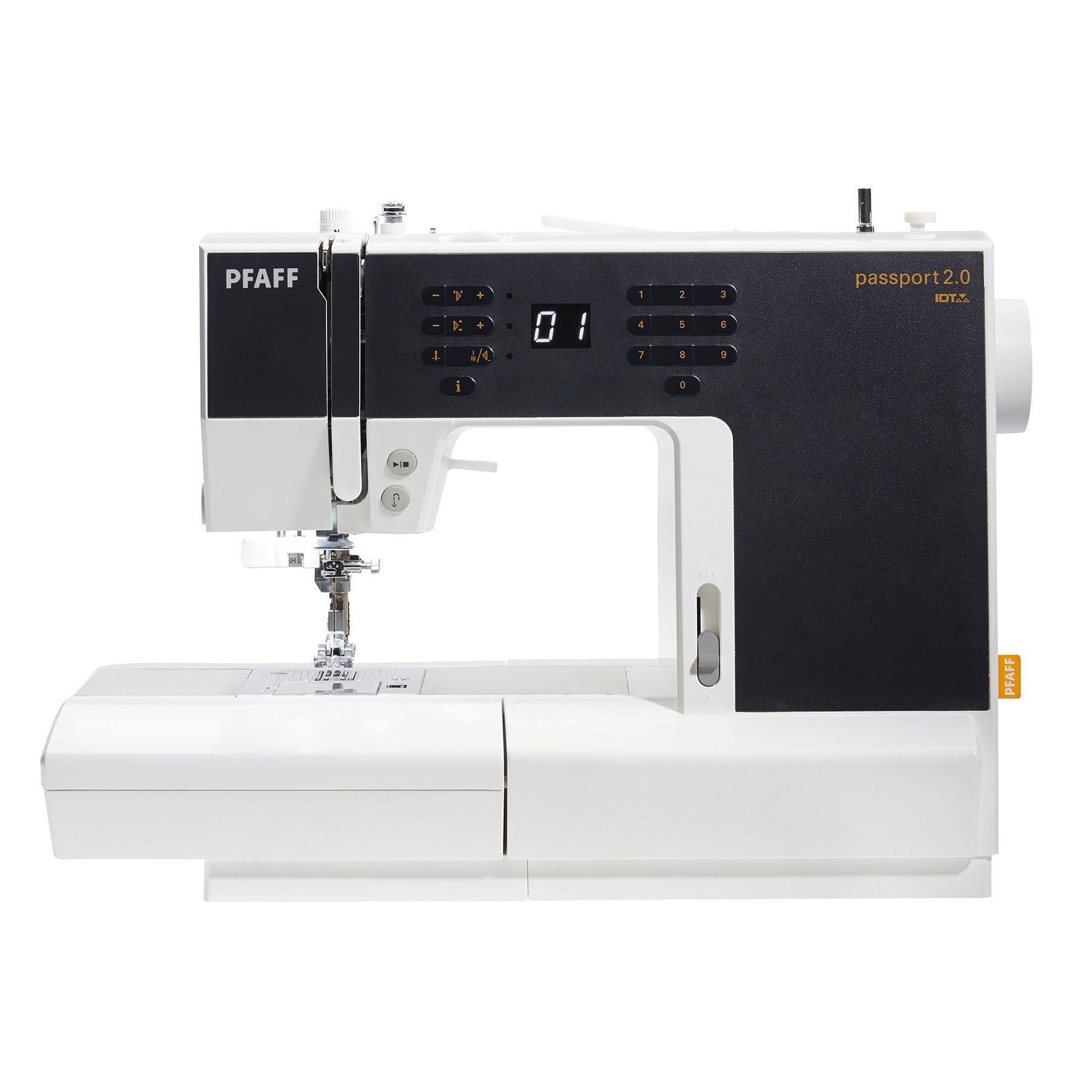
Explore this need in the finder →The PFAFF passport 2.0 is a compact computerized sewing machine, not an embroidery combo. Its current U.S. listing identifies SKU 850154112 and a 6.3 kg machine with 70 stitches, original IDT dual feed, Start/Stop, a speed slider and a 145 mm needle-to-tower sewing space. That mix is appealing if you take a machine to class, put it away between projects, or sew mostly garments, repairs and smaller home projects. The short throat is the tradeoff to weigh before treating “portable” as “easy to quilt anything.” This assessment is based on the manufacturer’s page and manual, not hands-on testing.
A compact sewing-only machine with useful feed control
The defining feature is PFAFF’s IDT system: the manual shows an integrated upper feed working with the feed dogs below. It is part of the machine, rather than a separate walking-foot attachment in the listed box. That distinction matters for buyers comparing package checklists, but the system is not a promise that every fabric, foot or seam will sew perfectly without a test. The manual still recommends selecting the right foot and checking tension and stitch settings on a scrap. The 70-stitch chart includes utility, stretch, quilt, needle-art, satin and decorative choices. The maker specifies up to 7 mm stitch width and 4.5 mm length, and the manual shows 29 needle positions for straight stitching. The feed dogs can be lowered for documented free-motion work such as stippling; that is not a dedicated longarm setup. A free arm is available by sliding off the accessory tray, which is useful for sleeves and other tubular areas. For routine sewing, this is more flexible than a basic dial machine without becoming a large-screen workstation. A small 1.3-inch display and numbered selection buttons choose stitches; a built-in needle threader reduces one repetitive step, while thread tension remains manual. Two bright work lights are listed. A manual thread cutter means you still trim the thread yourself rather than expecting a programmable snip at the end of a seam. The machine is not documented as a motorized embroidery unit, serger, coverstitch or longarm machine.Choose the controller and speed requirement carefully
The included foot control is the ordinary way to sew, and the guide also documents Start/Stop sewing without the pedal. A speed slider caps the pace in either routine. That gives a newer sewer or someone who prefers a button-operated motor a useful choice without removing the machine’s need for a household power outlet. The product page lists a maximum speed of 800 stitches per minute; the manual confirms that the slider sets the maximum but does not give a numeric tolerance or lower-speed scale. Treat 800 as the maker’s published maximum, not a measured speed at every stitch or fabric. The maker lists a one-step buttonhole foot, 5B, and the manual explains that the button placed in its holder sets buttonhole length. The stitch chart has several buttonhole styles rather than one universal result. Stabilize the fabric as the guide directs and sew a test on a similar scrap; a buttonhole choice for a light blouse is not automatically the best finish for a thick coat. The manual also describes adjusting presser-foot pressure for lighter or heavier fabrics, a separate control from upper-thread tension.Check the exact package and the available work area
PFAFF lists 18 included accessories, including the foot control, hard cover, bobbins, basic tools and six named feet: standard 0A, fancy-stitch 1A and 2A, blindhem 3, zipper 4 and one-step buttonhole 5B. The product page’s gallery image description refers to an “Extension Table with Bag Bundle,” but the same page’s written “What’s Included” list does not name an extension table or carrying bag. Do not treat the gallery label as proof that a particular dealer’s SKU includes them. Confirm the written box contents, return terms and exact 850154112 item before paying extra for a bundle. The 145 mm opening is much smaller than the 200 mm PFAFF ambition 610 and the 250 mm PFAFF quilt expression 725. The Passport’s 7 mm stitch width is also below the quilt expression 725’s 9 mm maker-stated maximum. If embroidery is essential, compare a documented sewing-and-embroidery machine such as the creative expect 350; it adds a separate hoop workflow, but its 165 mm sewing opening is still compact. These are different setups, not automatic upgrades for every sewer.Ownership is straightforward, but compact still means planned storage
At 6.3 kg (13.9 lb) the machine is lighter than many larger computerized machines, but a safe carry plan should include its foot control, power cord and any case or table only if that exact package supplies them. Measure the closed storage space and the table you will sew on; the manufacturer page does not provide body dimensions in its specification list. A hard cover is listed, but do not assume it is a padded travel bag. The manual says no oiling is needed. It does call for periodic cleaning: turn the machine off, remove the bobbin cover and needle plate as directed, and brush lint from the feed-dog and bobbin area. The guide specifically warns against blowing air into that area. Keep the cutter path clear and use the correct needle and foot; the manual identifies the 130/705H needle system. These small maintenance steps matter whether the machine lives on a table or travels to a class. Choose the Passport 2.0 when a portable computerized sewing routine, integrated IDT, buttonhole selection and a speed cap matter more than a wide throat or confirmed add-on bundle. Choose a roomier model for repeated quilt work, a separately documented embroidery arrangement for hoop designs, and verify the exact dealer package if a table or padded bag is essential. Its strongest case is not “does everything”; it is a well-specified compact sewing setup whose space and package limits are visible before you buy.Key details at a glance
| Motor and stitch controls | The exact U.S. page describes 70 stitches, a 1.3-inch diagonal display, built-in needle threader, needle up/down, manual cutter, speed slider, Start/Stop and manual thread tension. The manual shows numbered stitch selection, not a touchscreen. It documents sewing with either the supplied foot control or Start/Stop. |
|---|---|
| Stitch choices and limits | The U.S. specification lists 70 stitches, maximum 7 mm width and 4.5 mm length. Manual pages 7–8 show utility, stretch, quilt, needle-art, satin and decorative categories; the straight stitch offers 29 needle positions. The product page and guide do not specify an alphabet/font count, so sewing lettering is not matched as a confirmed feature. |
| Buttonhole routine | The model includes one-step buttonhole foot 5B. The manual says the button in the foot holder determines length, lists four buttonhole styles, and recommends stabilizing fabric and sewing a test on scrap. It does not specify a universal maximum buttonhole length. |
| Working space and size limits | The exact product page specifies 145 mm needle-to-tower space. That is a compact domestic sewing opening, not a quilting longarm frame. It is substantially smaller than the current PFAFF ambition 610 200 mm and quilt expression 725 250 mm listed openings. |
| Supplied tools and fabric support | The exact product page says 18 included accessories. Its written list includes five bobbins, felt pad, screwdriver, multipurpose tool, spool caps, seam ripper/brush, edge guide, auxiliary spool pin, foot control, power cord, needles, hard cover and feet 0A, 1A, 2A, 3, 4 and 5B. It does not name a separate walking foot, extension table or bag; however, its gallery alt text says ‘Extension Table with Bag Bundle.’ Leave table/bag inclusion unknown and verify a seller’s exact SKU and written contents. |
| Needle setups, cutting and memory | The exact model is a computerized domestic sewing machine. Its manual documents single-needle sewing, one-step buttonholes, drop feed for free-motion work and a free arm. The listing/manual do not document motorized-hoop embroidery, overlock, coverstitch or a dedicated longarm arrangement. An unknown embroidery feature cannot meet an essential hoop requirement. |
| Presser-foot pressure | The manual describes a presser-foot pressure dial, set to N by default. It says pressure may be loosened for very light fabric and tightened for heavy fabric; this is distinct from the upper-thread tension dial. |
| Cleaning and lubrication | The manufacturer guide says no lubrication/oiling is needed. It instructs owners to switch off, remove the bobbin cover and stitch plate as directed, and brush lint from the feed dogs and bobbin area; it specifically says not to blow air into the bobbin case. Needle system 130/705H is listed in troubleshooting. |
Use the exact model’s instructions for operating limits, supplied equipment and version differences.
Sources for this assessment
- Official U.S. PFAFF passport 2.0 Sewing Machine listing. Product structured data identifies SKU 850154112 and GTIN 7393033082628; page text provides 70 stitches, 7 mm width, 4.5 mm length, 145 mm sewing space, 6.3 kg, speed, IDT and the written accessory list.
- Official PFAFF passport 2.0 English owner’s manual, 32 pages. Exact overview, included feet, stitches, threading, IDT, pressure adjustment, controller, buttonholes, quilting and maintenance sections inspected.
Choose the operating routine that suits your work.
Start with whether you sew, embroider, serge or coverstitch, then compare controls, working area, supplied tools and setup limits.