
Your needs, this model
Does it fit your priorities?
Can I sew ordinary seams with computerized controls, no foot pedal, a separate speed ceiling and at least 9 mm of single-needle width?
Yes for this setup: the exact page and manual document computerized sewing, Start/Stop without the foot control, a speed slider, 9 mm maximum width and 250 mm of space to the right of the needle. The strict maximum-spm number is unresolved because the product page and guide conflict.
Explore this need in the finder →Will the expression 715 stitch a design in a motorized embroidery hoop?
No. PFAFF’s expression-line feature table explicitly marks the 715 as having no embroidery capability. Sewn fonts and a free-motion foot are not a motorized hoop setup.
Explore this need in the finder →Can I require at least 1,050 published stitches per minute as the maximum for the matched setup?
Not established for strict matching: the U.S. specification table says 1,050, but the 715-specific English guide says 1,000. No numeric speed value is put in the matcher plan; request clarification if this threshold is essential.
Explore this need in the finder →Can twin-needle sewing be required to use the automatic thread cutter?
No positive recommendation is made. The manual covers twin-needle threading and width safety, but the combined twin-needle/cutter behavior is not confirmed in this exact operating plan.
Explore this need in the finder →Can I require a supplied large extension table in the exact standard box?
The official included lists do not establish an extension table in the standard package. Confirm the dealer SKU and written box; an unknown package does not satisfy an essential table requirement.
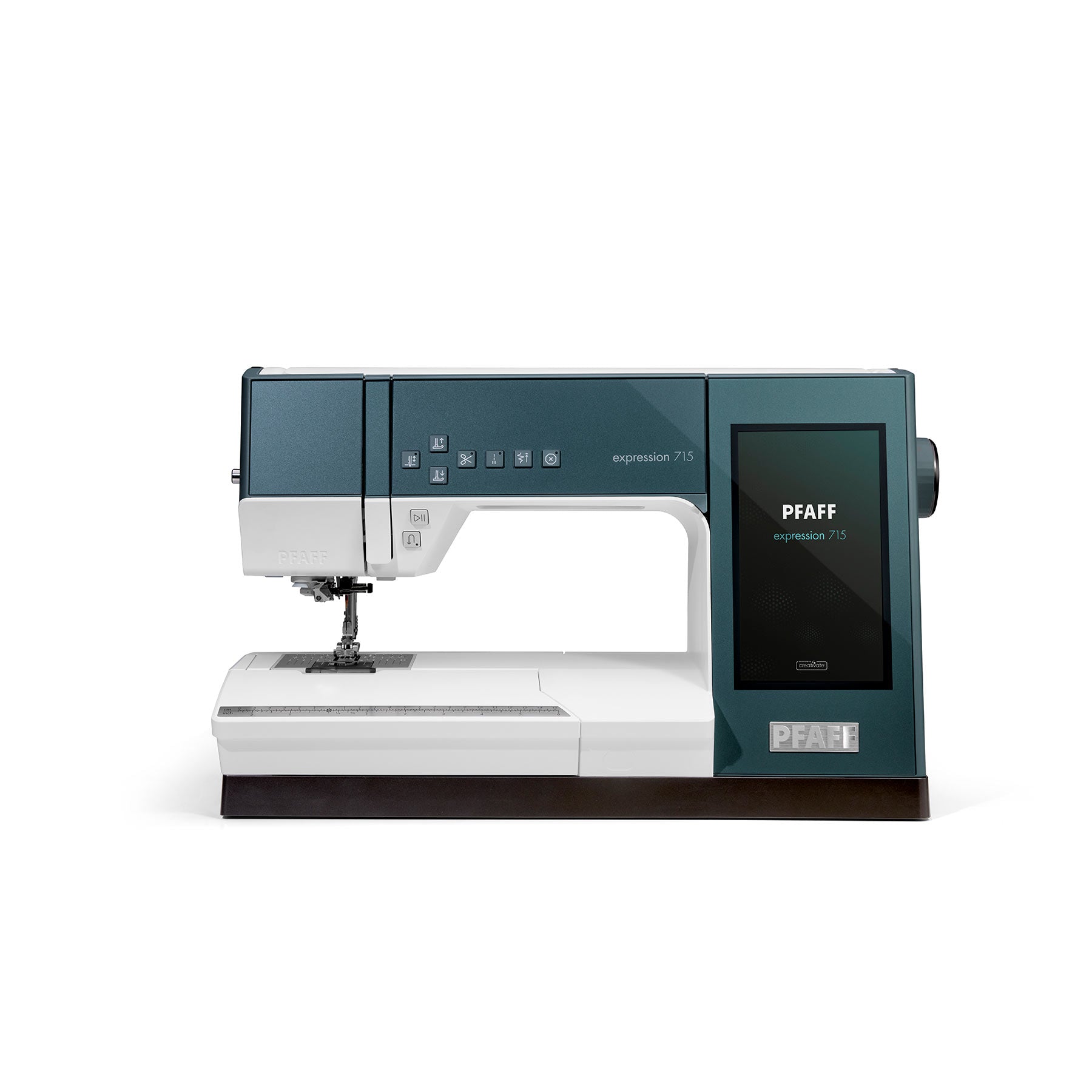
Explore this need in the finder →The PFAFF expression 715 is a substantial computerized sewing machine for someone who wants a wide stitch menu, a large touch display and more room at the needle than a basic flatbed. Its U.S. product page names the exact machine as SKU 850336112 and lists an 8-inch color capacitive screen, Original IDT dual feed, a 250 mm sewing space, 9 mm stitch width, four sewing fonts, an automatic needle threader and thread cutting. It is a sewing machine, not the motorized-hoop embroidery model in the PFAFF range.
Start with the work, not the stitch count
There is a reason not to choose this model by one headline number. The U.S. specification table says 600 stitches, while the FAQ lower on the same page says 274. The official manual describes stitch menus and techniques without reconciling those totals. Treat the exact count as unresolved and compare the routines you will use: utility seams, decorative and maxi stitches, stitched fonts, quilting, buttonholes and the specialty stitch techniques are more useful than either bare total.
The maximum-speed number also conflicts. The U.S. page gives 1,050 stitches per minute; the exact English user guide lists 1,000. The speed slider still lets you set a ceiling, but do not treat either published maximum as definitive until PFAFF clarifies the mismatch.
Control and feeding tradeoffs
The guide shows a foot control and a Start/Stop button. It explicitly says the button starts and stops the machine without the foot control, and a separate slider adjusts sewing speed. That gives two real single-needle sewing arrangements: pedal control for variable foot pressure, or a button-operated run with a manually chosen speed ceiling. For buyers who select computerized controls, pedal-free operation and a separate speed control as essentials, the expression 715 has documentary support; the exact maximum speed remains an open fact.
Original IDT adds an integrated upper feed alongside the feed dogs. It can help keep layers moving together for garments, home decor or quilt piecing, but it is not a detachable walking foot in the package, and no feed system eliminates the need to match needle, stitch, foot and stabilizer to the fabric. The 250 mm opening gives more clearance to the right of the needle than the 200 mm PFAFF ambition 620, though it remains a household flatbed, not a longarm. The manual also documents adjustable presser-foot pressure, needle up/down, adjustable LED lighting and a free arm after sliding off the accessory tray. Those controls are useful for fitted work and cuffs; they are not a guarantee that every thick or stretchy stack will feed well without test sewing.
Buttonholes, cutting and the actual kit
The kit supports both automatic and manual buttonhole approaches: the Sensormatic 5A foot sews a length entered on the machine, while foot 5M is for manually stepped buttonholes and can hold cording. The guide recommends stabilizing the area and testing on similar scrap. That matters more than assuming a one-step cycle will suit every fabric or button. The machine's cut button can trim both upper and bobbin threads on demand, or you can request a cut at the end of a stitch or sequence. It is not a promise that every seam is silently trimmed by default; the manual also warns against using the cut function with certain accessories installed in holes in the needle plate.
Check the exact dealer box before purchase. The product page's supplied-feet list repeats 1A and does not name 2A, but the model-specific manual lists 0A, 1A and 2A, followed by blindhem 3, zipper 4, Sensormatic buttonhole 5A, manual buttonhole 5M, embroidery/free-motion 6A, maxi-stitch 8 and a quarter-inch quilting foot. The manual also lists the foot control, power cord, cover and small accessories. Because those two official lists disagree, ask the seller to confirm the written U.S. package and any bundle additions. The page does not establish that a large extension table is included; IDT is also not a separate walking-foot accessory.
Connected features, sewing limits and care
The 715 connects to CREATIVATE over Wi-Fi for documented machine services, tutorials and updates. The official PFAFF expression-line comparison describes the 715 as having no embroidery capability; the full embroidery setup belongs to the creative expression 750. Four sewn fonts and a 6A embroidery/free-motion foot do not make this a motorized-hoop machine. The manual's broad boilerplate calls it a sewing-and-embroidery machine, but provides no hoop unit or embroidery operating plan for this 715. For that essential need, choose a model with a documented embroidery module instead.
The guide's care routine is practical: no oiling is needed. Switch off, remove the needle plate as directed, brush lint from the feed-dog and bobbin areas, take care around the cutter blade, and do not blow air into the bobbin case. At 11.5 kg and 571 × 220 × 307 mm, this is a large workstation rather than a portable machine to pack away after every short project.
Who should shortlist it?
Shortlist the expression 715 if you will use its wide sewing area, IDT feed, screen guidance, 9 mm stitches and connected help often enough to justify the larger body and more involved controls. If you want a smaller, simpler PFAFF flatbed, compare the ambition 620: it has a 200 mm opening, narrower 7 mm stitch width, fewer sewn fonts and a simpler screen, while retaining IDT and pedal-free Start/Stop. If motorized embroidery is essential, do not let the 715's CREATIVATE connection or sewn lettering satisfy that requirement; compare the reviewed PFAFF creative icon 3, which has an actual embroidery unit and hoops. Ask a dealer to settle the expression 715's current speed ceiling and exact accessory package before treating either as a purchase requirement.
Sources: the exact U.S. PFAFF expression 715 page, the official English expression 715 User's Guide (471097926E), and PFAFF's official expression-line comparison. Reviewed October 24, 2026; manufacturer documentation only, not a hands-on test.
Key details at a glance
| Motor and stitch controls | The exact U.S. page says Start/Stop and speed slider. The 715-specific manual says Start/Stop starts/stops sewing without the foot control and the separate slider changes speed. Its exact maximum conflicts: the U.S. specification table says 1,050 stitches/minute and the manual technical page says 1,000; max_speed_spm is therefore unknown for strict numeric matching. |
|---|---|
| Stitch choices and limits | The U.S. page specification table says 600 stitches; its FAQ says 274. The exact manual describes nine stitch-menu groups and four sewing fonts (Comic, Cyrillic, Outline and Script) but does not reconcile the two totals. stitch_patterns and total_sewing_patterns_including_fonts remain null; the maximum width is 9 mm and maximum length 6 mm. |
| Buttonhole routine | The package page names the Sensormatic 5A and Manual 5M buttonhole feet. The 715 manual says the 5A sews a length entered on the machine and describes automatic Sensormatic buttonholes; 5M is manually stepped and can hold cording. The guide recommends stabilizing and testing on a similar scrap. No maximum length is asserted. The matcher does not use a separate auto-stop promise because the material does not independently specify completion-stop behavior. |
| Working space and size limits | The exact manufacturer page gives 250 mm (9.8 in) needle-to-tower; the machine dimensions are 571 × 220 × 307 mm and net machine-only weight 11.5 kg in the manual. This is a home flatbed, not a dedicated longarm. |
| Supplied tools and fabric support | The U.S. page lists 1A Fancy Stitch foot twice and does not name 2A; the exact manual lists 0A, 1A and 2A, then 3, 4, 5A, 5M, 6A, 8 and a quarter-inch quilting foot. Manual accessories also list five bobbins, foot control, power cord, cover, needles and tools. Treat this as an unresolved page/manual package discrepancy and ask a dealer to confirm the written box. No extension table or separate walking foot is named; integrated IDT is different from a detachable walking foot. |
| Needle setups, cutting and memory | Official PFAFF comparison explicitly marks expression 715 as having no embroidery capability, while creative expression 750 has motorized embroidery. The 715 manual includes a 6A embroidery/Sensormatic free-motion foot and a generic sewing-and-embroidery sentence, but it documents no 715 embroidery unit, hoop or motorized embroidery plan. Four sewn fonts and CREATIVATE connectivity do not qualify as hoop embroidery. No serger, coverstitch or longarm plan is established. |
| Presser-foot pressure | The model-specific manual has a presser-foot pressure setting and says specialty techniques may need adjustment; pressure is separate from thread tension. |
| Cleaning and lubrication | The manual says no lubrication/oiling is needed. Switch off before cleaning the needle plate/bobbin area, brush lint from the feed teeth and bobbin area, take care around the automatic cutter, wipe the screen with a slightly damp microfiber cloth, and do not blow air into the bobbin case. |
Use the exact model’s instructions for operating limits, supplied equipment and version differences.
Sources for this assessment
- Exact current U.S. PFAFF expression 715 page, SKU 850336112; 600 stitch/1050 spm specification table and package list
- Official 98-page English PFAFF expression 715 User’s Guide, file/document 471097926E; manual technical page states 1000 stitches/minute
- Official U.S. manual directory card links the expression 715 English guide to the exact product page
- Official PFAFF expression-line comparison; explicitly marks expression 715 sewing-only with no motorized embroidery capability
- Exact U.S. product page hero image, 1800 × 1800 JPEG; casing displays expression 715

Choose the operating routine that suits your work.
Start with whether you sew, embroider, serge or coverstitch, then compare controls, working area, supplied tools and setup limits.