
On this page
Your needs, this model
Does it fit your priorities?
Can I insist on computerized ordinary sewing with Original IDT, a 250 mm workspace and at least 9 mm single-needle width?
Yes. The exact U.S. listing documents those capabilities together, and the official Expression Line guide identifies the 710; this is a sewing machine, not a longarm.
Explore this need in the finder →Can I sew with the pedal disconnected and set a separate speed ceiling?
Yes. The 710 guide documents Start/Stop without the foot control and a speed button/slider with four speed levels. The maker page's 1,050 stitches/minute value remains the listed maximum, not a project-speed promise.
Explore this need in the finder →Does this exact Special Edition listing include its five bonus presser feet?
The maker page lists a narrow-edge, invisible-zipper, piping, couching/braiding and open-toe appliqué foot. Ask the dealer to confirm the exact SKU's carton, especially if buying a used or dealer-selected bundle.
Explore this need in the finder →The PFAFF expression 710 Special Edition is a computerized, single-needle household sewing machine whose case and listed bundle are the point of this exact configuration. The U.S. product page identifies SKU 850356112, calls it a dealer-exclusive, and describes a five-foot bonus accessory kit. The page showed the listing out of stock when checked; that is a current availability snapshot, not a reason to omit the model or a promise about dealer inventory. Its core sewing brief is concrete: Original IDT integrated upper feed, 250 mm from needle to tower, up to 9 mm stitch width, a 3.5-inch color screen, and a page-listed maximum of 1,050 stitches per minute.
A roomy domestic machine, not a longarm
The 250 mm opening gives fabric more room to the right of the needle than a compact domestic machine. That is useful when guiding a quilt sandwich or a broad home-decor panel, but it remains a flatbed sewing space; the maker does not describe a longarm frame or carriage. Original IDT feeds from above as well as through the feed dogs, so it is an integrated system rather than a separate walking-foot attachment. That can be a good fit for layered seams and paired fabrics, but the listing is not evidence that every thick intersection, knit or slippery lining will feed perfectly. Test the actual stack and choose an appropriate needle and foot.
What changes in the Special Edition
The word “Special Edition” is not just a color label on this product page: the exact package description names five bonus feet—a narrow-edge foot for IDT, invisible-zipper foot, piping foot, couching/braiding foot for IDT, and open-toe appliqué foot for IDT. Those additions can make the package more ready for edge finishing, zipper insertion, piping and decorative work than a listing without that kit. The manufacturer’s page also contains multiple package-count labels and a longer itemized list; ask the dealer to confirm the exact carton and included accessories against SKU 850356112 rather than treating a headline count as a complete inventory. The five named bonus feet are the clearest edition-specific difference. Do not assume that a used or dealer-selected bundle still has them.
Controls that suit a deliberate sewing routine
This is a computerized machine, not a mechanical dial model. The page identifies 245 stitches in its feature copy but 247 in its specifications; because the maker does not reconcile those totals, neither is a sensible minimum to shop by. It consistently lists three sewing fonts, up to 9 mm width, up to 6 mm stitch length, stitch sequencing and tapering, and a built-in needle threader. More useful than the disputed headline count is whether you will use its specific routines: editable decorative stitches, lettering, mirror/reposition controls, or a saved sequence.
The product page lists both a foot control and a Start/Stop button. The linked Expression Line manual confirms that the 710 can start and stop without the foot control, and that its speed control reduces speed by half; a long press opens a four-level speed slider. That makes a pedal-free setup a documented option, while the included pedal remains available for conventional control. The manual also describes adjustable presser-foot pressure and automatic foot lift. These are real control choices, not proof of hands-on performance on a particular material.
Buttonholes, threading and practical limits
The page lists a Sensormatic one-step buttonhole foot and a separate manual foot. The manual says the Sensormatic 5A sews buttonholes up to 50 mm; longer buttonholes use the 5M foot in four manual steps. Automatic thread snips are listed, and the manual explains that snips operate at programmed cut commands and can be disabled. It also identifies the 710’s feed-dog lowering control, a useful setup option for compatible free-motion work. The 6A foot is described in the manual as an embroidery/free-motion foot, but it is not a motorized embroidery unit or hoop. If your essential job is placing stored designs in a hoop, choose a documented sewing-and-embroidery configuration instead.
The built-in needle threader is not universal: the manual excludes twin, triple and wing needles, as well as size 60 and smaller. It does document twin-needle threading and a width-selection setting that limits stitch width to the chosen twin needle. The safe numeric maximum for a twin setup is not established here, so do not use the machine’s 9 mm single-needle maximum as a twin-needle promise. The guide also says no oiling is needed and gives cleaning instructions; periodic lint removal and attention around the snips knife remain part of ownership.
Who should compare it?
Choose this exact Special Edition when the 710’s roomy domestic sewing space, integrated feed and computerized stitch tools match your work and you genuinely want the five named extra feet. Compare the standard expression 710 Purple listing carefully: it is a separate U.S. SKU and product page, not an interchangeable package identity, even though both pages describe a 710 sewing configuration. If the bonus kit is not useful, the regular page may be the more relevant comparison; if you need broader workspace, PFAFF’s performance icon is listed with a 310 mm opening, while quilt expression 720 is another reviewed computerized IDT option. Verify each seller’s exact SKU, table and carton before buying. The Special Edition is sewing-only, not a serger, coverstitch machine or motorized embroidery combination.
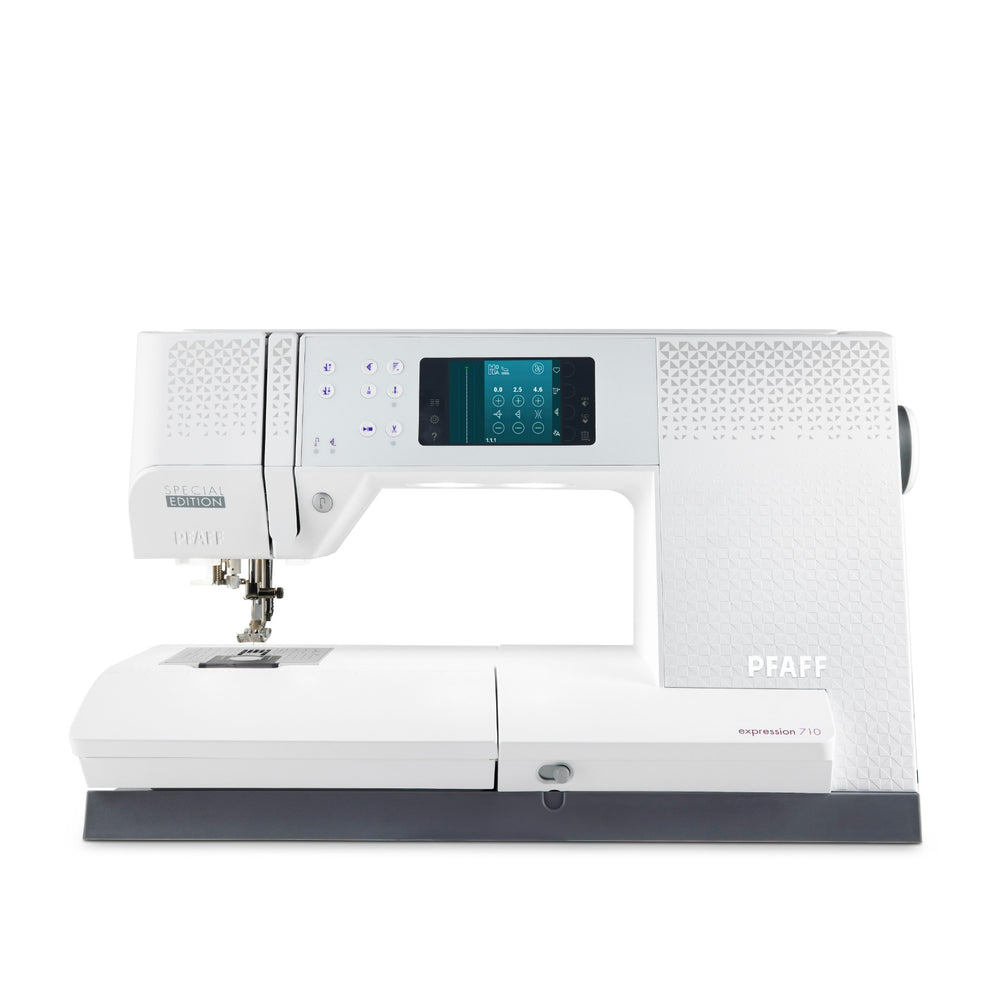
Sources: the exact U.S. PFAFF expression 710 Special Edition page and its linked official Expression Line user guide (710/720, including controls, buttonholes, twin-needle setup and care). The exact hero image shows the Special Edition badge and expression 710 mark; it does not show the kit, and the manufacturer does not disclose photo-versus-render method. Reviewed October 26, 2026 from manufacturer materials, not a hands-on test.
Key details at a glance
| Motor and stitch controls | The exact U.S. page lists a computerized 3.5-inch color screen, Start/Stop, a foot control and 1,050 stitches/minute maximum. The linked official manual identifies the 710 and documents sewing without a foot control, a speed button that halves speed and a four-level slider; the separate speed limiter is therefore supported. |
|---|---|
| Stitch choices and limits | The feature copy says 245 stitches while the specification field says 247; the product page does not reconcile the totals. Three sewing fonts, up to 9 mm width, up to 6 mm length and stitch tapering are listed. |
| Buttonhole routine | The page lists Sensormatic one-step 5A and separate manual 5M feet. The model guide supports 5A buttonholes up to 50 mm and directs a manual four-step 5M method above 50 mm. The guide does not explicitly establish automatic completion stopping as a separate requirement. |
| Working space and size limits | The exact U.S. page says 250 mm (9.8 inches) from needle to tower. This is a roomy domestic flatbed opening, not a dedicated longarm system. |
| Supplied tools and fabric support | The exact Special Edition page names five bonus feet and itemizes the kit. The page also displays multiple package-count labels; exact dealer carton should be checked against SKU 850356112. The page does not name an extension table or separate walking foot; integrated IDT is different. |
| Needle setups, cutting and memory | The product page lists a household sewing machine. Its 6A free-motion/embroidery foot does not establish a motorized hoop-embroidery unit. No overlock, coverstitch or longarm plan is represented. |
More specifications and setup details
| Cleaning and lubrication | The linked manual says no oiling is needed and describes cleaning the exterior and bobbin area; it cautions around the thread-snips knife. Follow the guide's cleaning steps rather than adding oil. |
|---|
Use the exact model’s instructions for operating limits, supplied equipment and version differences.
Sources for this assessment
- Exact U.S. PFAFF expression 710 Special Edition page; identity, feature copy, specifications, five bonus feet, package list and linked guide
- Exact whole-machine Special Edition listing on the complete current two-page PFAFF U.S. directory
- Official Expression Line user guide linked from the exact product page; manual identifies 710 and 720
- Official exact Special Edition hero image linked from its U.S. product page; 1000 × 1000 JPEG

Choose the operating routine that suits your work.
Start with whether you sew, embroider, serge or coverstitch, then compare controls, working area, supplied tools and setup limits.