
On this page
Your needs, this model
Does it fit your priorities?
Can I insist on computerized ordinary sewing with Original IDT, a 250 mm needle-to-tower workspace and at least 9 mm single-needle width?
Yes for the documented foot-control plan: the exact product page identifies computerized controls, IDT, 250 mm space and a 9 mm maximum stitch width.
Explore this need in the finder →Does the exact U.S. page list a one-step Sensormatic buttonhole and automatic thread snipping in an ordinary sewing machine?
Yes. The official Expression Line guide identifies the 710 and documents the Sensormatic 5A one-step routine up to 50 mm; longer buttonholes require the 5M foot and four manual steps. The exact page also lists automatic snips. Automatic completion stop is not independently asserted.
Explore this need in the finder →Does the U.S. product listing meet a requirement for a published maximum speed of at least 1,050 stitches per minute?
The exact page specifications state 1,050 stitches per minute, so the listing meets that published threshold. The linked guide was not readable here, so this remains a product-page value rather than a cross-checked manual value.
Explore this need in the finder →Can I rely on this listing for motorized-hoop embroidery?
No motorized unit or hoop is established by the exact page or its displayed package. The 6A accessory is a presser foot for embroidery/free-motion use, not proof of a motorized hoop setup.
Explore this need in the finder →Can I require a confirmed pedal-free Start/Stop and speed-limiter routine?
Yes. The official 710 guide says Start/Stop operates without the foot control, and the speed control halves speed or opens a four-level speed slider. The exact U.S. page separately lists the included foot control and 1,050-spm maximum.
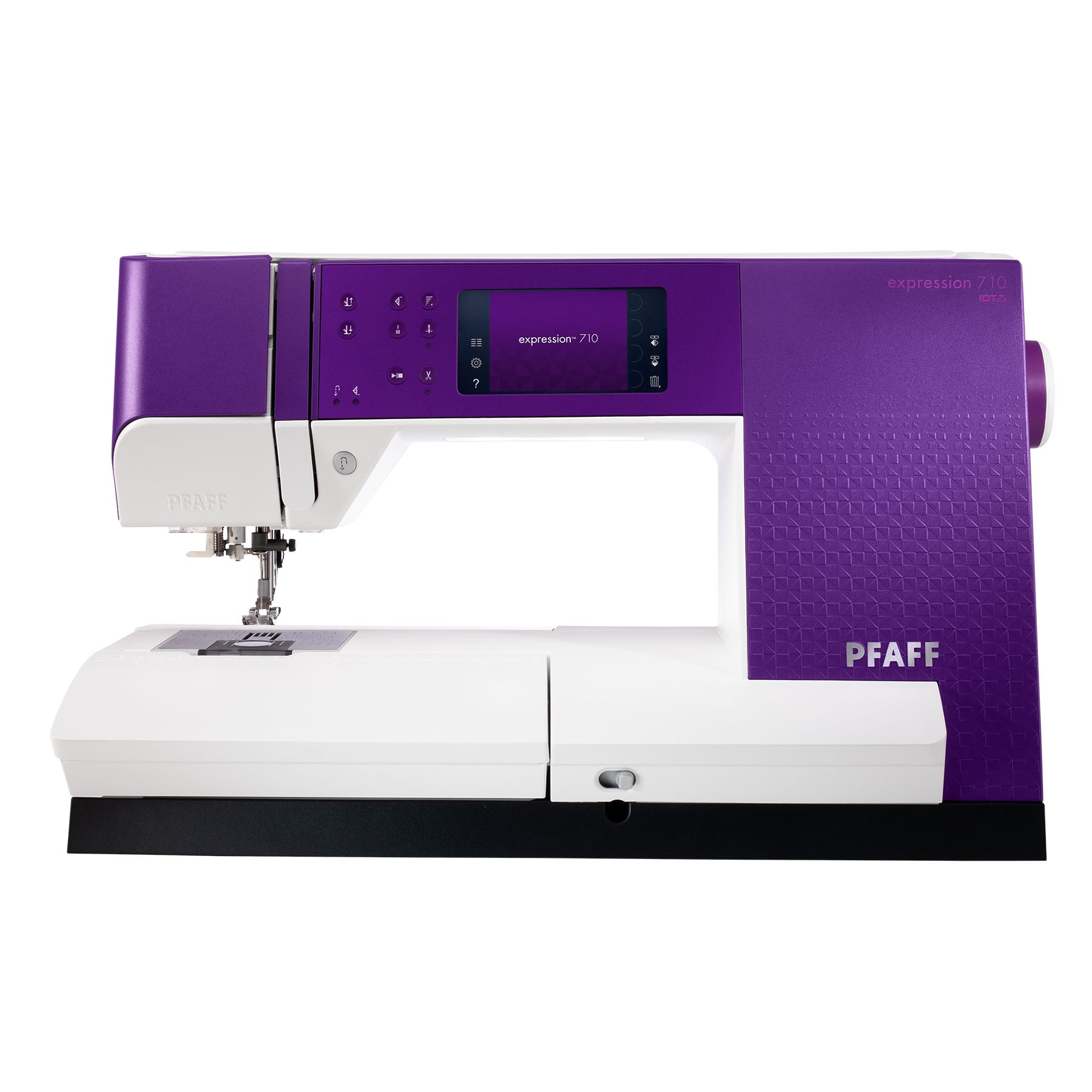
Explore this need in the finder →The PFAFF expression 710 is a computerized household sewing machine for someone who expects to use a wide stitch menu, integrated upper feed and a roomy flatbed. The U.S. listing identifies the purple expression 710, SKU 850349112, and specifies a 250 mm space from needle to tower, 9 mm maximum stitch width, a 3.5-inch color touch screen and Original IDT. This is a conventional sewing machine, not a serger or a dedicated longarm. The listing’s current back-order language is temporary; it is not evidence of dependable local stock.
Room and feed for layered sewing
The 250 mm sewing space is a useful difference from a compact domestic machine when you are guiding bulky home-decor pieces or a quilt sandwich beside the needle. It still leaves the fabric supported by your table and hands; it does not turn a flatbed into a longarm. PFAFF’s Original IDT is the machine’s integrated dual-feed system, carrying layers from the top as well as the feed dogs below. That can help keep adjacent layers moving together, but it does not guarantee that every knit, batting or thick crossing will feed evenly. Use an appropriate needle and foot, stabilize as needed, and test the exact stack before committing to a seam. IDT is built into the machine and is distinct from a separate walking-foot accessory; the maker’s displayed included-foot list does not call one a walking foot.
Do not choose by the headline stitch total
The official page contradicts itself: its feature copy advertises 245 stitches, while its specifications section says 247. It consistently lists three built-in sewing fonts, a 9 mm maximum stitch width and 6 mm maximum stitch length. Because the page does not reconcile its two stitch totals, neither number is a sound buying threshold. Think instead about whether the routines you will use are represented: utility seams, decorative work, lettering, buttonholes and stitch customization. The listing also describes stitch tapering, repositioning, mirror imaging, density adjustment and twin-needle customization. Those are useful controls for planned embellishment, not proof that the machine’s stitch library will suit every technique or fabric.
Buttonholes, cutting and control
PFAFF lists a Sensormatic foot for one-step buttonholes, a separate manual buttonhole foot, automatic thread snipping, automatic thread tension and an automatic presser-foot lift. The linked Expression Line manual identifies both the 710 and 720: it says the 5A Sensormatic foot handles buttonholes up to 50 mm, while longer ones use the 5M foot in four manual steps. A separate automatic completion stop is not established by that sequence alone. The displayed package list names both buttonhole feet and the foot control, alongside feet for standard, blindhem, zipper, free-motion and quarter-inch quilting work. Automatic tension is an adjustment aid, not a promise that one setting will produce a balanced seam in every thread-and-fabric combination. The manual says thread snips can be enabled for programmed cut commands, and explains how to adjust presser-foot pressure.
The exact page also lists a Start/Stop button, digital speed control and a maximum sewing speed of 1,050 stitches per minute, and includes a foot control. The linked manual confirms that Start/Stop can run the machine without the foot control; the speed button halves sewing speed, and a long press opens a four-level slider. A pedal-free setup and separate speed ceiling are therefore documented. The 1,050 figure remains the maker page’s stated maximum, not a project-speed promise.
What to confirm in the seller’s box
The listing promotes 24 complimentary accessories and then shows an itemized group of presser feet, a straight-stitch plate, foot control, power cord, needles, bobbins, tools, edge guide, stylus and spool caps. Those details are more useful than a bundle headline, but the selling dealer’s actual box can differ. Ask for the exact SKU and a written included-accessories list, especially if a particular foot or table is essential. The page does not establish that an extension table is included. It also lists an “Embroidery / Sensormatic Free-motion” foot; a foot is not an embroidery motor or hoop. The page and package list do not establish a motorized-hoop embroidery setup, so do not shortlist the 710 for that essential job. A serger or coverstitch hem likewise requires a different machine mechanism.
Who should compare it?
The expression 710 deserves a look if you want a large domestic work area, integrated IDT, 9 mm stitch width, computerized selection and built-in lettering without stepping up to a sewing-and-embroidery combination. If screen size is a deciding factor, compare the expression 715: its exact U.S. listing describes an eight-inch display, while the 710’s is 3.5 inches. They are not interchangeable editions, and the 715’s own source material has a separate stitch-count discrepancy. A less demanding sewing routine may not make good use of either machine’s breadth; in that case compare simpler models on their actual controls and working space rather than paying for decorative options. If stitch count, pedal-free control, the exact dealer bundle, twin-needle limits or care instructions will decide your purchase, consult a readable model-specific guide or obtain a written answer. No hands-on performance claim is being made here.
Sources: the exact U.S. PFAFF expression 710 Purple product page and its linked official Expression Line user guide (the guide explicitly covers 710 and 720; the copy read here documents button controls, speed settings, pressure, buttonholes and care). One page-linked retrieval returned an HTML viewer, so that failed response is preserved; the identical original PDF was already archived from the manufacturer’s manual source. The 245/247 stitch-total conflict, exact dealer carton, twin-width maximum and image production method remain unresolved. The maker-hosted image was visually checked against the purple expression 710 casing; the manufacturer does not disclose whether it is a photograph or render. Updated October 26, 2026 from manufacturer materials, not a hands-on test.
Key details at a glance
| Motor and stitch controls | The exact U.S. page lists computerized color-touch controls, a Start/Stop button, foot control and 1,050 stitches/minute maximum. The exact page links the official Expression Line guide, reused from its identical archived URL; the guide identifies the 710 and documents Start/Stop without foot control, a speed button that halves speed, a four-level slider and adjustable presser pressure. |
|---|---|
| Stitch choices and limits | The exact listing feature copy says 245 stitches while its specifications say 247; no stitch total is asserted. The listing consistently identifies three built-in sewing fonts, 9 mm maximum width and 6 mm maximum length. |
| Buttonhole routine | The exact page lists one-step Sensormatic 5A buttonholes and a separate 5M manual foot. The Expression Line guide states that 5A sews buttonholes up to 50 mm; above 50 mm use 5M in four manual steps. The manual does not explicitly establish automatic completion stop as a separate matcher condition. |
| Working space and size limits | The maker describes 250 mm (9.8 inches) from needle to tower. This is a household flatbed workspace, not a longarm quilting frame. |
| Supplied tools and fabric support | The page advertises 24 complimentary accessories and lists presser feet, straight-stitch plate, foot control, power cord and basic tools. Confirm the exact dealer box in writing. The page does not list an extension table or a separate walking foot; integrated IDT is a different feature. |
| Needle setups, cutting and memory | The exact listing names a household sewing machine and its displayed accessories include an embroidery/free-motion foot, but not a motorized embroidery unit or hoop. A foot used for free-motion work does not establish a stored-design hoop workflow. No hoop-embroidery, overlock, coverstitch or longarm operating plan is represented. |
More specifications and setup details
| Presser-foot pressure | Adjustable presser-foot pressure is not stated in the captured exact product-page material; the model guide was not readable. This remains unknown. |
|---|---|
| Cleaning and lubrication | The linked Expression Line manual says no oiling is needed and describes cleaning the exterior and bobbin area; it cautions around the thread-snips knife. Follow its cleaning instructions rather than adding oil. |
Use the exact model’s instructions for operating limits, supplied equipment and version differences.
Sources for this assessment
- Exact current U.S. PFAFF expression 710 Purple page, SKU 850349112; features, specifications, listed package and model-linked guide
- Previously archived second page of current U.S. PFAFF all-machines directory; exact expression 710 Purple card
- Previously archived official manual directory; exact expression-line manual card lists the expression 710
- Official product-page-linked expression-line manual URL; bounded fetch returned an HTML Mozilla PDF viewer, not manual pages
- Exact image linked as the hero image by the U.S. expression 710 product page; 1800 × 1800 JPEG
- Official Expression Line user guide linked by the exact 710 page; reused identical archived PDF and individually inspected 710 sections

Choose the operating routine that suits your work.
Start with whether you sew, embroider, serge or coverstitch, then compare controls, working area, supplied tools and setup limits.