
Your needs, this model
Does it fit your priorities?
Can I sew without the foot control, use the original IDT feed and keep a 7 mm stitch-width ceiling?
Yes in the computerized single-needle Start/Stop plan: the exact guide documents button sewing and the slider, and the exact U.S. page identifies Original IDT and 7 mm maximum stitch width.
Explore this need in the finder →Can I make automatic hoop embroidery up to 170 × 100 mm and transfer a design over Wi-Fi?
Yes for the included embroidery unit and hoop plan: the U.S. listing states CREATIVATE connectivity and a 170 × 100 mm maximum. Check the connected device and service terms for your intended transfer workflow.
Explore this need in the finder →Will this meet a quilting brief that requires at least a 9 mm stitch width and 240 mm needle-to-tower space?
No. The exact listing gives a 7 mm maximum width and 165 mm sewing space; the 750 and quilt expression 725 have larger documented openings, though each differs in other ways.
Explore this need in the finder →Does the exact standard package include a detachable walking foot?
No separate walking foot is listed. The original IDT system is integrated into the machine and is not the same as a supplied detachable walking-foot attachment.
Explore this need in the finder →Can I require a large extension table in the standard box?
No table appears in the exact U.S. box list or model guide's included accessories. Ask the seller for a written confirmation of any dealer bundle.
Explore this need in the finder →Will this machine trim and overlock a raw edge like a serger?
No. The creative expect 350 is a sewing-and-motorized-embroidery combination; neither overlock nor coverstitch operation is documented.
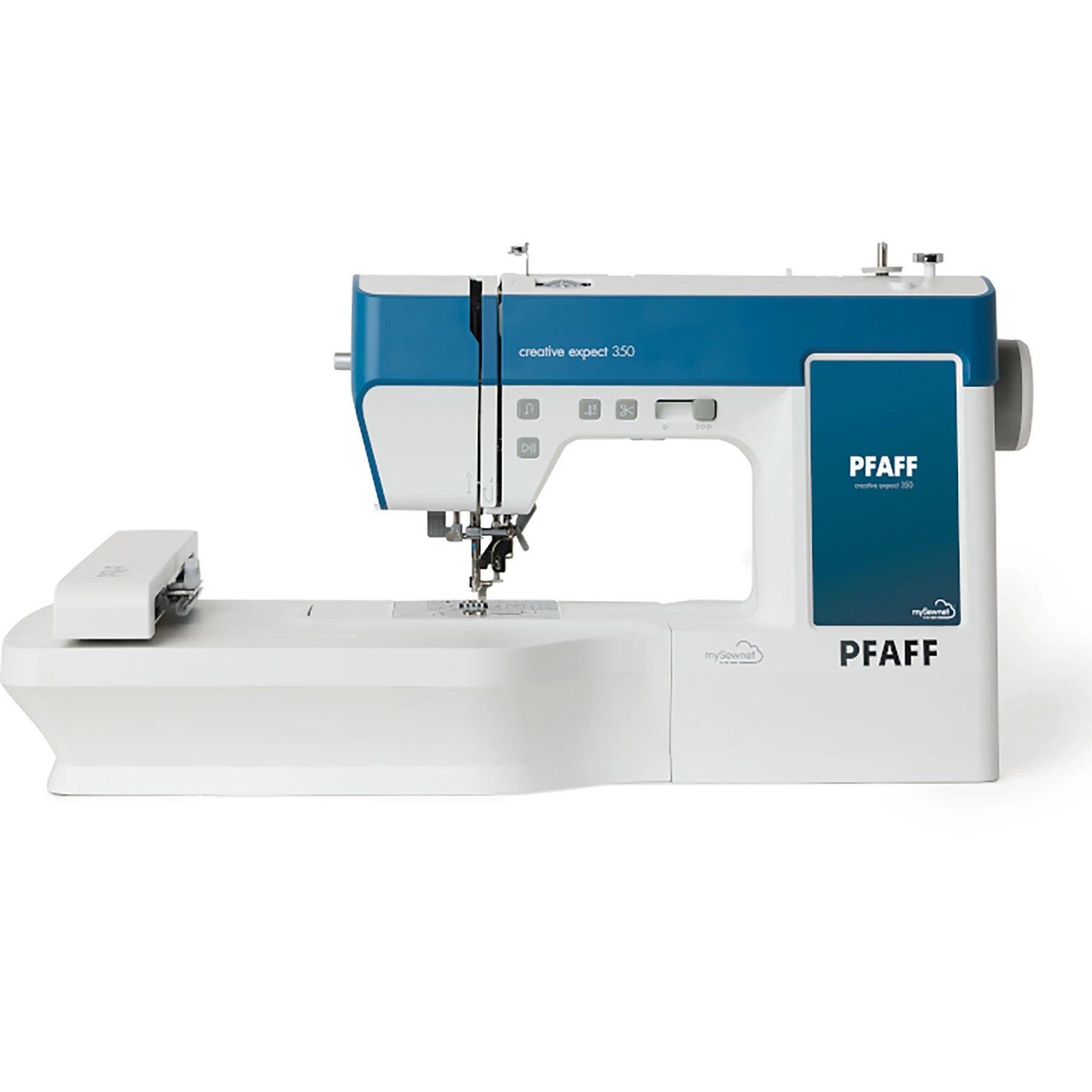
Explore this need in the finder →The PFAFF creative expect 350 is a true sewing-and-embroidery combination in a smaller, more approachable format than PFAFF's large-format flagship machines. Its U.S. listing identifies SKU 850353112, a 7-inch color touchscreen, 250 sewing stitches, built-in Original IDT feed and a separate motorized embroidery unit. It suits a home sewer who will actually switch between garment or home sewing and hoop embroidery. This is a source-based assessment of the maker's current listing and model-specific guide, not a hands-on test.
Two distinct jobs in one machine
For ordinary sewing, the expect 350 is a computerized single-needle flatbed with an opening of 165 mm from needle to tower. PFAFF's Original IDT system feeds the fabric from above and below; the maker confirms that it is built into this model. The listed 250 stitches and four sewing fonts support utility, decorative and lettering work, but those totals do not tell you which stitches fit your projects.
The machine has a 7 mm maximum stitch width and the guide lists stitch length up to 5 mm. That gives it room for a range of decorative and utility work, but it is a narrower field than PFAFF's 9 mm machines. The guide gives 165 mm of sewing space, a meaningful practical limit when turning a bulky quilt sandwich or large home-decor panel. The removable accessory tray exposes a free arm for trouser hems and sleeves. If your ordinary sewing is dominated by full-size quilts or broad panels, compare a machine with a larger opening before paying for embroidery functions you may not use.
Embroidery with an intentionally modest field
Unlike a sewing-only machine that can only make sewn lettering or free-motion decoration, this package includes an embroidery unit that moves the hoop through a design. The standard listing names two hoops, 170 × 100 mm and 100 × 100 mm; the page states 170 × 100 mm as the maximum area. That is useful for garment names, small motifs and compact home accents, but it does not provide the continuous large layout of a 360 × 350 mm setup. PFAFF's higher creative expression 750, for example, can reach that larger published maximum only with an optional Grand Dream Hoop, while its included hoops are smaller. The expect 350's 170 × 100 mm ceiling is the more honest starting point if most of your planned designs are small.
The page lists 180 built-in embroidery designs and ten embroidery fonts, with on-screen tools for moving, combining, rotating and mirroring. Stabilizer, thread, needle choice and hooping still matter; test a motif on similar material before stitching a finished garment.
Screen and wireless workflow, with a learning curve
The 7-inch color touchscreen supports on-screen layout work and stitch sequencing. PFAFF lists CREATIVATE Wi-Fi for transferring and saving designs among supported devices, while separate embroidery software is offered for advanced design creation. Do not assume the machine includes an unlimited desktop editor or a particular subscription tier; check current account and service terms if transfer is essential.
Basic operation can be either foot-controlled or button-operated. The guide documents Start/Stop sewing and embroidery without the foot control, plus a speed slider and needle-up/down control. Its technical table gives a maximum of 800 ± 50 rpm under a stated default straight-stitch condition. That figure is not a promise that every decorative stitch or embroidery pattern will run at that rate. A built-in thread cutter is useful, but the guide's functions should not be confused with a claim that it will automatically trim every thread type or every stitch sequence.
Package and size details to check
The U.S. page says the package contains 20 accessories. It names the two hoops; utility foot 0A; decorative-stitch foot 2A; blind-hem foot 3; zipper foot 4; buttonhole foot 5; and embroidery foot. The guide also identifies the foot control, five bobbins, needles, brush, seam ripper and guide. Neither list names a separate walking foot or extension table. Ask for written box contents if either is essential or a retailer is advertising a bundle.
The guide puts the machine itself at about 9.5 kg and its embroidery unit at 2.3 kg, with the embroidery assembly detached for storage. This is not a featherweight travel machine; you will need room for the machine, embroidery unit, hoops and stabilizer. The manual says no oiling is needed, but regular lint removal from the feed teeth and bobbin area is still part of ownership. For the intended buyer, the screen-and-hoop learning curve matters as much as the listed stitch totals.
Who should compare it—and who should not
Choose the creative expect 350 when a medium-size sewing bed, integrated IDT and genuine motorized embroidery in a 170 × 100 mm maximum field fit your projects. It makes more sense than a sewing-only model when you will use the hoops, and it is a more compact embroidery proposition than the creative expression 750 if you do not need the larger optional Grand Dream Hoop layout, 8-inch screen or 250 mm sewing space. For a quilting-first buyer, the sewing-focused quilt expression 725 offers a 250 mm opening and 9 mm maximum stitch width but no included motorized embroidery unit. Those are functional differences, not simple rankings.
Pass on this machine if your essential need is a large uninterrupted embroidery field, a wider 9 mm stitch, a longarm workspace, serger/coverstitch finishing, an included separate walking foot or a guaranteed extension table. It is also a poor value if you only want a computerized sewing machine and will leave the embroidery unit packed away. Before purchase, check the exact U.S. SKU, seller package, preferred hoop size, connected-service terms and a sample design workflow. The expect 350's advantage is combining two useful modes; its limits are the small embroidery field, modest sewing opening and the time needed to learn both workflows.
Sources: the exact U.S. PFAFF creative expect 350 listing, the official PFAFF manual directory, and the 72-page PFAFF creative expect 350 User's Guide 471131726B. Reviewed October 25, 2026; manufacturer documentation, not a hands-on test.
Key details at a glance
| Motor and stitch controls | The official page lists a 7-inch screen, semi-automatic needle threader, built-in thread cutter, needle up/down, Start/Stop and speed slider. The manual's technical table gives a maximum of 800 ± 50 rpm at default straight-stitch length. Because the source does not provide a guaranteed lower bound of 800 rpm, the numeric matcher value is unknown and cannot satisfy an essential minimum-speed request. |
|---|---|
| Stitch choices and limits | The exact U.S. page specifies 250 stitches, four sewing fonts and 7 mm maximum stitch width. The manual's technical table gives stitch length from 0 to 5 mm. The manufacturer does not define whether the 250 total includes fonts, so the total-stitch field remains null rather than adding the fonts. |
| Buttonhole routine | The product page includes a One-Step Buttonhole Foot 5. The manual describes one-step buttonhole stitches, but does not establish a universal maximum buttonhole size; match the buttonhole style and garment button on a sample. |
| Working space and size limits | The U.S. page gives 165 mm (6.5 inches) from needle to tower. This is a useful domestic sewing bed, not a large-quilt or longarm workspace. The accessory tray can be removed for free-arm work; the manual says the embroidery unit is detachable for ordinary sewing. |
| Supplied tools and fabric support | The U.S. page says 20 accessories and lists the 170 × 100 and 100 × 100 mm embroidery hoops, 0A utility foot, 2A decorative-stitch foot, 3 blind-hem foot, 4 zipper foot, 5 one-step buttonhole foot and embroidery foot among its box contents. The official guide also lists a foot control, five bobbins, guide, needles and tools. The page and guide do not list a separate walking foot or extension table. A dealer may bundle extras; verify the written package for SKU 850353112. |
| Needle setups, cutting and memory | Use the included embroidery unit and an included hoop for the machine's separate motorized embroidery arrangement; remove the unit for ordinary sewing and use the free arm when needed. No overlock, coverstitch or longarm capability is documented. |
| Cleaning and lubrication | The model guide says no lubrication is needed. It directs the user to switch off and unplug before cleaning, remove the bobbin cover and needle plate as instructed, brush lint from the feed teeth and bobbin area and keep the area around the cutter clear. It does not promise maintenance-free use. |
Use the exact model’s instructions for operating limits, supplied equipment and version differences.
Sources for this assessment
- Exact U.S. PFAFF creative expect 350 product page. Structured product identity names SKU 850353112; product text describes sewing and embroidery functions, 250 stitches, accessory package, IDT, Wi-Fi features, specifications and current listing.
- Official manufacturer manual directory; exact creative expect 350 English guide link and model card were personally inspected. Reused archived page from turn86; no duplicate directory body downloaded.
- Official 72-page English PFAFF creative expect 350 User's Guide, document 471131726B. Machine overview, accessories, buttonhole and control instructions, embroidery modes, care and technical specifications inspected.
Choose the operating routine that suits your work.
Start with whether you sew, embroider, serge or coverstitch, then compare controls, working area, supplied tools and setup limits.