
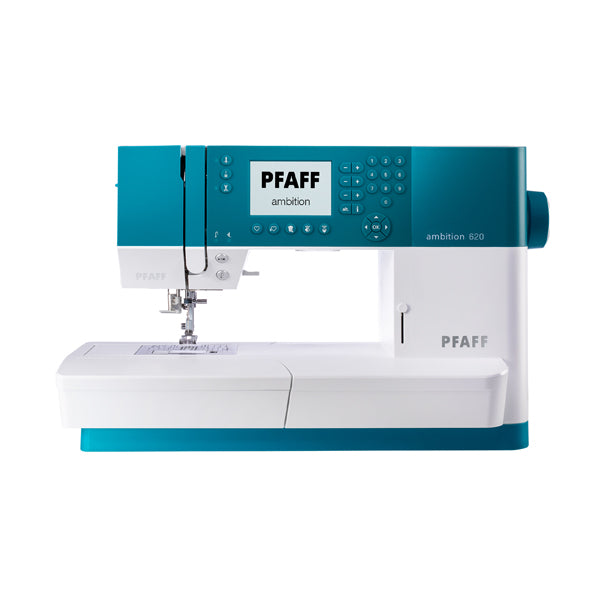
Your needs, this model
Does it fit your priorities?
Can a computerized setup sew without a pedal and cap its maximum speed?
Yes. The U.S. page lists Start/Stop and a separate speed slider; the ambition 620 section of the manual says Start/Stop runs without the foot control. It remains a mains-powered household machine.
Explore this need in the finder →Can I require automatic snips and a saved sequence containing built-in lettering in a single-needle plan?
Yes in the documented single-needle sewing plan. The manual describes the snips button and end-of-stitch/sequence behavior, two alphabets and saved sequences up to 60 stitches or letters. The guide excludes specified buttonhole and other special patterns from sequences.
Explore this need in the finder →Can this machine stitch a motorized embroidery hoop design?
No. The exact listing and manual identify a domestic sewing machine with sewn alphabets, not a motorized embroidery hoop setup; lettering alone is not embroidery.
Explore this need in the finder →Compared with the ambition 610, the PFAFF ambition 620 adds thread snips and stitch composition rather than a wider workspace. Its current U.S. listing identifies SKU 850225112. The manufacturer specifies 136 stitches up to 7 mm wide, two sewn alphabets, an automatic thread-snips function, stitch sequencing, a speed slider, Start/Stop operation, and PFAFF’s integrated IDT feed. The 200 mm opening to the right of the needle matches the 610 and quilt ambition 635; the 620 is a well-equipped flatbed, not a longarm or embroidery machine.
What changes at the needle
IDT feeds from above as well as through the feed dogs below. That can help keep layers moving together when piecing a quilt, stitching a long seam, or working with fabrics that tend to creep. It is an integrated upper feed, not a detachable walking foot. The guide identifies which included feet work with IDT and cautions that some sewing feet and techniques require different setups. Feed technology does not remove the need to select an appropriate needle, stabilize a buttonhole, support bulky work, or test an unfamiliar fabric stack.
The listed 136 stitches are not all one-click substitutes for basic seams. Most cover utility, quilting, decorative and buttonhole work; six numbered patterns (131–136) in the manual’s 620 chart call for optional specialty feet. The two built-in fonts are Block and Cyrillic. In the sewing sequence mode, the guide permits a saved pattern-and-letter sequence of up to 60 stitches or letters, but excludes buttonholes, eyelets, bartacks, darning and sew-on-button stitches from saved sequences. That makes short sewn labels and repeatable decorative combinations possible; it does not turn the 620 into a motorized embroidery model or establish computer-file design transfer.
Buttonholes and the controls that matter
The one-step buttonhole uses foot 5: place the button in the foot’s holder, choose the pattern and sew a stabilized test on scrap before sewing the garment. The button sets the finished length; the guide covers buttonholes up to 25 mm. There are several styles, including linen, standard, rounded and eyelet forms, so stitch count should not be read as a promise that every style suits every cloth or button.
The Start/Stop button can run the motor without the foot control, while a separate speed-control lever sets the maximum speed. That is useful for long, steady seams or users who prefer not to regulate the motor with a pedal; the machine still needs a household electrical outlet. The maker lists an 800-stitches-per-minute maximum, not a speed guarantee under every stitch or fabric load. The needle up/down control helps hold a pivot point. Thread snips are more capable than a hand-operated edge cutter: the manual says the button can cut both threads on demand, or be set to cut when a stitch or sequence completes. It remains a user-selected operation, not a claim that the 620 trims automatically after every ordinary seam without a setting.
Package and setup questions before purchase
The page lists standard foot 0A, IDT fancy-stitch foot 1A, fancy-stitch foot 2A, IDT blindhem foot 3, IDT zipper foot 4, and one-step buttonhole foot 5, plus a foot control, hard cover, power cord, needles, bobbins and small tools. The manual separates the 620’s kit from accessories that are shown for the companion quilt ambition 630; do not borrow the 630’s extra quilting feet when checking a 620 box. The regular included list does not name a large extension table or detachable walking foot. If either is essential, ask the dealer to confirm the exact SKU and written box contents rather than infer a bundle from a photo or another model’s kit.
The manufacturer currently directs the U.S. 620 listing to a store/dealer rather than a direct online add-to-cart. Check the exact ambition 620 identity, authorized seller, warranty terms, local service and package before comparing offers. Search results can mix refurbished units, the ambition 610 and the quilt ambition 630; a similar teal-and-white machine is not sufficient proof of an identical listing.
Limits and care
The ambition 620 is for ordinary single-needle sewing. Its decorative lettering is sewn by the needle as the fabric feeds under the presser foot; there is no documented embroidery hoop arrangement. A chain of overcasting patterns is not a serger, and a mock-cover-hem stitch is not a coverstitch mechanism. The 200 mm needle-to-tower span helps with home quilting and garment work, but quilt bulk still needs table support and careful handling. It is not a dedicated longarm system.
Presser-foot pressure can be adjusted separately from thread tension, and feed dogs can be lowered for documented free-motion work. Those controls give a careful sewer more options across light, stretchy or layered fabric, but settings still need a test swatch. The manual says routine oiling is not needed; it directs cleaning lint from the bobbin and feed-dog area with the machine off, and warns against blowing air into the bobbin case. That specific care advice is more useful than assuming every computerized machine takes the same maintenance routine.
Which ambition is the closer fit?
Choose the 620 over the ambition 610 when the two fonts, stored sequences and thread-snips control solve a real sewing task. The 610 keeps the same 200 mm opening and IDT approach with a simpler stitch set and hand-operated thread cutter; its own package and manual deserve their separate review. The quilt ambition 635 moves to a color touch screen and a larger 201-stitch chart, while keeping the 200 mm opening and IDT. Its extension-table bundle status also needs seller confirmation. None of these sewing-only models supplies hoop embroidery. If the essential requirement is embroidery, a serger’s cutting/overlocking mechanism, a true coverstitch hem, or a dedicated longarm, look at a different operating type rather than asking this machine to cover it.
Choose the ambition 620 when its feed, speed, sequencing and snips solve real sewing work; confirm the dealer’s exact box, optional feet, table and service arrangements before buying.
Key details at a glance
| Motor and stitch controls | The exact U.S. page identifies a computerized machine with a 3.6-inch diagonal display, Start/Stop button, separate speed-control slider and foot control. Manual code 4710496-26A has an ambition 620-specific control chapter (pages 28–40); Start/Stop runs without the foot control but still needs mains power. |
|---|---|
| Stitch choices and limits | The product specification states 136 stitches, 7 mm maximum width and 5 mm maximum length. The 620 stitch chart lists two sewing alphabets, Block and Cyrillic, separately from the 136 stitches. Six charted patterns (131–136) require optional beading, candlewicking or join-and-fold-edging feet; do not count these optional feet as standard accessories. |
| Buttonhole routine | The shared official guide’s ambition 620 stitch chart lists seven buttonhole patterns. Its one-step foot 5 uses the inserted button to set length, up to 25 mm; the guide directs the user to stabilize the fabric and test on a scrap. It does not mean that every style is suitable for every button or cloth. |
| Working space and size limits | The exact product page states 200 mm (7.87 in) from needle to tower. The shared guide’s technical table gives 480 × 193 × 300 mm and net machine weight 8.8 kg. This is a household flatbed opening, not a longarm frame. |
| Supplied tools and fabric support | The page’s included list names standard foot 0A, IDT fancy-stitch 1A, fancy-stitch 2A, IDT blindhem 3, IDT zipper 4 and one-step buttonhole 5, as well as foot control, cover, power cord, needles, five bobbins, tools and other small accessories. It does not list an extension table or separate walking foot. The companion quilt ambition 630’s optional feet are treated as separate; confirm the exact dealer SKU and box if a table or quilting foot is essential. |
| Needle setups, cutting and memory | The ambition 620 has single-needle household sewing plans; stitched alphabets and sequences are not hoop embroidery. The current manual documents twin-needle threading and a width program, but the behavior of thread snips, lettering and saved combinations in twin-needle operation is not used as an essential positive because the source does not establish those combinations. It is not a serger, coverstitch or longarm system. |
| Presser-foot pressure | The guide identifies a presser-foot pressure dial and separate electronic thread-tension adjustment. Pressure is adjustable for fabric; it does not guarantee identical feeding for every layer. |
| Cleaning and lubrication | The exact guide says no lubrication/oiling is needed. It instructs users to clean lint from feed dogs and bobbin area with the machine switched off, and warns not to blow air into the bobbin case. |
Use the exact model’s instructions for operating limits, supplied equipment and version differences.
Sources for this assessment
- Exact U.S. PFAFF ambition 620 product page, SKU 850225112
- Official 68-page English ambition 620 / quilt ambition 630 User’s Guide, code 4710496-26A, ©2018
- Official U.S. manual directory labels the linked guide PFAFF ambition 620 Sewing Machine Manual and links the exact U.S. product page
- Previously archived two-page current U.S. PFAFF whole-machine directory; ambition 620 row already recorded in the observed inventory
- Exact official PFAFF ambition 620 image from its current U.S. product page; image method not declared

Choose the operating routine that suits your work.
Start with whether you sew, embroider, serge or coverstitch, then compare controls, working area, supplied tools and setup limits.