
Your needs, this model
Does it fit your priorities?
Do you need a knife-trimming overlock machine for raw-edge finishing?
Yes. The exact admire 3000 page and stitch chart identify a 4/3/2-thread overlocker for overlock, flatlock and rolled-edge formations.
Explore this need in the finder →Must the same machine make a coverstitch hem without cutting the edge?
No coverstitch plan is documented for this exact PFAFF admire 3000. Choose a coverstitch machine or a model with an explicit combo plan.
Explore this need in the finder →Do you require automatic air threading for the loopers?
The admire 3000 manual shows manual color-path threading for both loopers; its included hand tool assists threading the needles, not air-threading the loopers.
Explore this need in the finder →Do you need both a supplied extension table and adjustable presser-foot pressure?
The exact U.S. PFAFF page lists the 10-inch extension table, and the manual shows an adjustable pressure dial. Test the chosen fabric on a scrap.
Explore this need in the finder →Must the machine sew ordinary lockstitch seams and buttonholes?
The admire 3000 is an overlocker; its exact page and guide do not establish conventional lockstitch seams or a buttonhole routine.
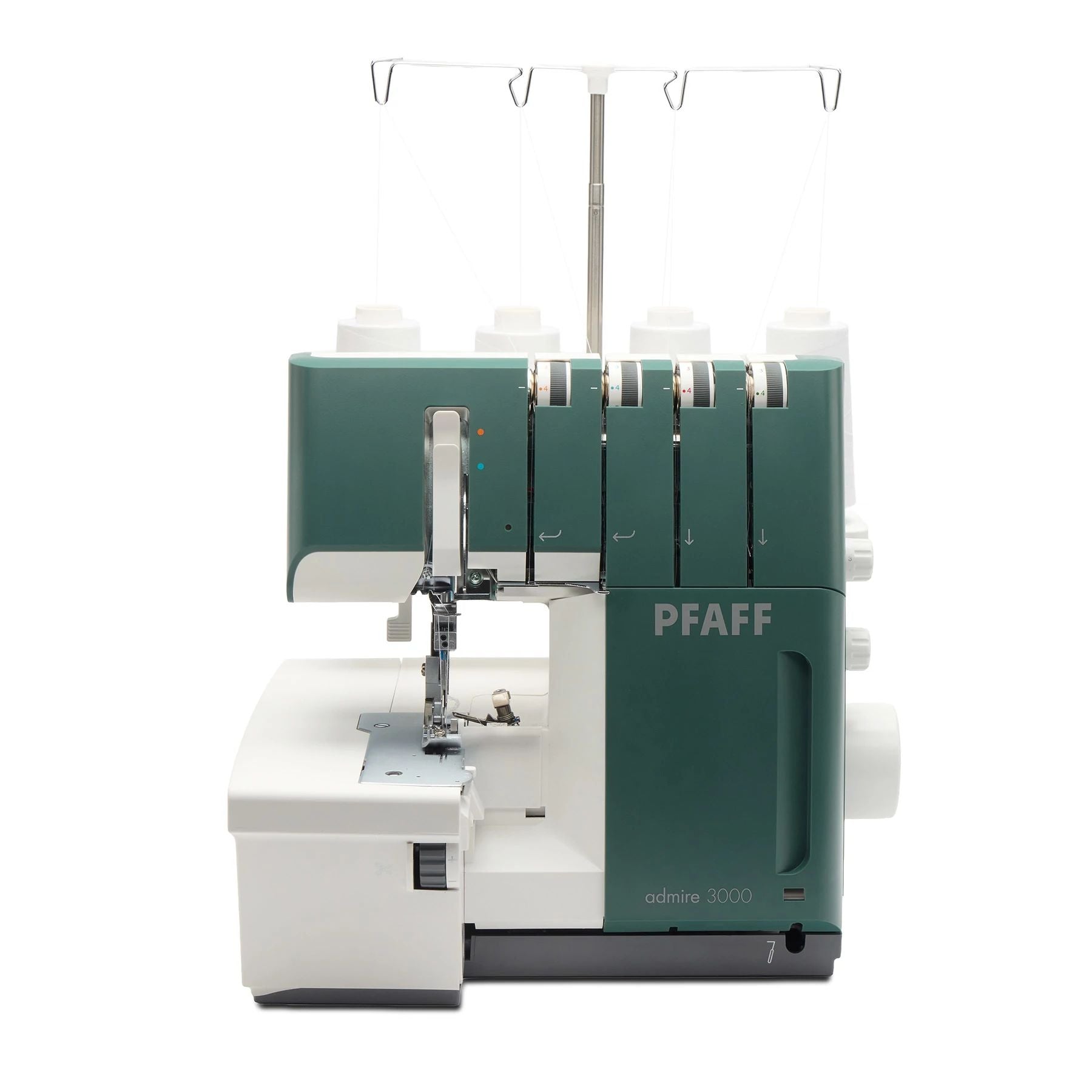
Explore this need in the finder →The PFAFF admire 3000 is a dedicated U.S. overlock machine, SKU 850352112, for trimming and finishing fabric edges with serger stitches. Its manufacturer lists 16 stitch choices and 4-, 3- and 2-thread capability. That range makes it a plausible companion for a garment maker who already has an ordinary sewing machine and wants stretch seams, edge finishes, flatlock effects or rolled hems. It is not the machine to choose if you need one chassis to make normal lockstitch seams, a separate coverstitch hem or an independently documented chainstitch.
What the stitch count does—and does not—buy
The 16 choices are overlock formations, not 16 general-purpose sewing stitches. The exact English manual explains that settings combine needle position, thread routes, tension and the upper-looper converter. Its chart covers four-thread overlock seams, three-thread stretch and overlock variants, narrow edges, flatlock and picot edges, plus two-thread overlock, wrapped overlock and rolled-edge formations. Several entries are wide/narrow alternatives. Switching from a strong four-thread seam to a two-thread rolled edge is a setup change, not a menu tap.
The cutter is part of the decision. In ordinary overlock sewing it trims the raw edge while the needles and loopers form the finish. For rolled hems, the manual directs you to retract the stitch finger, change the thread arrangement and sample the fabric. A two-thread setup needs the supplied upper-looper converter. Flatlock also depends on tension and fabric orientation; the manual says the joined pieces must be pulled apart to flatten the stitch. Those details help buyers who are happy to learn a serger chart, but they are real setup work for anyone expecting automatic stitch balancing.
Edge control and fabric handling
Precise Thread Control is a useful differentiator: the manual describes it as a fine adjustment to the stitch finger that changes how looper threads wrap around the fabric edge. It complements the separate tension and cutting-width controls rather than replacing them. The needle system can use one or two needles; the manual gives a 3–9 mm cutting-width range and 0.8–4 mm stitch length. It also lists differential feed from 0.7 to 2.0 and adjustable presser-foot pressure. These controls let you counter stretching or puckering, gather lightweight fabric, and tune an edge—but the manual repeatedly calls for test sewing on a similar scrap before sewing the project.
The included extension table adds 10 inches (25.5 cm) of support, and the knee lifter raises and lowers the foot while your hands stay on the material. That is helpful for long garment panels or awkward bulky sections. Do not mistake the table for a larger needle-to-body throat: the U.S. listing and manual do not state a numeric serger clearance. A knee lift or extra foot height also does not prove that every heavy stack will pass cleanly. The manual advises against forcing fabric, warns that pins can damage the cutters, and gives troubleshooting steps when feed is poor.
Threading, control and upkeep are part of ownership
The name “automatic needle stop up” refers to where the needles and loopers return when sewing stops; it does not mean the machine threads itself. The guide’s colored upper- and lower-looper paths are manual, and its included needle threader is a hand tool for the needles. Lower-looper lighting improves visibility, but you still thread in the right order and check each path. The machine uses a foot control. PFAFF’s U.S. page advertises speeds up to 1,500 stitches per minute, while the exact guide’s specification table says “maximum 1400 ± 150 rpm.” Since those figures do not establish a single precise ceiling, and no separate speed limiter is documented, do not shortlist this model for an essential numeric speed cap.
This overlocker also asks for more routine care than a flatbed. The manual says to switch off and unplug before maintenance, brush lint from the looper and cutter area, and lubricate the indicated points with sewing-machine oil after every 24 hours of use. It lists a 9.8 kg machine and a 323 × 305 × 298 mm body. That makes it a substantial workstation, not a light machine to put away after every short seam.
Package details and the right alternative
The current U.S. PFAFF page says 24 accessories are included and specifically names an extension table, universal standard presser foot, needles, converter, needle threader, tools, foot control and soft dust cover. The exact manual also depicts the knee lifter, waste tray, cone holders, thread nets and spool caps. The online list does not clearly count every small item as a separate accessory, so verify a particular dealer’s written box contents rather than treating the number 24 as 24 extra presser feet. The page marks the model dealer-exclusive; it does not establish a local seller’s current stock or terms.
Compare it with the bernette 64 AIRLOCK if you want an overlocker but automatic looper air threading is a priority: that exact model documents air threading for the loopers, while its needles still thread manually. The PFAFF instead emphasizes its included large table, knee lift and precise thread control. Both are sergers, not general lockstitch machines; neither should satisfy a required coverstitch job. Choose a coverstitch model or a documented combo when hems without trimming are essential. If you want a PFAFF admire 3000 because of its PTC and table, you should be comfortable threading, sampling, adjusting and cleaning a dedicated overlocker. This is a source-based assessment, not a hands-on test.
Sources: the exact U.S. PFAFF admire 3000 listing (SKU 850352112), its official English 46-page User’s Guide, and the official U.S. manual directory. Checked October 24, 2026; manufacturer documentation only, not a hands-on test.
Key details at a glance
| Motor and stitch controls | Mechanical thread, stitch-length, cutting-width, differential-feed and pressure adjustments with a foot controller. The exact U.S. listing advertises up to 1,500 stitches/minute; the linked manual says maximum 1,400 ± 150 rpm, so no single strict maximum or separate limiter is inferred. |
|---|---|
| Stitch choices and limits | The U.S. PFAFF page states 16 choices and 4/3/2-thread capability. The exact English manual charts 2-, 3- and 4-thread overlock formations including stretch overlock, flatlock, rolled edges, picot and narrow-edge variants. These are serger stitch formations, not ordinary lockstitches. |
| Buttonhole routine | The exact U.S. page and manual identify an overlock machine and do not document a conventional lockstitch buttonhole routine. |
| Working space and size limits | The manufacturer confirms an included extension table that adds 10 inches (25.5 cm) of support. No numerical right-of-needle clearance is specified in the exact U.S. listing or manual, so throat_mm remains unknown. |
| Supplied tools and fabric support | The current U.S. listing says 24 included accessories and names the extension table, universal standard presser foot, needles, upper-looper converter, needle threader, tools, foot control and soft dust cover. Its manual depicts a knee lifter, waste tray, cone holders, spool caps and thread nets. Confirm the seller’s written box; do not interpret 24 as 24 separate specialty feet. |
| Needle setups, cutting and memory | Two separate overlock arrangements are documented: a two-needle four-thread formation and one-needle two/three-thread formations. No ordinary lockstitch, independent coverstitch or standalone chainstitch plan is documented for the admire 3000. |
| Presser-foot pressure | The exact manual depicts a dedicated presser-foot pressure dial and gives guidance for lighter versus heavier fabric; it directs the user to test a scrap. |
| Cleaning and lubrication | The exact manual requires unplugging before maintenance, brushing lint from the looper/cutter area, and lubricating the indicated parts with sewing-machine oil after every 24 hours of use. |
Use the exact model’s instructions for operating limits, supplied equipment and version differences.
Sources for this assessment
- Exact U.S. PFAFF admire 3000 Overlock Machine page, SKU 850352112; feature, package and gallery text personally read.
- Official U.S. SINGER/PFAFF/HUSQVARNA VIKING manual directory; exact admire 3000 manual listing inspected.
- Official PFAFF admire 3000 English User’s Guide, 46 pages; linked from the U.S. PFAFF manual directory and read section by section.
- Exact U.S. manufacturer product-page hero image; downloaded at original JPEG size and personally inspected.

Choose the operating routine that suits your work.
Start with whether you sew, embroider, serge or coverstitch, then compare controls, working area, supplied tools and setup limits.