
Your needs, this model
Does it fit your priorities?
Will it cut and overlock a raw edge with a serger mechanism?
Yes. Elna lists this exact ES4 as a 2/3/4-thread overlocker. The detailed needle combination still needs the correctly identified ES4 guide.
Explore this need in the finder →Can it replace an ordinary machine for lockstitch seams?
No ordinary lockstitch plan is documented for this overlocker.
Explore this need in the finder →Does the exact page establish coverstitch capability?
No. The exact page describes overlock function, not a separate coverstitch plan.
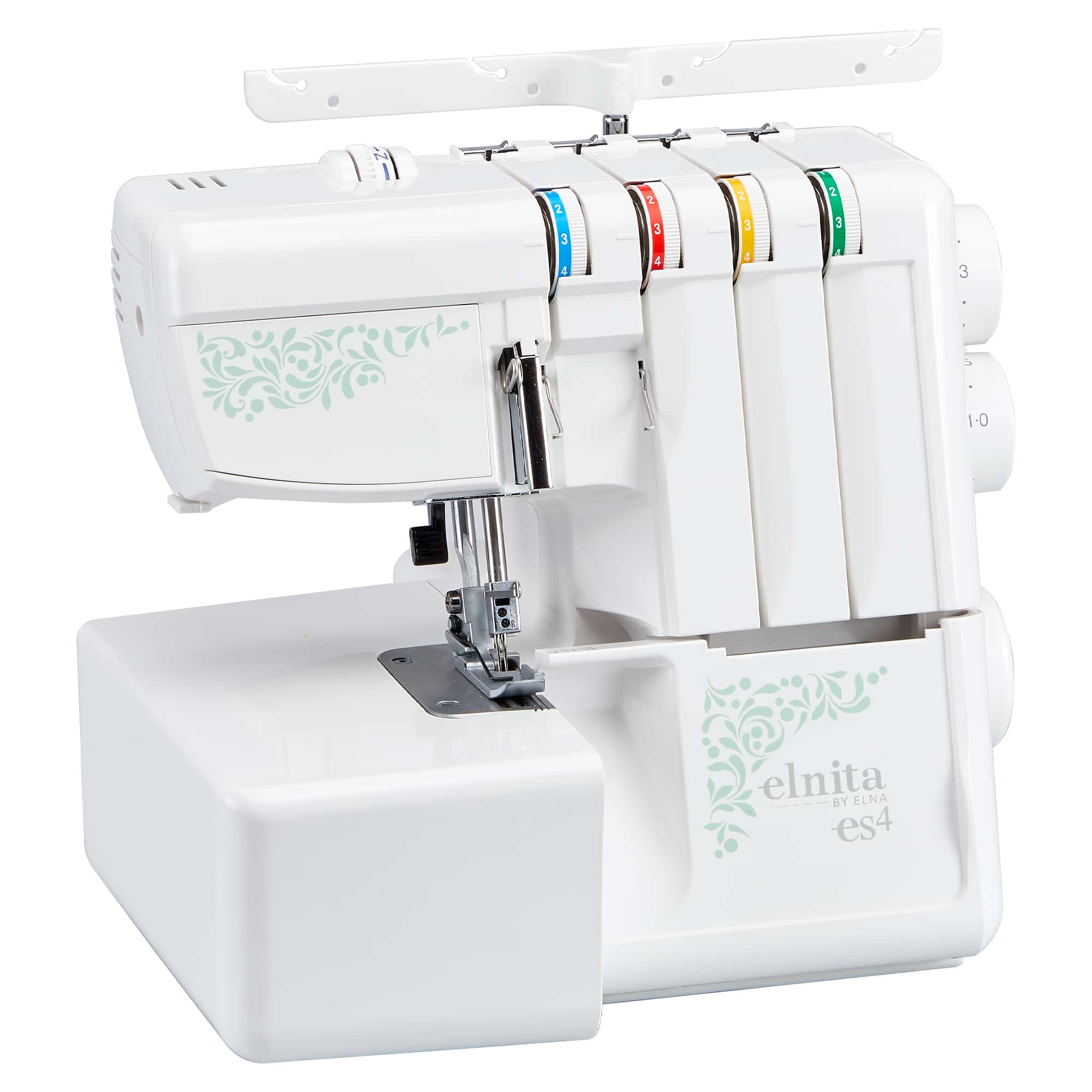
Explore this need in the finder →The Elna elnita ES4 is a serger, not a substitute for a regular sewing machine. Its job is to trim, hem and finish an edge with overlock stitching while sewing it. That makes it a useful specialist for knit hems and garment seam finishing, but a poor one-machine choice if your everyday work also needs straight seams, zigzag, buttonholes or ordinary garment construction. Elna’s U.S. page identifies this exact model as an overlocker and lists two-, three- and four-thread operation, a foot controller, adjustable thread tension and an LED lamp.
What the published numbers say—and what they do not
Elna lists a maximum speed of 1,300 stitches per minute and a feed-length range of 1.0–5.0. Those are capability limits, not a claim that every fabric or seam should be sewn at the top rate. The page also distinguishes cutting width from chaining width and gives separate values depending on whether the left needle is used: cutting widths are 5.3–7.3 mm with the left needle and 3.1–5.1 mm without it; the listed chaining widths are 5.5–7.5 mm and 3.3–5.3 mm. Do not treat those knife/cutting dimensions as an ordinary machine’s zigzag stitch width. The product page does not establish a differential-feed range, a separate speed limiter, or an automatic thread cutter, so those should not be assumed when you compare setups.
Choose it for edge work, not for every seam
The practical reason to buy an ES4 is repeated edge finishing. A serger can trim and encase a raw edge as it sews, reducing the separate seam-and-overcast steps used on a conventional machine. The page lists the 2/3/4-thread range, but it does not provide an exact stitch chart or fabric-by-fabric setup in the archived material reviewed here. If you need a particular formation—such as a narrow rolled hem, a specific stretch seam, or a confirmed needle arrangement—check the current manual with Elna or the seller before buying; the U.S. support page’s ES4-labelled manual link resolves to a conventional sewing-machine instruction book, not an ES4 serger guide. I have not used that mismatched manual to fill in ES4 settings.
What comes in the listed box
The U.S. product page names a foot controller, needle set, tweezers, brush, nets, a large spool holder, oil, needle threader, dust cover and accessory box, along with the manual. That is useful serger maintenance and threading equipment, but the page does not list a large extension table or an included walking foot. The name “needle threader” appears in the accessory list; it is not enough to claim an automatic needle-threading system. Confirm the seller’s actual box and the correct needle and thread supplies before checkout, especially if a third-party listing shows extra feet or a different package.
Who should compare it with something else?
If you need ordinary seams, try a conventional mechanical or computerized sewing machine first; overcasting stitches on a regular machine do not replace the ES4’s serger mechanism, but the ES4 also cannot replace that regular machine. If your projects require coverstitch hems, confirm a separate coverstitch capability rather than assuming it from “serger.” If your priority is a known multi-layer knit workflow, differential feed, a slow-speed ceiling, or an automatic cutter, the ES4’s current published page does not settle those questions. It is the strongest fit when you specifically want a current U.S.-listed overlocker and can verify the exact setup you intend to use, not when a broader machine description leaves essential details to guesswork.
Key details at a glance
| Motor and stitch controls | Exact page confirms adjustable tension and foot controller; separate speed limitation/control type unknown. |
|---|---|
| Stitch choices and limits | Page lists 2/3/4 threads and feed length 1.0–5.0; separate knife widths and chain widths are not zigzag width or differential feed. |
| Buttonhole routine | No conventional lockstitch buttonhole is documented. |
| Supplied tools and fabric support | Page lists foot controller, needle set, accessory needle threader, tweezers, brush, nets, oil, dust cover and box. |
| Needle setups, cutting and memory | Exact page describes overlocker for cutting, hemming and sewing edges. No ordinary lockstitch, coverstitch or embroidery plan. |
Use the exact model’s instructions for operating limits, supplied equipment and version differences.
Sources for this assessment
Choose the operating routine that suits your work.
Start with whether you sew, embroider, serge or coverstitch, then compare controls, working area, supplied tools and setup limits.