
Your needs, this model
Does it fit your priorities?
Can mechanical pedal sewing meet a four-step buttonhole and 5 mm width requirement?
Yes. Elna lists 5 mm maximum width and the exact manual describes a four-step routine.
Explore this need in the finder →Can it make a one-step automatic buttonhole?
No. The manual describes four manually selected stages.
Explore this need in the finder →Does the 650 spm rating mean I can set a separate speed cap?
No separate limiter is documented; the figure is only the maker-listed maximum.
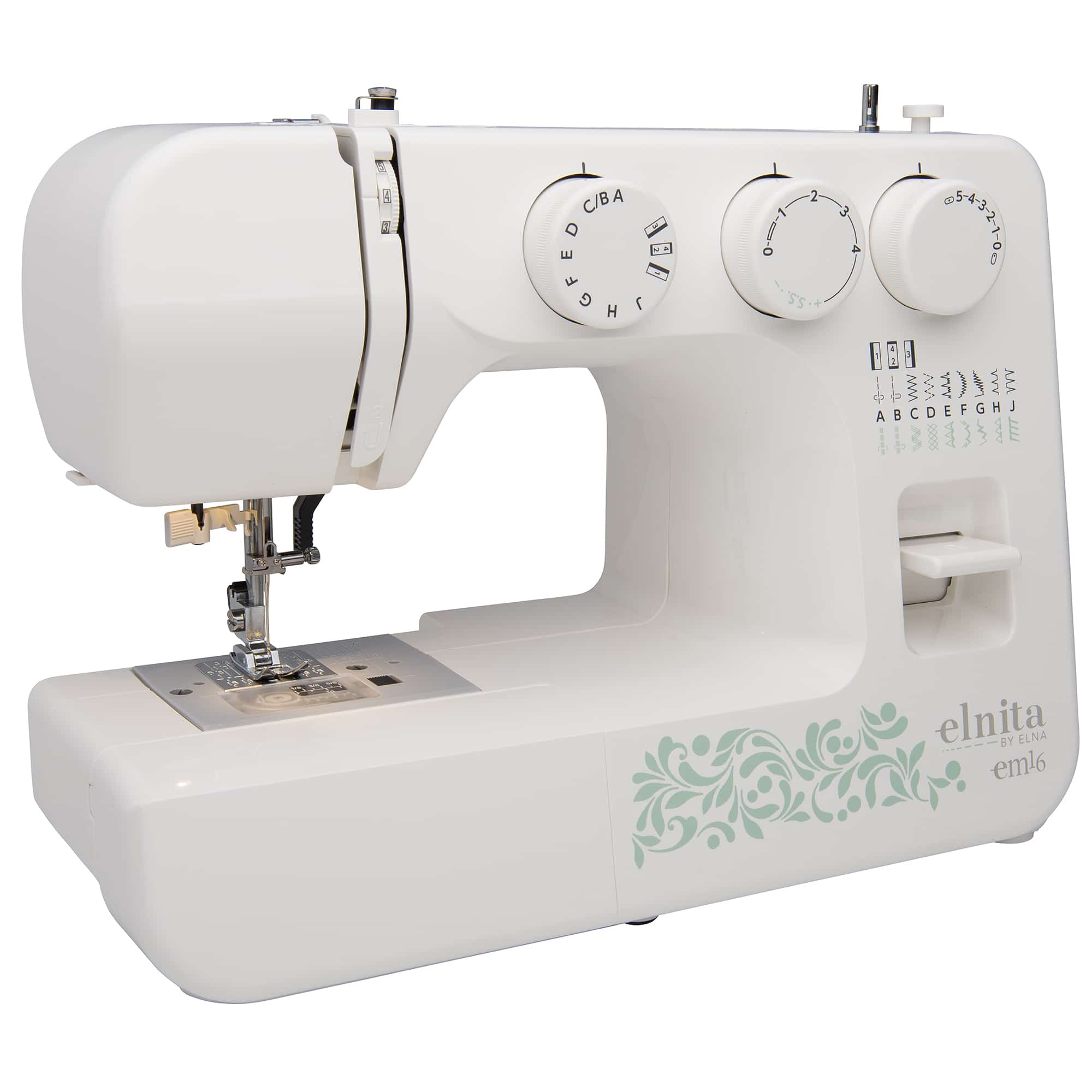
Explore this need in the finder →The Elna elnita EM16 is the mechanical, dial-controlled option in this group. It is for straightforward household sewing where 16 stitch patterns, a four-step buttonhole and basic controls are enough. Elna’s U.S. listing specifies a maximum speed of 650 stitches per minute, 5 mm maximum zigzag width, 4 mm maximum length, a built-in needle threader and adjustable thread tension. The maker also calls out drop feed and an extra-high presser-foot lift, two useful details for darning or making room under the foot for thicker projects. It does not have the screen or computerized stitch control found on the EC30, EC60 and EF72.
Mechanical controls and a deliberate buttonhole
Pattern selection, width and length are set with physical dials. The foot controller varies the sewing pace, but neither the product page nor the manual documents a separate speed limiter or pedal-free Start/Stop motor setup. The published 650 spm is the maximum figure, not an independent cap; if you need to prevent a new sewist from exceeding a chosen speed, the EM16 does not establish that control. Its buttonhole is a four-step routine with a sliding foot. The manual asks the operator to sew the sides and bartacks in separate stages, so repeated buttonholes require more manual repositioning than the automatic one-step cycle on the EC60.
Useful basics, with no overstated kit
The standard box list includes a zipper foot, blind-hem foot, sliding buttonhole foot, zigzag foot, needle set and four bobbins. The extension table doubles as accessory storage and can be removed for free-arm sewing. There is no published throat measurement, so the EM16 should not be chosen for a specific under-arm clearance based only on its appearance. Elna lists a drop feed, which gives a documented option for free-motion or darning work; that is not the same thing as a built-in walking foot or integrated dual feed. The page does not list either of those attachments as standard.
When a computerized model is worth the step up
Choose the EM16 if you prefer mechanical adjustment, want a basic stitch library and do not need a start/stop button or a one-step automatic buttonhole. The EC30 adds a top-drop bobbin, LCD and computerized setup, although its memory buttonhole still involves manual stops and reverse-button steps. The EC60 moves to 60 stitches, a speed slider, start/stop option, 7 mm width and an automatic stopping buttonhole. The EM16’s 5 mm width and slower 650 spm ceiling can be a sensible match for basic construction, but the speed figure does not equal a speed limiter.
A compact choice for classes and small projects
Elna positions the EM16 for home sewing and for taking to classes or guild meetings. The 16-stitch count, drop feed and extra-high lift make it more versatile than a fixed straight-stitch machine, though it remains a conventional pedal-operated model. It will not trim edges as a serger does, make a coverstitch hem, or create motorized hoop embroidery. If those functions are essential, choose a machine with a documented plan for that job rather than expecting the decorative and utility stitches to stand in for a specialist mechanism. Check the current seller package and service support for your exact unit; this review does not claim hands-on testing or a performance result on particular fabrics.
Stretch stitches add a useful decision point
The 16-pattern count hides a practical distinction: the EM16 manual documents a straight-stretch pattern for reinforcing areas such as crotch and armhole seams or backpack seams, plus a zigzag-stretch pattern for stretch fabrics where zigzag is appropriate. It cautions that the fabric moves back and forth during the straight-stretch stitch, so the operator must guide it carefully. That gives the EM16 more utility than its four-step buttonhole alone suggests, but it does not establish a particular knit result or a serger-like edge finish. If stretch sewing is a regular job, decide whether mechanical pedal control and the listed 5 mm maximum zigzag width suit your work, and plan to test a sample rather than treating a stitch count as a performance guarantee.
Key details at a glance
| Motor and stitch controls | Physical selector and foot controller; no speed slider or Start/Stop. |
|---|---|
| Stitch choices and limits | Exact page lists 16 stitches, 5 mm width, 4 mm length, 650 spm. |
| Buttonhole routine | Manual PDF p.50 (printed p.46): four-step buttonhole. |
| Supplied tools and fabric support | Exact page lists zipper, blind-hem, buttonhole and zigzag feet; no walking foot or large table. |
| Needle setups, cutting and memory | Mechanical household sewing and drop feed; not hoop embroidery or serging. |
Use the exact model’s instructions for operating limits, supplied equipment and version differences.
Sources for this assessment
Choose the operating routine that suits your work.
Start with whether you sew, embroider, serge or coverstitch, then compare controls, working area, supplied tools and setup limits.