
Your needs, this model
Does it fit your priorities?
Can a computerized single-needle plan sew up to a 9 mm maximum width with a speed slider?
Yes; exact page lists 9 mm width, and the linked manual documents the separate speed slider.
Explore this need in the finder →Can I use Start/Stop without the connected pedal?
Yes, after disconnecting the foot controller as the manual specifies.
Explore this need in the finder →Does the EF72 include a motorized embroidery hoop?
No hoop embroidery plan or unit is listed for the EF72.
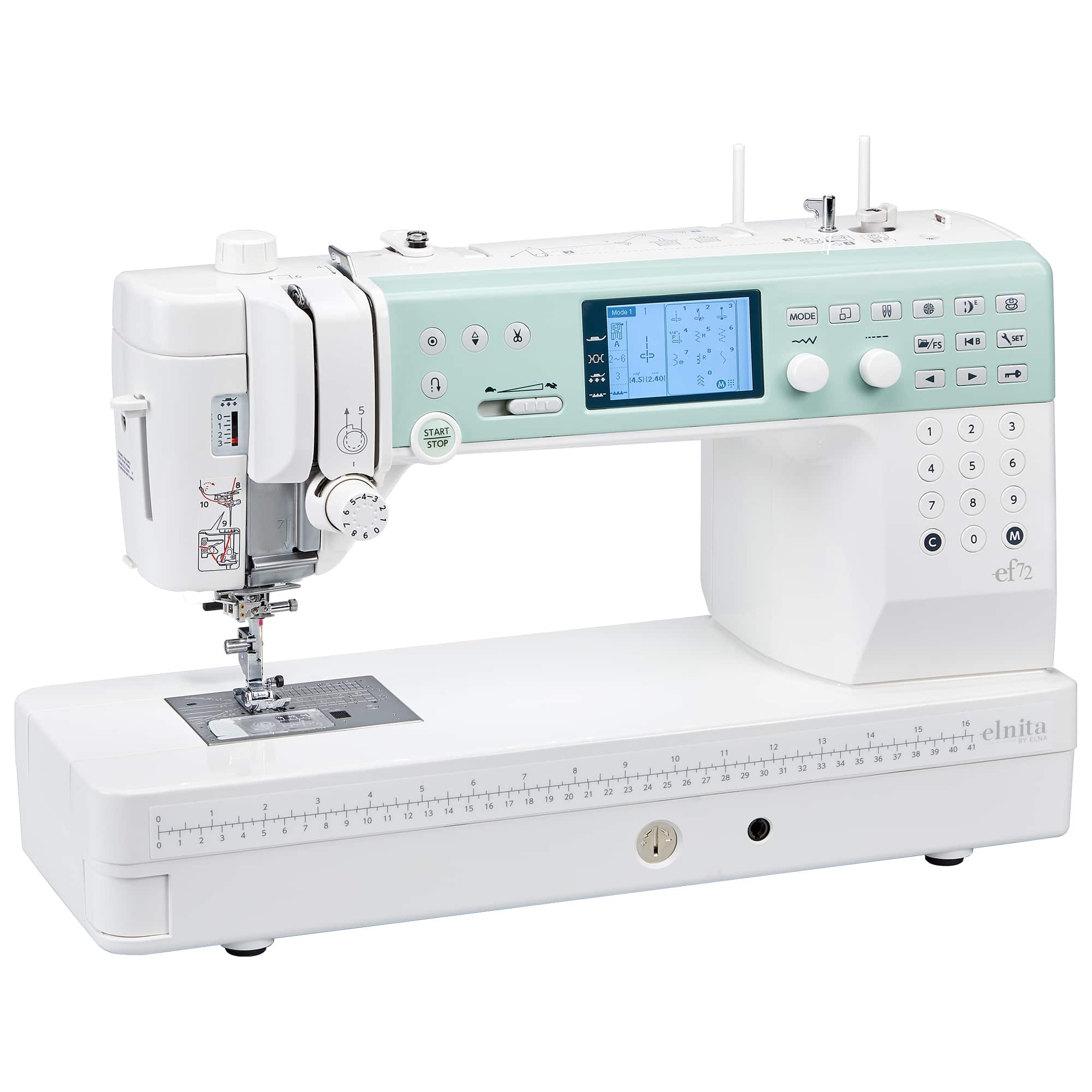
Explore this need in the finder →The Elna elnita EF72 is the computerized member of this group for quilters and sewists who want a broad single-needle sewing setup rather than a specialist serger or fixed-straight machine. Elna describes a 10-inch seamless flatbed, a “Superior Feed System,” up to 1,000 stitches per minute, a maximum 9 mm stitch width and a maximum 5 mm stitch length. The standard accessory list is unusually work-ready: it includes an automatic buttonhole foot, a straight-stitch needle plate, quilting bar and a convertible free-motion quilting foot, along with general-purpose, zipper, overcast, blind-hem and rolled-hem feet.
Useful breadth, with a substantial sewing surface
The EF72’s best buyer case is regular sewing that moves between utility stitches, wider decorative patterns and quilting details. Its 9 mm maximum width exceeds the 5–7 mm ceiling common on many ordinary machines, while the 10-inch flatbed gives a broad, continuous support surface for larger pieces. That 10-inch maker claim is a flatbed description, not a separately measured needle-to-arm throat figure, so do not compare it directly with machines whose published throat is measured from the needle to the tower. The included straight-stitch plate and quilting bar are useful tools for controlled piecing, but neither makes this a longarm or proves fabric-feeding performance on every batting stack.
Two documented ways to control it
The exact linked instruction book documents both foot-control sewing and a Start/Stop setup with the foot control disconnected; it also shows a speed-control slider. This gives a buyer a genuine choice between pedal operation and button control with a maximum-speed adjustment. Elna’s page lists up to 1,000 spm, which is a published machine ceiling, not a minimum speed or a real-world test result. The same guide describes a sensor square buttonhole whose size is set by placing a button in the supplied automatic buttonhole foot, as well as an automatic square buttonhole. That makes the EF72 more convenient for repeated garment buttonholes than a manual four-step routine, although you should still test a sample with the actual fabric and interfacing.
Check the button range and sample first
The manual gives the automatic buttonhole foot a documented button-holder range of 1–2.5 cm in diameter. It also warns that heavier or otherwise specific fabrics and threads can call for an adjustment, recommends making a test buttonhole, and advises interfacing fine or stretch fabrics. That turns the automatic cycle into a practical convenience rather than a guarantee: it can size around buttons within that holder range, but the finished result still depends on the actual cloth and thread. If your project uses larger buttons or delicate fabric, confirm the setup before committing; the source does not promise the same result for every combination.
Quilting equipment is not the same as integrated feed
The page’s “Superior Feed System” wording is not an explicit claim of a walking foot or an integrated dual-feed mechanism, and the package list does not identify a walking-foot attachment. It does list a convertible free-motion quilting foot, which is a different tool and a different feed arrangement. If your essential need is even feeding from above and below, verify a named compatible walking or dual-feed setup rather than treating general feed language as proof. The manual lists the knee lifter as optional, and the page does not list a separate extension table; confirm those items if they are essential to your studio.
Who should compare the EF72 with another Elna?
Choose the EF72 over a mechanical model when computerized pattern selection, a wider stitch field, pedal-free control and a speed slider are important. The EC60 is a smaller-footprint alternative with 60 listed stitches, a 7 mm maximum width and a specifically documented convertible free arm; the EF1 is the opposite kind of choice, concentrating on straight stitching at a much higher stated maximum speed. The EF72 does not provide motorized-hoop embroidery or serger trimming. Its strengths are the flatbed, 9 mm sewing range, and a useful package for general sewing and quilting—not an unverified dual-feed claim or a promise that every supplied foot suits every fabric.
Key details at a glance
| Motor and stitch controls | Manual p.6: Start/Stop, speed slider, pedal; p.10: Start/Stop unavailable with pedal attached. |
|---|---|
| Stitch choices and limits | Exact page lists 9 mm width, 5 mm length. 10-inch flatbed is not numerical throat; “Superior Feed System” is not explicit dual feed. |
| Buttonhole routine | Manual pp.58–60 documents sensor-square/automatic-square routines. |
| Supplied tools and fabric support | Page lists automatic buttonhole foot, straight-stitch plate, quilting bar/free-motion foot; knee lifter optional. |
| Needle setups, cutting and memory | Single-needle sewing and quilting; no hoop embroidery, serger or coverstitch. |
Use the exact model’s instructions for operating limits, supplied equipment and version differences.
Sources for this assessment
Choose the operating routine that suits your work.
Start with whether you sew, embroider, serge or coverstitch, then compare controls, working area, supplied tools and setup limits.