
Your needs, this model
Does it fit your priorities?
Does the EC60 make a button-sized one-step buttonhole that stops at completion?
Yes. The exact manual shows the cycle stop after the final bartack.
Explore this need in the finder →Can it meet a 9 mm width minimum?
No. Elna lists a maximum width of 7 mm.
Explore this need in the finder →Does the EC60 automatically trim ordinary seam threads when its cutter is enabled?
Yes. Hold the cutter button until its icon appears; reverse or auto-lock then finishes and trims the seam. Use the face-cover cutter for thread size 30 or thicker.
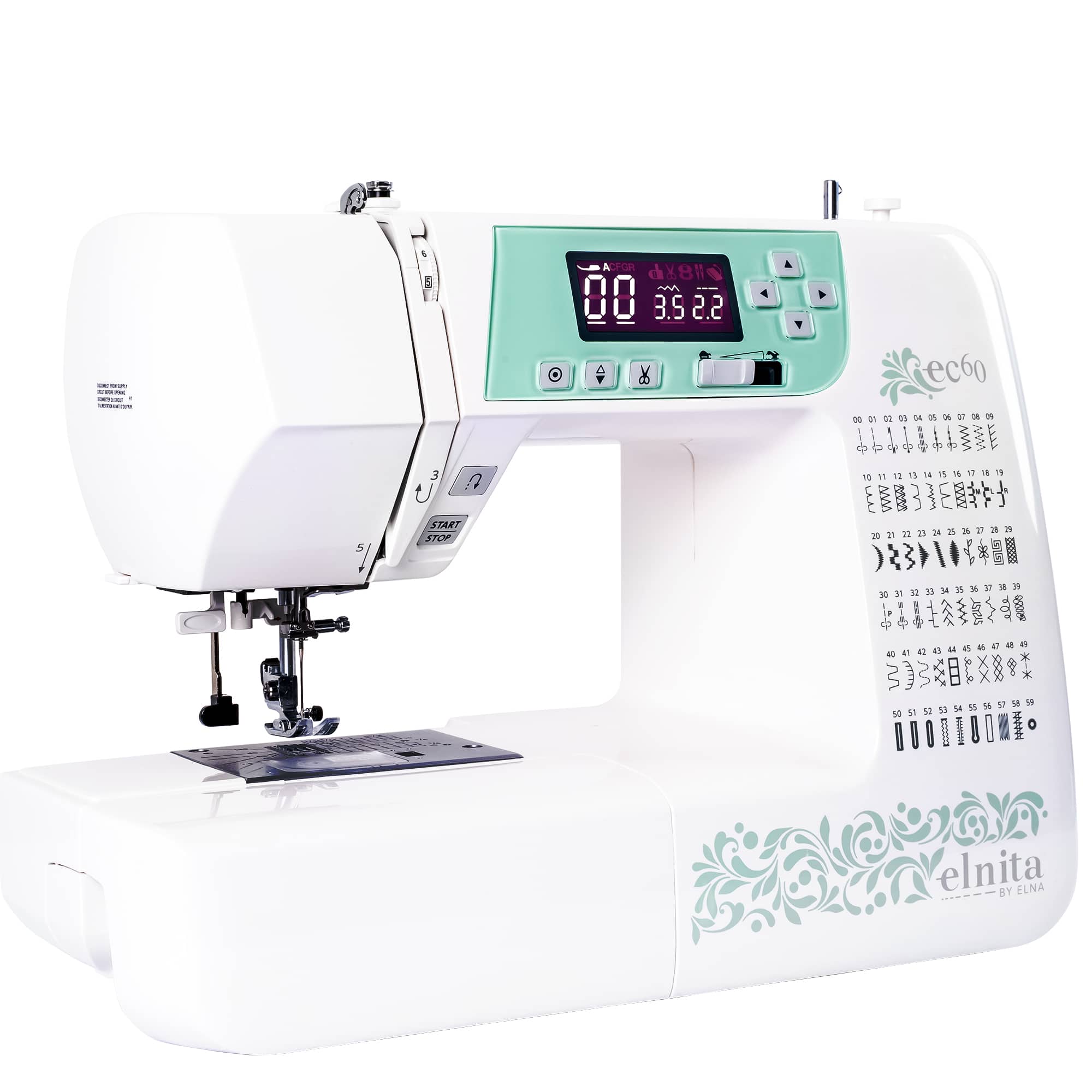
Explore this need in the finder →The Elna elnita EC60 is a computerized domestic machine for sewists who want quilting-oriented accessories and more control than a basic mechanical model without moving to the larger EF72. Elna lists 60 stitches, a 7 mm maximum stitch width, 4 mm maximum length and an 820-stitches-per-minute ceiling. It also has a convertible free arm, needle up/down, a built-in needle threader, adjustable tension and a speed slider. These specifications make it a versatile household option, but they do not establish how it will handle every fabric stack; the manual's setup guidance and a test scrap still matter.
A buttonhole cycle that completes itself
The automatic buttonhole is a practical difference from the EC30. The EC60 manual directs the user to place a button in the rear of foot R, mark the fabric, lower the foot and begin. The machine sews the sides and bartacks, then stops at the end of the cycle. That can save the operator from timing each stage, but it is not a guarantee that every buttonhole will be right on the first try. The manual notes that some fabrics need adjustment, so test on the same fabric and interfacing before cutting a garment opening. By contrast, the EC30's memory-style process has the user stop and press reverse through the first buttonhole's stages; it is not the same one-step cycle.
Automatic seam trimming is a separate, configurable feature
The EC60 also has a thread cutter for ordinary seam ends, distinct from the automatic buttonhole stop. To enable automatic trimming, the manual says to choose the stitch and press and hold the thread-cutter button until its icon appears. When the reverse or auto-lock button is pressed to secure the seam, the machine stops and trims the threads after the locking stitches. If the icon is not active, the operator can press the cutter button or use the manual cutter. For thread size 30 or thicker, Elna directs the user to the cutter on the face cover rather than relying on the automatic one. Thus the feature is useful for frequent seam changes, but it requires deliberate setup and has a stated thread restriction; it is not a cutter that should be assumed to operate in every setup without checking the display.
Computerized controls and quilting setup
The machine supports both foot control and Start/Stop operation. The manual says Start/Stop will not work while the foot control is connected, so a pedal-free session means disconnecting the pedal first. The slider can cap the pace below Elna's published 820-spm maximum, which is more useful for careful curves or new techniques than treating the maximum as a target. The 7 mm width is broader than a 5 mm machine's, but remains short of the EF72's 9 mm range. The included quarter-inch seam foot, quilting guide and darning foot suit piecing and free-motion practice; the extension table/accessory-storage piece is described as convertible for free-arm work. Still, this is a domestic machine, not a longarm, and a walking foot or integrated dual feed is not established in the reviewed package. If bulky quilt support or synchronized feeding is essential, compare an exact compatible accessory or a machine built around that use rather than inferring it from the quilting feet.
Pressure and fabric choices
The EC60's presser-foot pressure dial gives the user a documented adjustment that the simpler EC30 does not offer. The manual's starting settings are 6 for regular sewing, 3 for appliqué, cutwork, drawn work, basting and embroidery, 2–4 for fine fabrics such as chiffon, lace or organdy, and sometimes 1 for stretchy velour or knits. These are setup directions, not a promise that a particular fabric will feed perfectly. Start with the recommended range, use a matching needle and thread, and test a scrap before committing to a seam; the setting can then be adjusted if the fabric puckers or stretches. A sewist who mostly makes routine hems may rarely change the dial, while someone moving among fine cloth, stretchy knits and embellishment has a more concrete reason to value it.
Routine care and sensible limits
Elna's manual says to switch the machine off and unplug it before cleaning. Its bobbin-area procedure removes the needle, presser foot, needle plate and bobbin holder so lint can be brushed from the bobbin holder, feed dogs, thread-cutter mechanism and hook race; the center of the race is wiped with a dry cloth. The manual says not to dismantle beyond its instructions and that this machine does not require oiling. Clean the exterior with a soft cloth and neutral soap, and avoid storing it in high humidity, beside a radiator or in direct sunlight. This is manageable upkeep, but the cutter mechanism and feed area still need lint removal; a clear bobbin cover does not eliminate routine cleaning.
Who should choose it—and what to compare
The EC60 is a strong fit for someone who will use computerized stitch selection, pedal or pedal-free control, a speed limit, a one-step buttonhole, adjustable pressure or the supplied quilting feet. It is less compelling if you want all-mechanical dials, a 9 mm stitch width, a wide flatbed, embroidery, serging or a machine requiring no configuration for thread trimming. The EC30 keeps a smaller 30-stitch computerized setup and memory buttonhole but lacks the EC60's documented one-step buttonhole stop, 7 mm width and pressure dial. The mechanical EM16 trades away the LCD and computerized controls for dial selection, 16 stitches and a four-step buttonhole. At the other end, the EF72 offers a 9 mm width and a ten-inch flatbed for a buyer prioritizing quilting workspace. Compare those concrete differences with your projects: the EC60's value lies in combining adjustable controls and useful included feet, not in being a substitute for a specialized wide-bed or embroidery machine.
Key details at a glance
| Motor and stitch controls | Manual pp.6–8: pedal, Start/Stop and slider. |
|---|---|
| Stitch choices and limits | Exact page lists 60 stitches, 7/4 mm and 820 spm. |
| Buttonhole routine | Manual pp.27–30: automatic foot R and stop after bartacks. |
| Supplied tools and fabric support | Page lists 1/4-inch/quilting feet; manual documents an enabled automatic thread cutter with #30-or-thicker thread directed to face-cover cutter. No walking foot listed. |
| Needle setups, cutting and memory | General sewing and quilting prep; not hoop embroidery, serger or coverstitch. |
Use the exact model’s instructions for operating limits, supplied equipment and version differences.
Sources for this assessment
Choose the operating routine that suits your work.
Start with whether you sew, embroider, serge or coverstitch, then compare controls, working area, supplied tools and setup limits.