
Your needs, this model
Does it fit your priorities?
Do you need a real serger-style overlock stitch that trims and finishes an edge?
The b68 Maker's overlock plan combines edge cutting and thread wrapping; an overcast stitch on a conventional sewing machine is not the same operation.
Explore this need in the finder →Do you need coverstitch hems on stretch garments without cutting the edge?
The b68 Maker has a separate coverstitch setup and table insert; it requires a change from overlocking.
Explore this need in the finder →Must the exact package include the b68 Maker guides, six specialty feet, and mini vacuum cleaner?
The Maker page lists these items; a particular seller's box still needs checking.
Explore this need in the finder →The bernette 68 Maker is a serger/coverstitch combination, not a regular lockstitch machine with decorative options. Its exact U.S. page identifies a b68 AIRLOCK platform in a limited Maker design with an extra accessory set. It can finish and join edges, sew coverstitch hems, make chainstitches, and use combination stitch patterns after you change the machine setup. If you also need ordinary straight seams, zippers, buttonholes, or conventional garment construction, plan on pairing it with a separate sewing machine.
One chassis, several real stitch jobs
For overlocking, the knife trims the edge while the needles and loopers form the seam; the manual describes standard two-, three- and four-thread overlock work, with five-thread safety options also in the stitch library. For hems, binding, or parallel topstitching, you switch into coverstitch or chainstitch mode and do not cut the fabric edge. The combo patterns combine overlock and chainstitch components in a single setup. These are different configurations, not a one-button mode change: the manual describes changing the knife cover or coverstitch insert, the upper-looper state, needles, thread paths, and stitch settings as the job changes. Expect setup and a test seam between tasks.
The 31 advertised stitch patterns are useful for knitwear, sportswear, hems, edge finishing, and decorative thread work. The Maker edition does not turn those into a conventional zigzag, buttonhole, or all-purpose straight-stitch library. Its 130 mm of space to the right of the needle is particularly helpful for supporting larger pieces during coverstitching, while the included slide-on table extends the working surface. A freearm cover lets you work around tubular cuffs or hems; it is not a substitute for the large bed of a quilting machine.
Air threading is a help, not an automatic setup
The automatic air system threads the loopers. You still have to prepare the correct stitch, guide each thread through its tension path, and thread the needles manually. Color-coded paths make that work easier to follow, and the manual shows both standard and auxiliary threading methods if a looper thread does not feed through normally. The manual also warns against coated or waxed thread that can shed material into and block the air-threading pipes. Keep the included manuals beside the machine and use the stitch chart rather than relying on a remembered thread order.
Micro Thread Control fine-tunes the loop amount at a fabric edge, but it does not replace correct tension, knife width, thread choice, or practice. Differential feed adjusts from 0.6 to 2.0 to help reduce puckering or waviness and to gather when desired. The manual recommends testing on a scrap of the same fabric, then adjusting systematically. The foot controller varies speed; the published 1,300 stitches per minute is a maximum, not a promise of clean results at full speed or evidence of a separate speed limiter.
What makes the Maker bundle different
Bernette describes the Maker as the b68 AIRLOCK limited edition in an exclusive finish. Its value difference is the package: in addition to the shared b68 setup, the Maker page lists an overlock fabric guide, coverstitch fabric guide, six specialty presser feet, and a small USB-rechargeable mini vacuum cleaner. The six feet cover tasks such as blind hems, elastic, piping, gathering, and hems. If you will use those attachments, the bundle may save separate accessory shopping. If your projects rely mostly on the standard presser foot, table, and core stitch system, compare the exact offer for the standard b68 AIRLOCK instead. Neither product-page list guarantees that an individual used or retailer box is complete.
The exact English manual gives the body as 43 × 27 × 29 cm and 8.9 kg; with the slide-on table and cut-offs bin, the setup is about 59 × 40 × 29 cm. Make room for the thread stand, fabric passing through the needle area, and the table attachment, not only the machine body. The manual specifies ELx705 needles, a maximum fabric thickness of 5 mm, adjustable presser-foot pressure, a manual thread cutter, and cleaning/oiling steps. The U.S. manual lists 120 V / 80 W; routine lint removal and oiling are hands-on care, not a self-cleaning feature.
Who should shortlist it?
Choose the Maker if you sew enough knits or finished garments to want overlock and coverstitch capability in one dedicated station, appreciate the looper air threader, and can use the accessory set. Choose the standard b68 AIRLOCK if the stitch functions matter more than the special bundle. Compare the b64 AIRLOCK if you primarily overlock, or b62 AIRLOCK if you primarily need coverstitch and chainstitch; the current bernette directory gives these narrower models different stitch counts and functions. A conventional sewing machine remains the better first purchase if most of your work is straight seams or buttonholes.
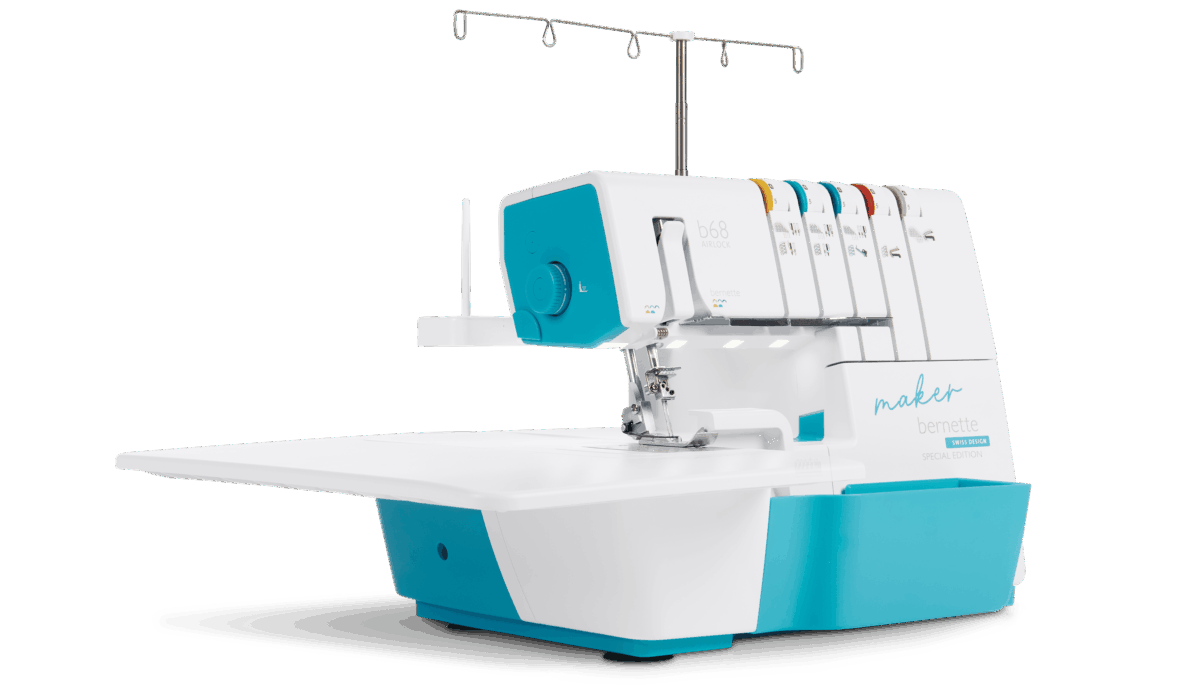
This is a source-based assessment, not a hands-on test. Before buying, confirm the exact Maker Edition name, supplied guides and feet, mini cleaner, manuals, and table with the seller. The manufacturer currently lists the model but does not establish a particular seller's stock or box condition. The exact official image shows the Maker finish and table configuration; bernette does not say whether it is a photograph or rendering.
Sources: exact U.S. bernette 68 Maker product page, its support page, the linked March 2026 English b68 manual, and the Maker brochure.
Key details at a glance
| Motor and stitch controls | Mechanical stitch and feed adjustments with a foot controller; no computerized stitch display or Start/Stop setup is documented. The manual describes a continuously variable foot pedal and lists 1,300 stitches/minute as the maximum, not as an independent speed limiter. |
|---|---|
| Stitch choices and limits | The 31 count is the manufacturer's total for overlock, coverstitch, chainstitch and combo patterns. It is not a conventional 31-stitch zigzag/lockstitch library; this model has no ordinary lockstitch seam or buttonhole setup. Official ranges are overlock 3-7 mm, coverstitch 2.8/5.6 mm, and combo 7.8-12.6 mm. |
| Buttonhole routine | No standard lockstitch or buttonhole function is documented; do not count overlock stitch patterns as buttonholes. |
| Working space and size limits | 130 mm space to the right of the needle. Manual body dimensions are 43 x 27 x 29 cm; with slide-on table and cut-offs bin the listed dimensions are 59 x 40 x 29 cm. These finishing-machine dimensions are not a sewing-machine throat comparable to a quilting arm. |
| Supplied tools and fabric support | The exact Maker page describes a limited edition of the b68 AIRLOCK with exclusive design and adds two fabric guides, six specialty feet and a mini vacuum cleaner. The standard base list includes the combo foot, slide-on table and inserts, freearm cover, knee lifter, thread tools, needles and CS Lock tool. Retailer, used-box and country-specific completeness are not verified. |
| Needle setups, cutting and memory | Separate real plans cover overlock, coverstitch, chainstitch and combo work. To change modes, the manual calls for changing inserts, knife/upper-looper configuration and thread/needle settings; they are not simultaneous needle setups. Automatic air threading applies to loopers, not the needles. The included needle threading aid is manual. |
| Presser-foot pressure | The manual documents a dedicated presser-foot-pressure wheel; light and heavy fabric may require different adjustments and a test sew. |
| Cleaning and lubrication | The 2026 manual calls for unplugging before cleaning, regular lint/thread removal and oiling the upper-looper joint with recommended overlock oil. Never clean the air pipes with compressed air; coated or waxed threads can damage/block the air-threader pipes. |
Use the exact model’s instructions for operating limits, supplied equipment and version differences.
Sources for this assessment
- Exact current U.S. b68 Maker product page and bundle details
- Official exact Maker support page linking the 2026 English manual and Maker brochure
- Exact official March 2026 English b68 manual linked by the Maker support page; Maker and standard AIRLOCK product pages link the same manual
- Exact Maker brochure with accessory and stitch-pattern tables
- Current U.S. directory naming the Maker and standard b68 separately
- Exact official 1200 x 685 Maker product image with the distinctive Maker design and slide-on table

Choose the operating routine that suits your work.
Start with whether you sew, embroider, serge or coverstitch, then compare controls, working area, supplied tools and setup limits.