
Your needs, this model
Does it fit your priorities?
Do you need a real serger-style overlock stitch that trims and finishes an edge?
The b68 Maker's overlock plan combines edge cutting and thread wrapping; an overcast stitch on a conventional sewing machine is not the same operation.
Explore this need in the finder →Do you need coverstitch hems on stretch garments without cutting the edge?
The b68 Maker has a separate coverstitch setup and table insert; it requires a change from overlocking.
Explore this need in the finder →Must the exact package include the b68 Maker guides, six specialty feet, and mini vacuum cleaner?
The standard b68 AIRLOCK page lists the core b68 package but not the Maker-only guides, six feet, and mini cleaner; confirm the seller box.
Explore this need in the finder →The bernette 68 AIRLOCK is a mechanical overlock/coverstitch combination for people who need more than a serger edge finish. It has separately configured overlock, coverstitch, chainstitch, and combination stitch patterns. The crucial limit is what it is not: there is no ordinary lockstitch setup for standard straight seams, zigzag, or buttonholes. Think of it as a garment-finishing machine alongside a regular sewing machine, not as a replacement for one.
Decide which of its modes you will actually use
In overlock mode, the knife trims the fabric edge as the needles and loopers join and finish it. The stitch list includes two-, three-, and four-thread overlock arrangements, rolled hems, flatlock, and a five-thread safety stitch. Coverstitch and chainstitch mode disables the upper looper and changes the insert so you can hem, topstitch, bind, or join fabric without cutting the edge. Combo patterns use overlock and chainstitch together for a reinforced seam. Although the machine offers all of these jobs, you must change settings and components when changing modes; consult the stitch chart, rethread or reposition as directed, and sew a test piece before committing to a garment.
The 31 stitch patterns are not 31 variations of a conventional sewing-machine stitch selector. The product is specialized around knit hems, edge finishing, stretch seams, and decorative serger or coverstitch work. The 130 mm opening to the right of the needle gives room to support a bulky garment during coverstitching. The slide-on table adds work support, while the freearm setup is useful around cuffs and other tubular pieces. It is not an embroidery system or a quilting bed.
Settings and threading still require judgment
The looper air threader is the standout convenience: it sends a prepared looper thread through its tube after you correctly set the threading connection and handwheel position. Needle threads remain manual. Color-coded guides reduce confusion, but the manual's stitch charts, tension wheels, presser-foot pressure, knife position, and needle placement still have to agree with the selected stitch. Waxed or coated thread may leave material in the air tubes and is specifically cautioned against. Bulky or decorative thread is a material choice to test with the intended stitch rather than a guarantee that every thread will feed correctly.
Micro Thread Control lets you trim the amount of looper thread wrapping the edge, and differential feed spans 0.6 to 2.0. Those controls can help with loop balance, puckering, waves, or intentional gathering, but they do not remove the need for a scrap test. The manual explains how a small change in differential feed affects knits and woven fabrics. Maximum speed is 1,300 stitches per minute; the foot controller, rather than a separate documented speed cap or start/stop routine, controls operation. The manual lists a manual thread cutter, so do not treat this model as having an automatic cutter.
Standard package and Maker comparison
The standard b68 AIRLOCK package is listed with the combined presser foot, knife and coverstitch inserts, slide-on table, freearm cover, knee lifter, spool stand, decorative-thread guide, needle set, tweezers, and CS Lock tool. Its extension table and knee lifter support larger projects and hands-free presser-foot lifting. The b68 Maker edition uses the same underlying b68 stitch platform but adds an exclusive finish, two fabric guides, six specialty presser feet, and a mini vacuum cleaner. That difference matters if you want the extra feet for blind hems, elastic, piping, gathering, or decorative work; it does not add a new stitch mode. See the focused b68 AIRLOCK vs Maker package guide before treating the names as interchangeable.
The manual gives a machine weight of 8.9 kg, body dimensions of 43 × 27 × 29 cm, 130 mm needle-to-right workspace, and a maximum fabric thickness of 5 mm. With the table and cut-offs bin, the listed envelope grows to about 59 × 40 × 29 cm. The machine takes ELx705 needles and uses a U.S. 120 V / 80 W supply according to the current English manual. It needs regular lint cleaning and manual oiling at the specified looper joint. The knife, needles, and loopers are moving parts, so mode changes and service work need to follow the manual's switch-off and unplug instructions.
Who should shortlist it?
Shortlist the AIRLOCK if your wardrobe projects need both a true serger seam and a stretch coverstitch hem, and you are comfortable learning several threading and stitch setups. It can reduce the number of separate finishing machines, but that convenience comes with conversion work and a sizable table footprint. If you only need edge finishing, the b64 AIRLOCK is the more focused overlocker in the same bernette family. If coverstitch or chainstitch is your only need, compare the b62 AIRLOCK. If you need ordinary construction seams, start with a standard sewing machine and add the serger only if edge finishes justify it.
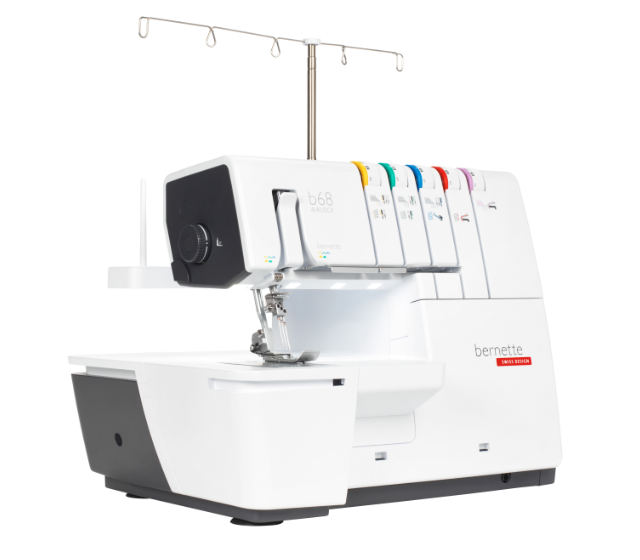
This assessment is based on the exact current U.S. product page, linked English manual, and 2026 U.S. b60-series brochure, not hands-on testing. Confirm the standard package contents and condition with the seller; the manufacturer says accessory components can vary across countries and does not establish current stock for every retailer. The exact image is the standard b68 AIRLOCK model with its dark control panel, not the special Maker finish.
Sources: exact U.S. bernette 68 AIRLOCK page, official support page, the March 2026 English b68 manual, and the 2026 U.S. bernette 60-series brochure.
Key details at a glance
| Motor and stitch controls | Mechanical stitch and feed adjustments with a foot controller; no computerized stitch display or Start/Stop setup is documented. The manual describes a continuously variable foot pedal and lists 1,300 stitches/minute as the maximum, not as an independent speed limiter. |
|---|---|
| Stitch choices and limits | The 31 count is the manufacturer's total for overlock, coverstitch, chainstitch and combo patterns. It is not a conventional 31-stitch zigzag/lockstitch library; this model has no ordinary lockstitch seam or buttonhole setup. Official ranges are overlock 3-7 mm, coverstitch 2.8/5.6 mm, and combo 7.8-12.6 mm. |
| Buttonhole routine | No standard lockstitch or buttonhole function is documented; do not count overlock stitch patterns as buttonholes. |
| Working space and size limits | 130 mm space to the right of the needle. Manual body dimensions are 43 x 27 x 29 cm; with slide-on table and cut-offs bin the listed dimensions are 59 x 40 x 29 cm. These finishing-machine dimensions are not a sewing-machine throat comparable to a quilting arm. |
| Supplied tools and fabric support | The exact standard U.S. page lists the combo foot, knife and coverstitch inserts, slide-on table, freearm cover, knee lifter, thread stand, decorative-thread guide, needle set, tweezers and CS Lock tool. It does not list the Maker Edition six-foot/fabric-guide/mini-cleaner package. Verify each seller box; country and used-box variation remain unknown. |
| Needle setups, cutting and memory | Separate real plans cover overlock, coverstitch, chainstitch and combo work. To change modes, the manual calls for changing inserts, knife/upper-looper configuration and thread/needle settings; they are not simultaneous needle setups. Automatic air threading applies to loopers, not the needles. The included needle threading aid is manual. |
| Presser-foot pressure | The manual documents a dedicated presser-foot-pressure wheel; light and heavy fabric may require different adjustments and a test sew. |
| Cleaning and lubrication | The 2026 manual calls for unplugging before cleaning, regular lint/thread removal and oiling the upper-looper joint with recommended overlock oil. Never clean the air pipes with compressed air; coated or waxed threads can damage/block the air-threader pipes. |
Use the exact model’s instructions for operating limits, supplied equipment and version differences.
Sources for this assessment
- Exact current U.S. standard b68 AIRLOCK page with feature and included-package list
- Official b68 AIRLOCK support page linking the 2026 English manual and U.S. brochure
- Exact official March 2026 English manual linked by the standard U.S. AIRLOCK page; same current manual linked by the Maker page
- Official 2026 U.S. bernette b60-series brochure; b68 package and comparison rows inspected
- Current U.S. directory naming b68 AIRLOCK separately from b68 Maker
- Exact official 640 x 560 standard b68 AIRLOCK gallery image with dark control-panel trim

Choose the operating routine that suits your work.
Start with whether you sew, embroider, serge or coverstitch, then compare controls, working area, supplied tools and setup limits.