
Your needs, this model
Does it fit your priorities?
Do you need a real serger overlock that can trim and wrap a raw edge while joining fabric?
Yes. The b64 is a dedicated overlocker; its overlock setup combines stitching with the cutting knife. It does not replace an ordinary lockstitch machine for standard construction seams.
Explore this need in the finder →Must the machine sew a coverstitch hem without trimming the fabric edge?
No coverstitch mode is documented for the b64: its exact product page calls it an overlocker, the b60-series comparison assigns coverstitch to b62 and combo operation to b68, and the b64 chart lists overlock patterns. The linked manual has some generic coverstitch-insert wording; applicability to b64 is unclear and should not be treated as proof of an operating plan.
Explore this need in the finder →Would automatic air threading for the loopers help your routine?
Yes. The b64 routes looper thread through its air-threading system; needle threads still follow manual color-coded paths.
Explore this need in the finder →The bernette 64 AIRLOCK is a dedicated household overlocker: its 16 listed stitch patterns are for serger edge finishing, not a conventional straight-stitch machine. In the overlock setup, needles and loopers make the seam while a knife trims the edge. That one-pass action is useful for knit garments, tidy seam allowances and rolled hems. The b64 is a better fit when you specifically want that serger workflow than when you need a general-purpose machine to sew seams, buttonholes or coverstitch hems.
Choose it for overlocking, not as an all-purpose sewing machine
The current U.S. model page calls the b64 an overlocker and lists two-, three- and four-thread overlock formations among its 16 stitch options. The 2026 b60-series brochure makes the family distinction clear: the b62 is the coverstitch machine, the b64 is an overlocker, and the b68 is the overlock/coverstitch combination model. The b64 does not acquire coverstitch capability just because its sister model has it. Nor should its 16 serger formations be counted as 16 general sewing stitches or buttonhole patterns.
That boundary matters at the sewing table. If you regularly construct clothing, you will still want an ordinary sewing machine for straight seams, topstitching, zippers and buttonholes. If you mainly need a neat stretch hem without trimming the edge, compare the b62. If you want both serger finishing and coverstitch work in one chassis, compare the b68; it adds more modes, but switching between them requires configuration changes rather than a single universal setup. The b64’s specialization is also its practical advantage: there is no need to buy a combo machine when all you need is the overlock side.
One source nuance is worth knowing before ordering. The b64’s linked manual contains some general coverstitch-insert and coverstitch-care wording, but the exact model page calls the b64 an overlocker, the b60 brochure assigns coverstitch to the b62 and combo operation to the b68, and the b64’s own 16-pattern chart lists overlock formations. I treat the model-specific page and comparison table as the function evidence; the generic manual references do not establish a b64 coverstitch mode. If a seller claims otherwise, ask for that exact configuration and its stitch chart.
Looper air threading is helpful, but not fully automatic threading
The best-known convenience is the air threader for the loopers. Color-coded paths and the air-threading mechanism reduce the fiddly part of feeding thread through the looper channels. The needles are different: the manual shows them threaded by hand along their colored paths, with a separate manual needle threader/inserter supplied. This is not a machine that threads every thread path at the push of a button, and correct threading order still matters for stitch formation.
After threading, you still need to match the stitch chart to the job. The manual’s patterns use different needle positions, thread counts, knife settings, stitch lengths, tensions and rolled-hem settings. It also gives a micro thread control adjustment and differential feed from 0.6 to 2.0. Differential feed can help counter waviness on knits, stretch fine fabrics or gather fabric intentionally; it is a control to adjust for the material, not a fabric sensor. Start with the recommended values, test on a scrap cut from the project, then adjust the chart settings to the actual result. The manual warns against waxed or coated thread that can block the air-threader pipes, recommends clearing lint from the looper area, and cautions that aerosol sprays or compressed air can permanently damage the machine during cleaning.
Space and supplied support
Bernette lists 130 mm of space to the right of the needle, a free arm for sleeves and cuffs, five LEDs, a knee lifter and an included slide-on table. Those details help with garment handling, especially when you are controlling a long knit seam or a bulky sleeve. The page also lists a maximum speed of 1,300 stitches per minute. That is a maximum, not a separate speed limiter; the foot controller sets the pace. If you need an independent cap or pedal-free start/stop operation, the manufacturer’s listed b64 setup does not establish either.
The manual specifies a machine weight of 9.3 kg and a footprint of 43 × 27 × 29 cm without the retractable thread guide. With the slide-on table and cut-offs bin attached, the stated dimensions are 59 × 40 × 29 cm. Plan for the larger working footprint during use, not only the bare machine dimensions. ELx705 needles are specified, with a stated maximum fabric thickness of 5.3 mm. That figure is not a promise that any stack of bulky or coated fabric will feed cleanly; the manual’s troubleshooting advice is to baste thick layers with a conventional sewing machine first if they jam in the overlocker.
Who should shortlist the b64?
It makes sense for a home garment sewer who already has ordinary sewing covered and wants an overlocker for stretch seams, edge finishing, gathering, flatlock or rolled hems. The combination of looper air threading, mtc, differential feed, free arm and a supplied extension table makes the setup more approachable than a bare-bones serger, while still leaving meaningful choices to the operator. If you prefer a machine that selects settings for you, or you want a conventional lockstitch, embroidery or no-cut coverstitch hem, this model is not a substitute.
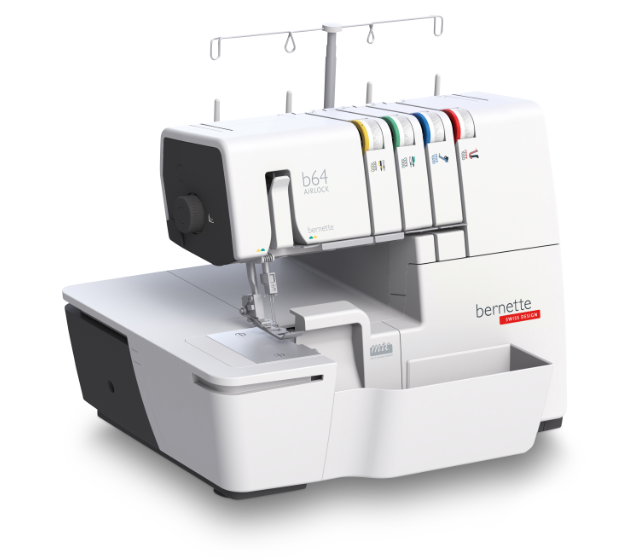
Before buying, check the exact seller’s box contents and service terms. The manufacturer’s U.S. page lists a standard overlock foot, slide-on table, knee lifter, cut-offs bin, thread tools, needles and other accessories, but a used machine or an individual retailer bundle may differ. Neither a manufacturer listing nor an Amazon search establishes current stock or condition. The included source image corresponds to the standard b64 AIRLOCK; bernette does not say whether it is a camera photograph or a 3D rendering. This assessment uses the exact U.S. product page, current linked manual and b60-series brochure, not hands-on testing.
Sources: bernette 64 AIRLOCK U.S. product page, official b64 support page, 2026-03 English b64 AIRLOCK manual, and the official b60-series brochure.
Key details at a glance
| Motor and stitch controls | Mechanical stitch and feed adjustments with a foot controller. The exact page states a maximum of 1,300 stitches per minute but does not document a separate speed limiter or Start/Stop sewing mode. |
|---|---|
| Stitch choices and limits | The manufacturer's 16 stitch count describes overlock formations, not a conventional lockstitch stitch library. The exact page and manual support two-, three- and four-thread overlock configurations; the comparison brochure classifies the b64 as an overlock machine, without coverstitch or chainstitch patterns. |
| Buttonhole routine | The exact b64 product page and the 2026 manual identify an overlocker and do not document a conventional lockstitch or buttonhole setup. Do not interpret the 16 overlock patterns as buttonhole routines. |
| Working space and size limits | The manufacturer states 130 mm of space to the right of the needle. The manual dimensions are 43 x 27 x 29 cm without the retractable thread guide and 59 x 40 x 29 cm with slide-on table/cut-offs bin; these are serger dimensions, not a quilting arm measurement. |
| Supplied tools and fabric support | The exact U.S. product page lists the standard overlock foot, slide-on table, knee lifter, freearm cover, cut-offs bin, knife cover insert, upper-looper converter, needles, thread guide, spools, decorative thread guide and tools. Confirm actual contents with the seller because box contents and condition can vary; no exact retailer stock status is asserted. |
| Needle setups, cutting and memory | The b64 is the overlock model in the b60 series. Its air threader carries looper threads; the manual needle threader/inserter is a separate tool and the needles are threaded manually. The exact U.S. model page and b60 brochure identify b64 as overlock-only, and its 16-pattern chart lists overlock formations. The linked manual contains generic coverstitch-insert/coverstitch-care wording; that wording is not enough to establish b64 coverstitch capability, so no coverstitch plan is represented. |
| Cleaning and lubrication | The 2026 manual calls for switching off and unplugging before cleaning or servicing, clearing lint from the feed dog and looper area, and using only the recommended overlock oil at the stated looper points. It warns that aerosol sprays or compressed air can permanently damage the machine during cleaning; coated or waxed threads may block the air-threader pipes. |
Use the exact model’s instructions for operating limits, supplied equipment and version differences.
Sources for this assessment
- Exact U.S. bernette 64 AIRLOCK product page, feature list, table and standard included accessories
- Official support page linking the exact 2026-03 English b64 manual, quick start and b60-series brochure
- Exact b64 AIRLOCK instruction manual, 2026-03 EN 5040064.2.04
- Official English b60-series comparison brochure; separate b62 coverstitch, b64 overlock and b68 combo functions
- Current U.S. bernette model directory listing the b64 AIRLOCK as a separate household machine
- Exact b64 AIRLOCK product gallery image from the official model page

Choose the operating routine that suits your work.
Start with whether you sew, embroider, serge or coverstitch, then compare controls, working area, supplied tools and setup limits.