
Your needs, this model
Does it fit your priorities?
Do you need stretch-garment hems and topstitching that do not trim the raw edge?
The b62 is the b60-family coverstitch machine. Its documented coverstitch formations finish hems and decorative seams without trimming the fabric edge.
Explore this need in the finder →Would you use a chainstitch for basting or another documented chain-seam task?
Yes. The b62 has three two-thread chainstitch needle positions. Its looper-thread loop can be undone by pulling the looper thread, so treat a basting seam as temporary and secure permanent seam ends as the manual instructs.
Explore this need in the finder →Must the machine trim and overlock the raw edge in the same pass?
The b62 is a coverstitch and chainstitch machine, not an overlocker. The b60 comparison assigns overlocking to b64 and the overlock/coverstitch combination to b68.
Explore this need in the finder →Is automatic air threading for the looper an essential convenience?
The product page documents automatic air threading for the b62 chain looper; the needles themselves are still threaded manually.
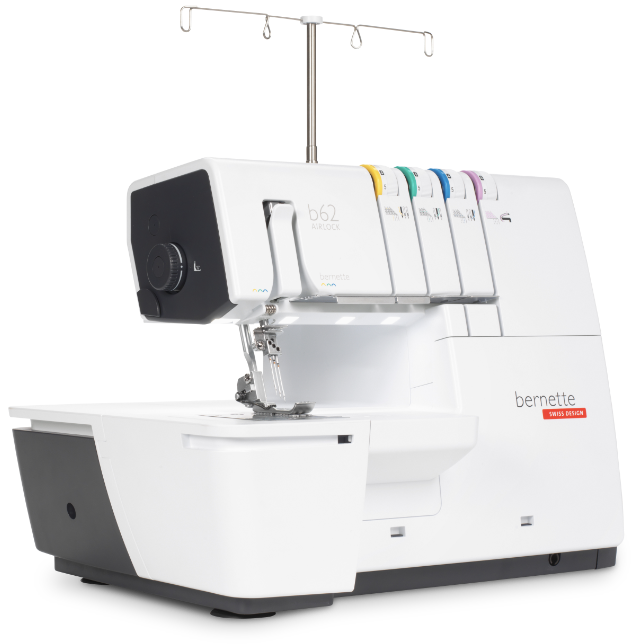
Explore this need in the finder →The bernette 62 AIRLOCK is a specialist coverstitch machine for hems, topstitching and other seams where you want thread on the fabric surface without a knife trimming the edge. It also makes a two-thread chainstitch for temporary basting and other documented uses. That combination is useful when a garment maker already has ordinary sewing covered and wants a separate finishing machine; it is not an all-purpose lockstitch machine, a serger overlocker, or the family's overlock/coverstitch combo.
Choose it for coverstitch work, not raw-edge serging
Bernette's U.S. page labels the b62 a coverstitch machine and specifies four coverstitches plus three chainstitches. The 2026 manual shows the actual formations: one four-thread coverstitch, a wide three-thread coverstitch, two narrow three-thread versions, and three two-thread chainstitches using different needle positions. Coverstitch can hem or topstitch a garment without cutting the edge. A separate serger with a knife is still needed to trim and wrap a raw edge; the b62 is not the machine to buy for one-pass overlocking or standard lockstitch seams, zippers, or buttonholes.
The b62's chainstitch is useful for basting fabric for a fitting and for other seam work the manual documents. Its looper-thread loop makes the seam easy to undo by pulling the looper thread, which is also a limit: do not treat a removable basting seam as if it were a secured conventional lockstitch. The machine has no listed overlock formation. In the same b60 family, the b64 is the dedicated overlocker and the b68 combines overlock and coverstitch functions. If you need two of those jobs, compare the exact b68 setup; if you mostly want no-cut stretch hems, the simpler b62 function is a better-defined fit.
Threading is simplified in one place, not automated throughout
The automatic air threader serves the chain looper. The three needle paths remain manual and color-coded, and the manual gives separate needle positions for each stitch. Air threading therefore removes one fiddly step but does not make a complete four-thread coverstitch setup automatic. Switching between the wide, narrow and chainstitch formations still means removing or adding the correct needles, threading the selected paths in order and following the stitch chart. Use the matching coverstitch insert where called for; the supplied slide-on table has its own insert for a larger smooth fabric-support area.
Settings remain part of the work. The manual lets you change stitch length from 1 to 5 mm, adjust differential feed from 0.6 to 2.0, set thread tension, and adjust presser-foot pressure through seven positions. Those controls can help handle stretch knits, lightweight fabrics and gathering, but they do not identify the fabric or guarantee a flat hem. Make a test seam using the same fabric, needle and thread combination as the project, then correct the stitch formation before sewing the garment. The specified ELx705 needle system matters; ordinary home-sewing needles are not a substitute.
Workspace and supplied support
For tubular hems, the free arm provides a route for cuffs, sleeves and narrow openings. For a long hem or wider garment panel, attach the included slide-on table and matching coverstitch insert. The knee lifter can raise and lower the presser foot while you keep both hands on the material, and five LEDs light the needle and work area. Bernette lists 130 mm to the right of the needle. The page includes a standard coverstitch foot, knee lifter, freearm cover, spool stand with needle pad, decorative thread guide, CS Lock Tool and a needle set, as well as the table and coverstitch insert. A dealer or marketplace bundle may not match that standard list, so check the actual box before buying.
The manual specifies a 12.8 kg machine and a maximum fabric thickness of 5 mm. That thickness is a stated limit, not a promise that every bulky stack or fabric combination will feed well. The chainstitch's loop structure and the coverstitch's thread layout also make end securing and removal different from an ordinary straight seam. The manual shows how to secure stitch ends, undo them, clean lint from the looper region and air-threader pipes, clean the suction feet, and oil the looper area. Keep those maintenance steps in the routine, switch off and unplug before cleaning, and follow the manual's test-sewing guidance rather than forcing the fabric through.
Who should shortlist it?
Shortlist the b62 if your repeated job is hemming jersey or other stretch garments, finishing a neckline or sleeve edge, or adding a coverstitch topstitch after the main construction seams are already sewn. The free arm, included wide table, knee lifter, air-threaded looper and adjustable feed give it practical support for that focused workflow. If the essential job is trimming and finishing raw edges, compare the b64. If you need both that serger action and coverstitching in one machine, compare the b68 and check which setup you would actually use; the b62 itself does not turn into an overlocker.
There is one unresolved speed specification: the current U.S. product page lists up to 1,300 stitches per minute, while the March 2026 English manual's technical table lists a maximum of 400–1,200. I do not treat those as the same exact value or infer a separate speed limiter from the foot controller. Retail stock, the condition and completeness of a particular seller's box, and comprehensive model-specific recall status also remain unverified. The exact b62 image comes from bernette's U.S. gallery; the manufacturer does not say whether it is a camera photograph or a rendering. This assessment is source-based, not a hands-on test.
Sources: bernette 62 AIRLOCK U.S. product page, official b62 support page, the March 2026 English b62 AIRLOCK manual, and the official b60-series comparison brochure.
Key details at a glance
| Motor and stitch controls | Mechanical stitch formations are selected by manual setup, thread paths and needle positions. The manual identifies a foot control with continuously variable pressure. The exact U.S. product page lists a 1,300-spm maximum, while the March 2026 manual lists 400–1,200 spm; no exact ceiling is asserted until that discrepancy is resolved. |
|---|---|
| Stitch choices and limits | Seven documented formations comprise four coverstitches (a four-thread, one wide three-thread, and two narrow three-thread formations) plus three two-thread chainstitch needle positions. These are specialist looper stitches, not seven ordinary lockstitch patterns. |
| Buttonhole routine | No conventional lockstitch or buttonhole operation is listed for the b62 AIRLOCK. Its coverstitch and chainstitch formations are not buttonholes. |
| Working space and size limits | The current U.S. product page lists 130 mm to the right of the needle, a free arm, five LEDs, an included slide-on table and matching coverstitch insert. The exact manual lists 12.8 kg and a bare body width of 16.9 in; table-attached footprint details are not used because the extracted metric dimensions have missing digits. |
| Supplied tools and fabric support | The U.S. page lists a standard coverstitch foot, slide-on table plus matching coverstitch insert, knee lifter, freearm cover, spool stand with needle pad, decorative thread guide, BERNINA CS Lock Tool and a BERNINA needle set. A particular dealer or marketplace box is not verified. |
| Needle setups, cutting and memory | Two separately represented operating plans: coverstitch formations, and a 2-thread chainstitch formation. The manufacturer does not list the b62 as an overlocker; no knife/overlock plan or general lockstitch plan is inferred. |
| Presser-foot pressure | Seven-step presser-foot-pressure adjustment is listed by the exact product page; the manual recommends test sewing and adjustment for light or heavy fabrics. |
| Cleaning and lubrication | The exact manual directs users to switch off and disconnect before cleaning, regularly remove lint/thread remnants, clean the looper and air-threader pipes and suction feet, and add a drop of BERNINA overlock oil to the upper looper joint. It warns against aerosol sprays/compressed air for cleaning. |
Use the exact model’s instructions for operating limits, supplied equipment and version differences.
Sources for this assessment
- Current U.S. product page for the exact bernette 62 AIRLOCK; function, specifications, standard contents, and image gallery.
- Official b62 support page linking the current March 2026 English manual, quick start, b60 comparison brochure, stitch overview, and tutorial list.
- Exact model manual: 2026-03 EN 5040062.1.04. Selected machine, accessories, setup, stitch, feed, threading, sewing, care, and specification passages personally read.
- Official b60-series comparison brochure distinguishing b62 coverstitch, b64 overlock, and b68 overlock/coverstitch combination. Reused the existing exact archive, not downloaded again.
- Exact b62 AIRLOCK official manufacturer gallery image, personally viewed at native resolution.

Choose the operating routine that suits your work.
Start with whether you sew, embroider, serge or coverstitch, then compare controls, working area, supplied tools and setup limits.