
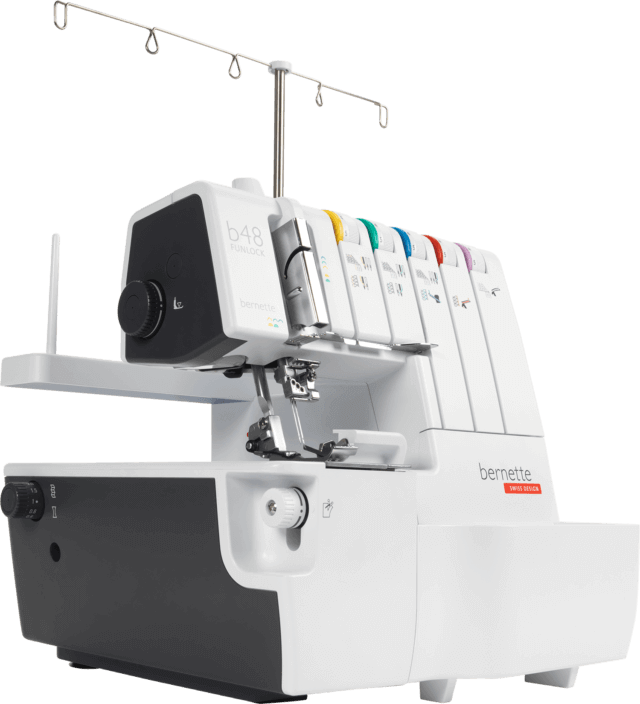
Your needs, this model
Does it fit your priorities?
Do you need a serger to cut and overlock a raw edge in one pass?
The b48 has a separate charted overlock plan with its knife; it is not an ordinary machine overcast stitch.
Explore this need in the finder →Do you need coverstitch hems without trimming the edge?
The b48 has a separate coverstitch configuration with two- or three-needle formations; it must be set up apart from overlocking.
Explore this need in the finder →Would you use the separate two-thread chainstitch setup?
The b48 chart includes a separate chainstitch configuration; use its needle, looper and seam-end instructions rather than treating it as a locked straight stitch.
Explore this need in the finder →Must it make ordinary locked sewing-machine seams?
No ordinary lockstitch configuration or buttonhole routine is established for the b48; its patterns are serger/cover/chain/combo formations.
Explore this need in the finder →The bernette 48 FUNLOCK is the most functionally broad member of the 40-series: one mechanical machine can be configured for overlocking, coverstitch hemming, chainstitch and the listed combination patterns. That breadth makes sense for a garment sewer who frequently finishes raw edges and hems knits, and who accepts changing needles, thread paths and machine setup between tasks. It is not a substitute for an ordinary lockstitch machine, and the name “combo” does not mean overlock and coverstitch happen at once without reconfiguration.
What the 23-stitch count means
Bernette divides the count into 15 overlock stitches, three coverstitches, four combo stitches and one chainstitch. The U.S. page lists two-, three-, four- and five-thread formations, with an overlock range of 3–7 mm, coverstitch widths of 2.8 or 5.6 mm, and combo stitching up to 10 mm. The 2023 manual’s chart is more useful than the headline count: it shows which needle positions, loopers, thread routes, inserts and knife settings belong to each formation. Use the chart for the job rather than expecting 23 conventional zigzag or decorative lockstitches.
The overlock setup uses its cutting knife to trim an edge as thread encloses it; this is the right mode for joining and finishing many garment seams in one pass. A coverstitch setup instead hems, topstitches or binds without cutting the edge. The manual shows separate two-needle and three-needle coverstitch configurations. Chainstitch and combo formations use their own charted threading; they are additional specialist routines, not evidence that the machine can sew ordinary straight-lockstitch seams or buttonholes. If your projects need basic construction seams, zippers or buttonholes, keep a regular sewing machine in the plan.
A flexible machine still asks for setup time
The 48 changes from one function to another through physical setup: use the prescribed needle positions and thread path, move the knife or converter as required, select the matching insert and stitch-length setting, then test. Overlock and coverstitch are not simply menu choices. If most projects use only overlocking, the b44 has the more focused job; if most of your finishing is knit hems and coverstitch without raw-edge trimming, the b42 is the dedicated alternative. Paying for a combo platform is easiest to justify when you will really switch between both functions.
Threading is assisted, not automatic from spool to needle. The product page identifies mechanical threaders for the lower and chain loopers, plus a separate manual needle threader and color-coded paths. That is a useful distinction from the air-threading system on some newer bernette machines: you still need to follow the b48’s chart and route the needle threads. The included cut-offs bin keeps knife trimmings contained, the machine has LED lighting and an 87 mm working area to the right of the needle, and the accessories stow in the looper cover. Those are practical workspace details, not a performance test.
Feed, tension, and finish quality require a scrap test
The manual gives a 0.6–2.0 differential-feed range, a 1–4 mm stitch-length range, adjustable presser-foot pressure and tension dials. Differential feed can stretch or gather fabric relative to the feed dogs; the useful setting depends on the fabric and stitch. The manual repeatedly treats tension settings as starting points and recommends adjusting in small steps after a sample seam. Try the same knit, woven or layered thickness, thread type and needles planned for the garment before committing to a hem. A published maximum of 1,300 stitches per minute is capacity, not a separate speed limiter or a promise about the pace of your work.
Coverstitch seams need deliberate end handling. The manual warns that they can unravel if the looper thread is pulled out at the end, and illustrates how to tie off the needle and looper threads. If you are new to coverstitch, allow practice time for starting, stopping and securing the seam, not just threading. The exact manual specifies ELx705 needles; a familiar household-machine needle is not an interchangeable substitute.
Package, dimensions, and care
The current U.S. contents list includes the standard overlock/cover foot, upper-looper converter, cover/chainstitch insert, needle set, manual needle-threader/inserter, spare stationary upper knife, cut-offs bin, dust cover, spool nets and caps, stabilizers, tweezers, brush, oil and screwdrivers. Verify the seller’s box contents and condition rather than assuming every marketplace listing has the full new-machine package. The 2023 manual lists the machine at 7.8 kg and 360 × 300 × 290 mm. There is no documented large separate extension table in the U.S. contents list.
Knife trimming makes lint collection part of ownership. Bernette instructs users to disconnect power before cleaning, brush lint from the looper and knife area often, and oil the designated points periodically with sewing-machine oil. The b48 is a reasonable fit when its two finishing functions will both be used; a dedicated b44 or b42 can be the simpler match for a one-function routine. Retail stock, a particular seller’s exact box and the manufacturer’s photo-versus-render method are not established here.
Sources: bernette 48 FUNLOCK U.S. product page, official b48 support and manual page, and the current-linked 2023 b48 instruction manual.
Key details at a glance
| Motor and stitch controls | Mechanical stitch/thread controls and foot controller. Official page/manual maximum 1,300 stitches per minute is a capacity, not a separately confirmed speed limiter. |
|---|---|
| Stitch choices and limits | The current U.S. page groups 23 formations as 15 overlock, 3 coverstitch, 4 combo and 1 chainstitch. Widths are overlock 3–7 mm and coverstitch 2.8/5.6 mm; combo widths are listed up to 10 mm. These are finishing-machine patterns, not 23 ordinary lockstitches. |
| Buttonhole routine | No ordinary lockstitch buttonhole routine is documented for this specialist finishing machine. |
| Working space and size limits | The official page specifies 87 mm to the right of the needle with LED work lighting; exact body dimensions/weight are in the model-specific manual. |
| Supplied tools and fabric support | Current U.S. standard list: overlock/cover presser foot, upper-looper converter, cover/chainstitch insert, cut-offs bin, spare stationary upper knife, ELx705 needle set, manual needle-threader/inserter, screwdrivers, oil, brush, tweezers, spool nets/caps/stabilizers and dust cover. Individual dealer box is unverified. |
| Needle setups, cutting and memory | The current U.S. page groups 23 formations as 15 overlock, 3 coverstitch, 4 combo and 1 chainstitch. Widths are overlock 3–7 mm and coverstitch 2.8/5.6 mm; combo widths are listed up to 10 mm. These are finishing-machine patterns, not 23 ordinary lockstitches. |
| Presser-foot pressure | Exact manual includes a dedicated presser-foot-pressure wheel; use the model-specific settings and test fabric. |
| Cleaning and lubrication | The exact manual calls for power disconnection before cleaning, dry-brush lint removal from the looper (and knife area on the overlock models), and periodic lubrication at the indicated points with sewing-machine oil. |
Use the exact model’s instructions for operating limits, supplied equipment and version differences.
Sources for this assessment
- Current exact U.S. bernette 48 FUNLOCK model page; functions, specifications, listed contents and model gallery.
- Current U.S. exact-model bernette 48 FUNLOCK support page and manual/resource list.
- Exact English manual 2023-06 EN 5040007.0.04, 5th edition; selected machine, threading, stitch, feed, maintenance and specification pages personally read.
- Official 2019 English b40-series brochure; used as secondary family comparison context only, superseded by current model pages/manuals for current exact facts.
- Exact official image for bernette 48 FUNLOCK, visually inspected at native resolution.

Choose the operating routine that suits your work.
Start with whether you sew, embroider, serge or coverstitch, then compare controls, working area, supplied tools and setup limits.