
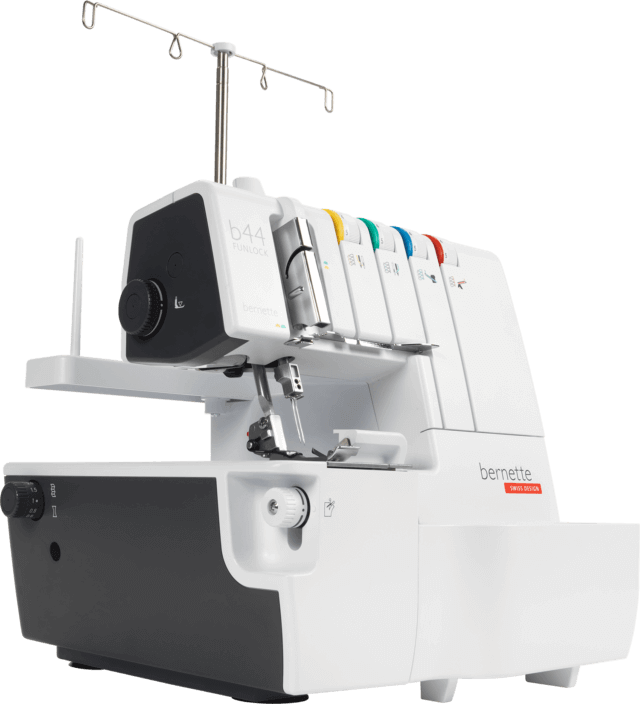
Your needs, this model
Does it fit your priorities?
Do you need a serger to cut and overlock a raw edge in one pass?
The b44 is the dedicated overlocker in the family; its overlock setup uses the knife and cut-offs bin.
Explore this need in the finder →Must it hem with coverstitch without cutting the fabric edge?
The b44 page and stitch chart document overlock only; a coverstitch hem is not established for this model.
Explore this need in the finder →Do you need a standalone chainstitch setup?
The b44 overlock and safety formations do not establish a separate chainstitch mode.
Explore this need in the finder →Must it sew ordinary locked construction seams or buttonholes?
The b44 is an overlocker, not a conventional lockstitch or buttonhole machine.
Explore this need in the finder →The bernette 44 FUNLOCK is a mechanical overlocker for a specific job: trim and wrap a raw fabric edge, and often join the seam, in one pass. Its 15 formations cover several two-, three- and four-thread overlock approaches, including flatlock, super-stretch, narrow seam and rolled hem. This makes it a useful companion to a regular sewing machine for garment construction, especially when knit edges or repeated seam finishing make a separate serger worthwhile. It is not a coverstitch machine or a general sewing machine.
Choose it for raw-edge finishing
The 44’s lower-driven knife cuts the seam allowance as you sew; its cut-offs bin collects the trimmings. That is materially different from an overcast stitch made by a conventional sewing machine, which does not use a serger knife and thread-looper system. The manufacturer rates the overlock width at 3–7 mm, and the manual explains how needle position and cutting-width adjustment change the seam. The chart includes 2-, 3- and 4-thread variants, a super-stretch formation, flatlocks, narrow seam and rolled hems. The exact setup, rather than stitch count alone, determines which needle positions and thread routes to use.
The 44 does not document coverstitch or a standalone chainstitch operating plan. Its four-thread safety seam is still an overlock formation, not a coverstitch hem. If you want a stitched hem across the top of a knit without trimming the edge, compare the b42 FUNLOCK; if you want that capability plus an overlocker in one chassis, compare the b48 FUNLOCK. None of these machines provides the regular lockstitch seams, buttonholes or zipper work of a standard sewing machine.
What the controls help with
The differential-feed dial ranges from 0.6 to 2.0. The manual describes the lower settings as stretching fabric and the higher settings as gathering; that control can help manage knits, lightweight material or deliberate gathers, but the appropriate setting depends on cloth and stitch. The stitch-length dial, cutting-width dial, tension dials and presser-foot-pressure control provide useful adjustment, yet they make a scrap test part of the workflow. Begin from the manual’s chart for the chosen formation, then test on a piece of the actual fabric and adjust in small steps. Do not interpret the published maximum of 1,300 stitches per minute as an independent speed cap; the machine is operated by a foot controller.
Threading is helped by the color-coded paths and a needle-threader/inserter, along with a lower-looper threading aid. Those features shorten some fiddly steps but do not mean the entire machine threads itself. Follow the sequence for the selected stitch, including the upper-looper converter where called for. The needle system is ELx705; the manual explicitly warns against substituting a standard household sewing-machine needle. Have a few suitable needles on hand and check the stitch chart before changing a setup.
Supplied equipment and working footprint
The current U.S. package list includes an overlock presser foot, upper-looper converter, spare stationary upper knife, ELx705 needle set, cut-offs bin, dust cover, spool nets and stabilizers, spool caps, brush, oil, tweezers, screwdrivers and a manual needle-threader/inserter. Accessories are stored partly in the looper cover and partly in a separate box. The list does not identify a coverstitch insert or dedicated coverstitch foot, which is consistent with the 44’s overlock-only identity. If buying a used machine or a retailer’s open-box unit, ask about the foot, converter, bin, needles and tools rather than trusting a generic product photo.
The machine has LED lighting and 87 mm of room to the right of the needle. Its 2023 manual lists dimensions of 336 × 263 × 294 mm and a 7.2 kg machine weight. A separate large extension table is not listed in the current U.S. contents. These figures are useful for planning a shelf, but leave clear space in front for fabric and at the left for the thread stand. The machine’s fast motor and cutting action also make maintenance more frequent than on a basic sewing machine: disconnect power before cleaning, brush lint from the knife and looper area often, and periodically oil the designated points with sewing-machine oil.
Who should compare the b48 or b42?
Pick the b44 when overlocking and cutting are the repeated tasks and the rest of your routine is handled elsewhere. Its stitch set is narrower than the b48’s because the b44 does not add coverstitch and combo modes. The b42 takes the opposite specialization: it covers hems and related seams without the b44’s cutting knife. The b48 combines both systems but still requires physical changes to the thread, needle and knife setup when moving between modes. If you want the fewest functions to learn, specialize; if both overlocking and coverstitch are regular work, compare the extra b48 mode against its setup complexity.
Bernette’s current U.S. product page and exact 2023 manual define the 44 as an overlocker; its support page links threading tutorials and the manual. Neither page establishes current dealer stock or the condition of an individual seller’s package, and this assessment is not based on hands-on sewing tests. Its practical appeal is a clearly bounded one: a dedicated serger with useful feed and stitch adjustments, for someone who already knows where an overlocker fits in the sewing process.
Sources: bernette 44 FUNLOCK U.S. product page, official b44 support and manual page, and the current-linked 2023 b44 instruction manual.
Key details at a glance
| Motor and stitch controls | Mechanical stitch/thread controls and foot controller. Official page/manual maximum 1,300 stitches per minute is a capacity, not a separately confirmed speed limiter. |
|---|---|
| Stitch choices and limits | The exact page and manual list 15 overlock formations: 2-, 3- and 4-thread overlock, super-stretch, flatlock, narrow seam, rolled hem and wrapped overlock. No standalone coverstitch or chainstitch plan is established. |
| Buttonhole routine | No ordinary lockstitch buttonhole routine is documented for this specialist finishing machine. |
| Working space and size limits | The official page specifies 87 mm to the right of the needle with LED work lighting; exact body dimensions/weight are in the model-specific manual. |
| Supplied tools and fabric support | Current U.S. list includes overlock foot, upper-looper converter, spare stationary upper knife, cut-offs bin, ELx705 needle set, needle-threader/inserter, screwdrivers, oil, brush, tweezers, four spool nets/caps/stabilizers and dust cover. Check an individual used/open-box package. |
| Needle setups, cutting and memory | The exact page and manual list 15 overlock formations: 2-, 3- and 4-thread overlock, super-stretch, flatlock, narrow seam, rolled hem and wrapped overlock. No standalone coverstitch or chainstitch plan is established. |
| Presser-foot pressure | Exact manual includes a dedicated presser-foot-pressure wheel; use the model-specific settings and test fabric. |
| Cleaning and lubrication | The exact manual calls for power disconnection before cleaning, dry-brush lint removal from the looper (and knife area on the overlock models), and periodic lubrication at the indicated points with sewing-machine oil. |
Use the exact model’s instructions for operating limits, supplied equipment and version differences.
Sources for this assessment
- Current exact U.S. bernette 44 FUNLOCK model page; functions, specifications, listed contents and model gallery.
- Current U.S. exact-model bernette 44 FUNLOCK support page and manual/resource list.
- Exact English manual 2023-03 EN 5040005.0.04, 5th edition; selected machine, threading, stitch, feed, maintenance and specification pages personally read.
- Official 2019 English b40-series brochure; used as secondary family comparison context only, superseded by current model pages/manuals for current exact facts.
- Exact official image for bernette 44 FUNLOCK, visually inspected at native resolution.

Choose the operating routine that suits your work.
Start with whether you sew, embroider, serge or coverstitch, then compare controls, working area, supplied tools and setup limits.