
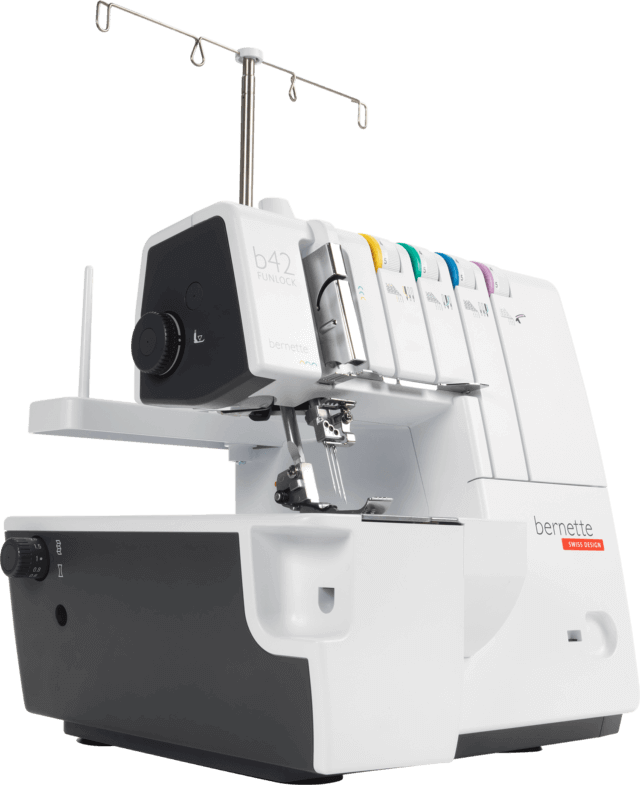
Your needs, this model
Does it fit your priorities?
Do you need coverstitch hems without trimming the edge?
The b42 has three documented coverstitch formations and uses a cover foot; it does not cut the raw edge.
Explore this need in the finder →Would you use the two-thread chainstitch for construction or decorative work?
The b42 manual documents a separate one-needle chainstitch; its looped end needs the manual securing method.
Explore this need in the finder →Must it trim and overlock raw edges?
The b42 has a coverstitch/chainstitch mechanism, not an overlock knife setup.
Explore this need in the finder →Must it make an ordinary locked sewing-machine seam or buttonhole?
The b42 chainstitch is not a conventional locked straight stitch, and the page/manual do not list a buttonhole routine.
Explore this need in the finder →The bernette 42 FUNLOCK is a dedicated coverstitch machine for garment hems, cuffs, bindings and decorative topstitching, with a separate two-thread chainstitch setup. Its strongest fit is someone who already has ordinary sewing and raw-edge finishing covered, but repeatedly wants the parallel-needle finish used on knits. The 42 is not a serger: it has no trimming knife or documented overlock mode. If cutting and wrapping a raw edge is the priority, the b44 FUNLOCK is the more relevant specialist.
Four formations, not four coverstitches
The current U.S. page says the b42 makes three coverstitches—one four-thread/three-needle option and wide and narrow three-thread/two-needle options—plus a chainstitch. These coverstitches use 2.8 mm or 5.6 mm widths. The 2023 manual agrees: its stitch overview lists one four-thread coverstitch, two three-thread coverstitch positions and a two-thread chainstitch. An older English b40-series brochure describes the b42 as having four coverstitches, which conflicts with both the newer exact product page and manual. I follow the current page and model-specific manual: four stitch formations total, of which three are coverstitches and one is chainstitch.
For a T-shirt hem or a cuff, a coverstitch forms rows of needle thread on top and a looper structure underneath without trimming the edge. That is why this task differs from the b44’s knife-and-looper overlocking. The b42’s chainstitch is its own two-thread operation. The manual describes it for construction or decorative stitching; because the looper thread can be pulled to undo the looped seam, it should not be mistaken for a conventional locked straight stitch or left unsecured when a permanent seam requires secure ends.
A separate finishing station takes practice
The manual gives one looper and configurations with one to three needles. Thread colors identify the paths; the looper and needles are threaded according to the selected chart, and the supplied tool is a manual needle threader/inserter. This is not an automatic air-threading setup. Switching between the wide, narrow and three-needle coverstitches means changing the needle arrangement and threading to the matching pattern. The manual’s end-securing instructions also matter: coverstitch can unravel if its looper thread is pulled out, so learn how to knot or secure the threads before hemming a finished garment.
Feed and tension adjustment are part of getting a clean result. The differential-feed dial spans 0.6 to 2.0, supporting stretch or gather adjustments, while the manual recommends a test seam and small tension changes to balance the fabric. It advises a stitch length above 2.5 mm for coverstitch and above 2 mm for chainstitch. Those are starting points from the manual, not a guarantee that a particular knit, needle and thread combination will behave the same way. Make a sample using the project fabric, then inspect both faces of the seam.
Size, package, and upkeep
The working area gives 87 mm to the right of the needles and the LED light helps illuminate the stitch plate. The manual lists a 6.8 kg machine weight and a 336 × 263 × 294 mm body. The current U.S. contents include a coverstitch foot, ELx705 needle set, needle-threader/inserter, four spool nets and spool caps, spool stabilizers, brush, oil, tweezers, screwdrivers and a dust cover. A separate extension table is not listed; the machine’s sewing table is part of the working surface, not proof that a larger add-on table is supplied. Check the exact box if the listing is for a used or open-box machine.
Coverstitch machines do not produce the same knife scraps as an overlocker, but the manual still calls for disconnecting power, removing lint from the looper and needle-plate area with a dry brush, and periodic lubrication at the marked points. Use sewing-machine oil only as directed. The specified ELx705 needle system also matters: a regular household needle is not interchangeable. If most work is basic woven construction, or if you need an overlocker to trim and finish, the b42 will leave an essential job to another machine.
Compare the three FUNLOCK roles
The b42 is the coverstitch-focused choice. The b44 FUNLOCK is a dedicated overlocker with 15 overlock formations and a knife but no coverstitch; the b48 FUNLOCK adds both overlock and coverstitch along with its combo and chainstitch configurations. The b48 offers more jobs but takes more physical setup between them. Choose by the operation you do, not by which model has the largest stitch count. A conventional sewing machine remains useful alongside any of these for standard seams, buttonholes, zippers and general garment assembly.
The manufacturer’s current U.S. product page and linked 2023 manual provide the b42’s stitch functions and standard list; the older series brochure is useful only for understanding the family and is not allowed to override current exact-model evidence. Retail stock and any individual seller’s package condition are not confirmed here, and no hands-on stitch-quality measurements are claimed.
Sources: bernette 42 FUNLOCK U.S. product page, official b42 support and manual page, the current-linked 2023 b42 instruction manual, and the older b40-series brochure for the explicitly noted historical count conflict.
Key details at a glance
| Motor and stitch controls | Mechanical stitch/thread controls and foot controller. Official page/manual maximum 1,300 stitches per minute is a capacity, not a separately confirmed speed limiter. |
|---|---|
| Stitch choices and limits | The current U.S. page and exact 2023 manual list three coverstitch formations—4-thread/3-needle and wide/narrow 3-thread/2-needle—plus one 2-thread chainstitch. An older 2019 series brochure describes four coverstitches, conflicting with the newer page/manual; the current exact sources govern. |
| Buttonhole routine | No ordinary lockstitch buttonhole routine is documented for this specialist finishing machine. |
| Working space and size limits | The official page specifies 87 mm to the right of the needle with LED work lighting; exact body dimensions/weight are in the model-specific manual. |
| Supplied tools and fabric support | Current U.S. standard list includes coverstitch foot, ELx705 needle set, manual needle-threader/inserter, four spool nets/caps/stabilizers, brush, oil, tweezers, screwdrivers and dust cover. No separate large extension table is listed; individual retailer package condition is unverified. |
| Needle setups, cutting and memory | The current U.S. page and exact 2023 manual list three coverstitch formations—4-thread/3-needle and wide/narrow 3-thread/2-needle—plus one 2-thread chainstitch. An older 2019 series brochure describes four coverstitches, conflicting with the newer page/manual; the current exact sources govern. |
| Presser-foot pressure | Exact manual includes a dedicated presser-foot-pressure wheel; use the model-specific settings and test fabric. |
| Cleaning and lubrication | The exact manual calls for power disconnection before cleaning, dry-brush lint removal from the looper (and knife area on the overlock models), and periodic lubrication at the indicated points with sewing-machine oil. |
Use the exact model’s instructions for operating limits, supplied equipment and version differences.
Sources for this assessment
- Current exact U.S. bernette 42 FUNLOCK model page; functions, specifications, listed contents and model gallery.
- Current U.S. exact-model bernette 42 FUNLOCK support page and manual/resource list.
- Exact English manual 2023-06 EN 5040003.0.04, 5th edition; selected machine, threading, stitch, feed, maintenance and specification pages personally read.
- Official 2019 English b40-series brochure; used as secondary family comparison context only, superseded by current model pages/manuals for current exact facts.
- Exact official image for bernette 42 FUNLOCK, visually inspected at native resolution.

Choose the operating routine that suits your work.
Start with whether you sew, embroider, serge or coverstitch, then compare controls, working area, supplied tools and setup limits.